Things have always been a bit slow around here, I will admit.
A large part of that is due to the fact that I, myself, am slow. I have a regular, 40-hour per week job that eats up most of my life, then there is family, then there are the myriad hobbies which jockey for turns in claiming the couple of hours or so I have each night before bed - a time that, like some creeping, time-gobbling glacier, inches earlier and earlier into the evening every year. Team Fortress 2 has not helped at all, and that is an understatement.
The short version is that I jump into a lot of different projects and they rarely get finished before another project comes along. At least projects offer the potential for in-progress updates and content.
What do you do when the project being worked on does really exist until it is finished? A story, for example?
I began writing what I thought was going to be a short story. Nevermet is putting together an anthology of short stories and, like with almost every other project they announce, I tried to get in on the action. But the story kept going ... and going. And going. It now currently sits at 15,467 words (shooting for at least 20k) and I think I'm halfway done with it.
I won't have the 50,000+ words publishers want to see for a novel. It will fall somewhere in or around the category of being a novella, depending on who you ask. A young adult novel, perhaps, though the content may not lend itself that demographic.
But what can I say about it? I don't want to give away plot or characters or anything that might be worth stealing - I'm paranoid like that - but I do want to draw in any potential readers' interest.
I read somewhere online (Peter Shallard or Lifehacker, I think) that if you tell people what you are working on, you are less likely to finish it. That the act of sharing some how equates to the act of finishing in our brains and gives us enough of a 'rush' that we grow bored or impatient with having to continue working on it and move on to the next project.
So why the heck am I writing this post? Have I shared too much? Does letting the few of you who know this blog exists what I've been up to put the whole story at risk?
I think (hope) it obligates me to finish.
But really, I'm writing this because, in my mind, I think I'm staying relevant. I feel like, by saying "I'm still here!" the few you who have this feed bookmarked (or whatever) will stick around to see what happens next, that this isn't just another exercise in vanity someone started and let fall by the wayside.
I WILL have something to offer. I just don't know what. Or when. So ... see you around?
Friday, July 29, 2011

Wednesday, June 29, 2011
VG: You Never Forget Your First(time playing TF2)
Last night I played a video game on the internet with other real live people. Not a big deal, in the grand scheme of things, since people have been doing it for years now. Just not this person. I've been so terrified of getting annihilated and verbally abused by obnoxious douchebags to the point that I avoided any serious online gaming.
Oddly enough, this fear never stopped me from accepting challengers way back when arcades existed (Ryu 4 life!). For some reason, though, playing online just seemed much more ... exposed? visible? I'm not sure what the word should be, but the idea behind it being that if/when I crash and burn, the whole world be able to see it.
 So Team Fortress 2 goes free and it's simply too big, too famous, and the 'Meet the' movies too entertaining to pass up. The first two times, I relegated myself to playing Dustbowl with some Easy bots. Did okay, but was far from getting on the leaderboard during those practice sessions. Despite some of the anti-F2P sentiment I was noticing online, I finally decided to heed some advice I read on the Penny-Arcade forums and simply jump in with real players.

So I decided to go with the Medic, since I figured he's useful to have regardless of the situation. And then the most amazing thing happened ....
I didn't totally suck.
In fact, after an hour's play, I had my self a nice collection of Medic achievements - 6 or so AND I managed to kill a Spy with the bonesaw (Very nearly had a Sniper, too, but he got away)- which felt REALLY good, given the number times I was stabbed in the back.
Now, I'm under no illusions that I'm some kind of prodigy. But overall, I felt positively reinforced by the experience. Which is the point, I guess. As for the abuse, the worst I got was "Hey Medic, with the ubercharge at the end, that would've been a good time to use it."
So, if you run into me (kingworks) playing TF2 sometime, do me a favor and slow down so I can heal you already - or, if you're on the other team, hack you to death with my saw! ;-)
Oddly enough, this fear never stopped me from accepting challengers way back when arcades existed (Ryu 4 life!). For some reason, though, playing online just seemed much more ... exposed? visible? I'm not sure what the word should be, but the idea behind it being that if/when I crash and burn, the whole world be able to see it.


So I decided to go with the Medic, since I figured he's useful to have regardless of the situation. And then the most amazing thing happened ....
I didn't totally suck.
In fact, after an hour's play, I had my self a nice collection of Medic achievements - 6 or so AND I managed to kill a Spy with the bonesaw (Very nearly had a Sniper, too, but he got away)- which felt REALLY good, given the number times I was stabbed in the back.
Now, I'm under no illusions that I'm some kind of prodigy. But overall, I felt positively reinforced by the experience. Which is the point, I guess. As for the abuse, the worst I got was "Hey Medic, with the ubercharge at the end, that would've been a good time to use it."
So, if you run into me (kingworks) playing TF2 sometime, do me a favor and slow down so I can heal you already - or, if you're on the other team, hack you to death with my saw! ;-)
Tuesday, June 14, 2011
Art: Two Zombie Pics
A couple of recent pics done for Nevermet Press' stock art catalog, it should be up on rpgnow.com soon. These are obviously scaled down for the web, the ones available for purchase will be print quality (300 dpi). Both were done in Photoshop CS with a Wacom Graphire 4 (6x9) tablet.


Wednesday, June 1, 2011
Video Games: Sayonara Supreme Commander

The latest victim of my campaign against time-wasting video games is Supreme Commander.
I picked this up at Ollies' for $5 - not a bad deal at all. It looked nice, despite being a few years old, and I was in the mood for sci-fi RTS - additionally, I'm too poor to get SCII and do not yet have a high-end machine to the game justice.
So what went wrong? The problem came to a head in the third mission of the UEF campaign when the Aeon were constantly attacking my bases and denying my attempts to expand the southernmost island. It took me FIVE HOURS to beat it. Needless to say, the wife was not happy when I came to bed at 2:30 am.
The game has this annoying approach of adding to the map and mission objectives incrementally. So you think you're building towards one corner of the map and when you finally get there - Oh, by the way, you have to clear out this base way over here that you had no idea existed, because we wouldn't let you explore that part of the map.
I looked up a walkthrough online and, from what I can tell, nearly all of the 15 missions are structured that way. Assuming each mission takes four hours (benefit of the doubt), that's 60 hours of enemy forces throwing themselves against my massed banks of turrets while I slowly pick away at their defenses. Also, I was so annoyed with the talking heads continually bugging me with comments about needing to check my objectives and that there are still alien scum that need killing. I get it - I'm slow!
60 hours of game play might be fine for your average gamer - heck, it would have been fine for me in college - but it's more than I have to give these days. Especially for a setting and story I really don't have any interest in.
Thursday, May 26, 2011
40k: Games Workshop has lost its [hive] mind
I should probably not write while I'm angry. I should wait until I've calmed down and assembled an articulate, organized, in-depth study on the topic. I should also quit drinking so much Mtn. Dew and get outside more.
I should do a lot of things.
It's bad enough that Games Workshop raise their prices every year. It's worse that they have decided to cut off half of the planet from ordering their products.
The straw that has broken this camel's back is the new Dark Eldar Haemonculus GW has just put up on Advanced Order.
I don't care about the new line of "Finecast" models replacing metal figures - it's just resin (cheaper for them to make, but they're going to sell them for more).
Okay, fine, whatever. It's a jerky move, but I was willing to see how things turned out ... But to try and sell A SINGLE model with NO OPTIONS WHATSOEVER for almost $20.00 !?!? My kustom Haemonculi looked cooler and cost way less to make.
Screw you, Games Workshop. I'm done.
I should do a lot of things.
It's bad enough that Games Workshop raise their prices every year. It's worse that they have decided to cut off half of the planet from ordering their products.
The straw that has broken this camel's back is the new Dark Eldar Haemonculus GW has just put up on Advanced Order.
I don't care about the new line of "Finecast" models replacing metal figures - it's just resin (cheaper for them to make, but they're going to sell them for more).
Okay, fine, whatever. It's a jerky move, but I was willing to see how things turned out ... But to try and sell A SINGLE model with NO OPTIONS WHATSOEVER for almost $20.00 !?!? My kustom Haemonculi looked cooler and cost way less to make.
Screw you, Games Workshop. I'm done.
Tuesday, April 26, 2011
Art: Harry Caricature

Monday, April 25, 2011
40k: Paint Stirs for Basecoating Infantry
This is a quick painting tip for applying base coats to batches of infantry models: Tape them to paint stirs (I used duck tape).

You can get the stirs for free from any paint store; the models can be turned to get at any angle you need, they don't fall over or get pushed around by the pressure released by the can and you won't get as much paint on your wrist/hands. I don't remember where I first heard this tip, but I tried it the other day on two units of Dark Eldar Wyches and I can confirm that it works.
I will undercoating all my infantry using this method in the future.
You can get the stirs for free from any paint store; the models can be turned to get at any angle you need, they don't fall over or get pushed around by the pressure released by the can and you won't get as much paint on your wrist/hands. I don't remember where I first heard this tip, but I tried it the other day on two units of Dark Eldar Wyches and I can confirm that it works.
I will undercoating all my infantry using this method in the future.
Thursday, April 14, 2011
Misc: Random Update - Spring 2011
I'm still around and busier than ever. Unfortunately, that means I don't have a lot of time to put blog posts together. Here's a quick update on what's happening in my own little world:
- The semester is almost over and that means assignments, projects, papers, etc. are being assigned and coming due all over the place - even for a guy like me who is only taking a single drawing class for the "fun" of it. It's been wearing a bit thin, lately, so I'll be glad when it's over (so will Jonathan over at Nevermet Press when I finally start submitting stuff again ^_^")
- I started writing a short story, only, I think it's growing into a full-blown novel. Have to wait and see. One of the challenges is the setting - I know very little about late 1800's France and Bavaria. I've been reading up in Wikipedia and looking for movies (especially sci-fi/horror) set in that period for information and inspiration. Suggestions are welcome.
- Warmer weather means yardwork (boo!) and vacations (yay!) - both of which are non-conducive to project advancement.
- Spiral Knights - I found out about this FREE online game from Penny-Arcade. Lovin' it so far. I'm on there as Kingworks after dinner (~8pm GMT-5/EST). Say 'hi' if you see me on there. ;-)
- Not a huge distraction at this point, but the third Humble Indie Bundle (called Frozenbyte) went on sale yesterday. I donated for the first two and have been immensely satisfied with them; so getting the latest one was a no-brainer. I will happily make a donation for quality indie games that supports charity.
- I got a Kindle 3 (the $130 Wi-Fi version) and Patrick Rothfuss' wonderful new The Wise Man's Fear (Kingkiller Chronicles, Day 2)
(sequel to the equally wonderful The Name of the Wind (Kingkiller Chronicles, Day 1)
) - both were immensely satisfying purchases. There is also a fun little puzzle game I got on sale for 99 cents called Triple Town
. I've seen not one
, but two (!) Kindle RPG's by Steve Jackson, but have yet to justify handing over $3.99 ea. for something that will eat up even more of my free time. Besides, I'm still eying the Essentials Monster Vault, Deluxe DM's Screen, and Dungeon Master's Kit (just in case anyone was feeling super generous. :-))
- At some point, I'm expecting Games Workshop to release some early photos of more new Dark Eldar models. At the top of the list of kits I hope they produce are the Venom gunship/transport and a set of 3 Haemonculi in plastic w/weapon options. Oh, that reminds me, I really need to finish painting the 2 units of new Wyches and 2 new Ravagers sitting on my shelf ... *sigh*
Tuesday, March 22, 2011
DnD: A New Approach to 4e Skill Challenges
I've read a lot of posts and tweets about making Combat more efficient in 4e; often frustrated that I didn't really have any good ideas or suggestions to offer. So I began to look at another oft-discussed aspect of the game: Skill Challenges and how to make them easier to manage for DM’s and provide a more organic, in-character experience for players.
I am very interested in any and all feedback from DM’s and players concerning this approach.
Handling a Skill Challenge
A Skill Challenge is a discreet event that occurs within a role-playing session. They have a beginning, operate across a series of turns until a predefined end-state has been reached; at which point the consequences of the players’ performance is determined. I propose that this structure exists primarily for the benefit of the DM; helping them stay focused and organized as they direct the game.
But what about the players? Frankly, I feel that announcing the start of a structured experience - such as a Skill Challenge or Combat Encounter - takes the players out of the game. Handled carelessly, it is tantamount to saying “Okay, we’re going to stop role-playing now and start rolling dice.” Not only does that interrupt the narrative flow of the game, but I think it tends to put players in a meta-mentality and hurts spontaneous in-character role playing that might have otherwise occurred. (Feel free to disagree with me in the comments)
Consequently, I would not recommend announcing when you begin a Skill Challenge. Simply let the party know that there is a goal or objective that needs to be achieved, and that they will be using their skills to do so. If there is someway to impart this information to the PC’s through an NPC or environmental clue, so much the better.
But what about the players? Frankly, I feel that announcing the start of a structured experience - such as a Skill Challenge or Combat Encounter - takes the players out of the game. Handled carelessly, it is tantamount to saying “Okay, we’re going to stop role-playing now and start rolling dice.” Not only does that interrupt the narrative flow of the game, but I think it tends to put players in a meta-mentality and hurts spontaneous in-character role playing that might have otherwise occurred. (Feel free to disagree with me in the comments)
Consequently, I would not recommend announcing when you begin a Skill Challenge. Simply let the party know that there is a goal or objective that needs to be achieved, and that they will be using their skills to do so. If there is someway to impart this information to the PC’s through an NPC or environmental clue, so much the better.
In the same way, DM's shouldn't feel obligated to divulge every reward or penalty earned in the challenge. Obviously results that have an immediate impact on what's happening need to be conveyed to the group, but imagine your PC's surprise when an unexpected ally pops up in a dire situation due to their success in a Skill Challenge a while back - or their dismay when attempts to rally support in a village fall on deaf ears due to their inept handling of a negotiation in another region. Regardless of how a DM chooses to implement this, it needs to plausible.
Complexity
Complexity equals the number of rounds participants have to complete a Skill Challenge. Example: A Skill Challenge of Complexity 3 lasts 3 rounds; each player will make 3 skill checks. Likewise, if any opposing NPC’s or monsters are working against the PC’s in the challenge, they will also get 3 checks each to negate a PC’s individual success.
Complexity should be in direct proportion to the amount of effort or the number of smaller tasks the PC’s would ordinarily have to put forth in order to accomplish their goal. Note that Complexity is NOT the same thing as Difficulty - which is how hard a task is to complete. A Skill Challenge can be simple and hard, or complex-yet-easy to accomplish.
Complexity should be in direct proportion to the amount of effort or the number of smaller tasks the PC’s would ordinarily have to put forth in order to accomplish their goal. Note that Complexity is NOT the same thing as Difficulty - which is how hard a task is to complete. A Skill Challenge can be simple and hard, or complex-yet-easy to accomplish.
Skills
DM’s decide ahead of time which skills will be Primary Skills. The players WILL NOT know which skills are Primary, nor will they be given any pre-written examples of how to use a skill. Instead, a PC may use any skill she wishes. Primary skills will, naturally, be the most effective; Secondary skills are slightly less effective and take a -1 to their final score; Other skills are a bit of a gamble, but still have a chance to succeed - especially if the player using them offers a particularly clever description of what they are doing; in which case, no penalty should be subtracted.
| Primary Skills | No penalty |
| Secondary Skills (optional) | -1 |
| All other skills | -2 |
You may still wish to implement skills that auto-fail during a Challenge (which almost always seems to be Intimidate). I would recommend against letting players know how the scores are adjusted, but it is ultimately up to the DM.
DC’s (Difficulty)
How hard is it to accomplish some (or all) part(s) of a Skill Challenge?
Each skill listed as Primary or Secondary needs a DC assigned to it; the level of DC’s selected in a Skill Challenge remains the same. See pgs. 158-9 and 126 in the Essential Rules Compendium for details.
All other skills should default to a level-appropriate Medium DC, unless use of a particular skill is especially risky, in which case it should be Hard.
Each skill listed as Primary or Secondary needs a DC assigned to it; the level of DC’s selected in a Skill Challenge remains the same. See pgs. 158-9 and 126 in the Essential Rules Compendium for details.
All other skills should default to a level-appropriate Medium DC, unless use of a particular skill is especially risky, in which case it should be Hard.
Accumulating Successes
There are two types of success : individual and group. Individual success occurs when a PC meets or beats a given DC in a round. Group success occurs when the majority of a party succeeds in a given round. If there are an even number of PC’s in a party, DM’s should decide ahead of time if an even split will result in a success (nice DM’s) or failure (mean DM’s). Regardless of the choice, STICK WITH IT - at the very least for the duration of the Skill Challenge; ideally for the entire campaign.
Success or Failure of the Challenge
The number of group successes needed is always two less than the Complexity, making things easy to remember. I would not recommend Skill Challenges of very high Complexities; instead, consider where it might make sense to increase DC’s.
| Complexity | Group successes needed | Complexity | Group successes needed | |
| 3 | 1 | 9 | 7 | |
| 4 | 2 | 10 | 8 | |
| 5 | 3 | ... | ... | |
| 6 | 4 | n | n-2 | |
| 7 | 5 | |||
| 8 | 6 |
Complexity 1 challenges are essentially a single Group Skill Check and thus, not included. A DM could run a Complexity 2 skill challenge, requiring one success - that might be easier to conceptualize as a Group Check with a ‘do over.’
Consequences: Success and Failure
There are four possible outcomes to every Skill Challenge:
1) Perfect: Target # of successes are accumulated with NO failures - The best possible outcome, this should be reward over and above the basic storyline goal of the Skill Challenge - perhaps with a boon or additional advantage to what the PC’s would normal get for accomplishing a Skill Challenge. DM’s may want to leave the Perfect finish off of Challenges of Complexity 1 or 2, since they are so easy to obtain.
2) Normal Success: Target # of successes before failure - The PC’s did what they needed to do and the story may progress as they hoped it would. If any additional rewards are given, they should be to a lesser degree than they would get for a Perfect finish.
3) Normal Failure: Failing to accumulate target # of success before failing - The PC’s failed to do what needed to be done. The story continues, but now they are at a noticeable disadvantage. Additional penalties may be awarded, but - as with Normal Success - should be to a lesser extent than those awarded for a Critical Failure.
4) Critical Failure: NO successes accumulated before failing the Challenge - The PC’s blew it. Big time. Not only did they fail to accomplish their goal, but they used up additional resources/goodwill in the process and took a blow to their reputation for it. The PC’s have additional negative results - such as damaged reputation with townsfolk, which causes prices to be higher when paying for goods and services - in addition to the now-altered story.
The consequences for failure should ALWAYS be considered when building a Skill Challenge and not put off until the moment the PC’s fail. The additional boons and penalties for particularly good or poor performance in a Skill Challenge can (and probably should) be generic and easily applicable to a variety of situations.
1) Perfect: Target # of successes are accumulated with NO failures - The best possible outcome, this should be reward over and above the basic storyline goal of the Skill Challenge - perhaps with a boon or additional advantage to what the PC’s would normal get for accomplishing a Skill Challenge. DM’s may want to leave the Perfect finish off of Challenges of Complexity 1 or 2, since they are so easy to obtain.
2) Normal Success: Target # of successes before failure - The PC’s did what they needed to do and the story may progress as they hoped it would. If any additional rewards are given, they should be to a lesser degree than they would get for a Perfect finish.
3) Normal Failure: Failing to accumulate target # of success before failing - The PC’s failed to do what needed to be done. The story continues, but now they are at a noticeable disadvantage. Additional penalties may be awarded, but - as with Normal Success - should be to a lesser extent than those awarded for a Critical Failure.
4) Critical Failure: NO successes accumulated before failing the Challenge - The PC’s blew it. Big time. Not only did they fail to accomplish their goal, but they used up additional resources/goodwill in the process and took a blow to their reputation for it. The PC’s have additional negative results - such as damaged reputation with townsfolk, which causes prices to be higher when paying for goods and services - in addition to the now-altered story.
The consequences for failure should ALWAYS be considered when building a Skill Challenge and not put off until the moment the PC’s fail. The additional boons and penalties for particularly good or poor performance in a Skill Challenge can (and probably should) be generic and easily applicable to a variety of situations.
Example Skill Challenge
DM's Notes
Complexity: 4 (need 2 group successes)
Primary Skills (DC): Diplomacy (Med), Bluff (High), Insight (Med), Perception (Med)
Secondary Skills (DC): Arcana (High), History (Med), Streetwise (High)
* Intimidate will auto-fail
Goal: Keep the infected people on the wagon from entering the city
DM: An outbreak causing people to turn into zombies has begun to ravage the countryside. You three (PC's) must try and convince the guard at the gate to raise the draw bridge before a wagon full of plague-infected farmers crosses into the city. One of the city residents - a relative of the people on the wagon - refuses to believe that they are infected and is arguing to let them in; he will make an opposing check against one of you at the end of each round. The guard will listen for 4 rounds before making up his mind. So, PC-1, you start and we'll go around the table.
Round 1
PC-1: Guardsman! You've got to close that gate - many innocent lives will be put at risk if you let that wagon cross without verifying if those people are infected or not. I rolled a 12, add 5 to diplomacy; 17.
DM: (makes a check mark on a sheet of paper for the success) Surprised, the guard looks at the wagon. 'Really? Infected?' he asks, looking concerned.
PC-2: I climb the wall, granting me a better view of the wagon. It definitely looks like the people are unwell. I got a 16 on Athletics.
DM: (-2 since Athletics wasn't a listed skill, it’s a failure; makes an 'x' on beside the check mark) The guard looks at you skeptically.
PC-3: Sir, you must know that this same incident occurred five years ago in the kingdom to the north. If only they'd taken the extra precaution of stopping the wagon and checking the people, a village could've been saved. History check of 19!
DM: (-1 for a Secondary skill, but it still passes; DM puts a second check mark down) The guard seems to nod his head thoughfully. At this point, the man speaks up angrily.
Man (DM): Those people are loyal subjects of the crown and have every right to enter this city!' (10 for Diplomacy fails the check).
DM: You can tell the guard doesn't appreciate the man's tone. 'I need something else to go on before I can close the gate,'he turns back to the party. (2 successes is enough to win the round - 1 group success so far)
Round 2
PC-1: I can tell you're unsure, maybe even a little nervous about closing the city in the middle of the day - but this is the right thing to do! A ... 12 on Insight?
DM: (No penalty, but 12 is too low; so an 'x' is marked below the first three marks) The guard seems to have taken your words the wrong way. 'Nervous?' he asks, somewhat crossly.
PC-2: Look pal, we're trying to save this city! If you won't raise the bridge willingly, we'll make you! Sweet! Natual 20 for Intimidation!
DM: (A second 'x' mark, as Intimidate auto-fails) The guard takes a step back, but refuses to throw the lever, instead putting a hand on the hilt of his sword. 'Are you threatening me?'
PC-3: Sir, please, I am sensitive to magic and I tell you that the people headed towards this city have been infected by a dark spell! 24 for Arcana after bonuses!
DM: (Takes off -1, but it still passes; check mark) The guard takes in your attire and magical acourtrements and seems swayed.
Man (DM): Oh please! These people are outsiders to our city! Who knows what ulterior motives they have in shutting our kinsmen out like common highwaymen? (DM decides that Streetwise bets fits and rolls 19; a success - which negates PC-3's success; the PC's have been shut out this round)
DM: The guard considers the man's words and turns a cold eye on your party. 'I've nearly made up my mind,' he says, 'you've one last chance to convince me, else I let those people in and report you lot as troublemakers to the city watch.' (The group now has 1 success and 1 failure)
Round 3
PC-1: The wagon is close now - you can see how pale and sickly the people on it are! They do not look well! Perception of 22 after modifiers.
DM: (starts a third row of marks with a check)
PC-2: Have you not seen the fliers around town about the illness that has befallen the countryside? Citizens are being warned to stay in the city; this is common knowledge! Got a 19 for Bluff.
DM: (another check mark) The guard looks around the street. It does seem like an unusually small number of people have passed through the city's gates today.
PC-3: Look! In the sky! Those are vultures circling - they can smell the stink of illness and decay emanating from the wagon. You do not want that in the city. I rolled a 20 on Nature.
DM: (a third check mark) The guard looks to the birds, then to the wagon, then back to the birds. He seems to be considering your words.
Man (DM): Oh come on! Birds!? You're seriously going to consider raising a drawbridge because of a couple birds? I just came here from Gustav's stall in the market; he's not heard anything 'bout no 'dark magic' or 'infections' - and GUstav knows everything that happens around here! (natural 20 on Streewise nets the NPC a victory over one of the PC's individual successes; however, two other individual successes win the round for the PC's)
DM: The guard nods in agreement. 'You're right, I haven't heard anything about it. But,' he starts winching up the draw bridge, 'better safe than sorry! We'll check them out. If they're clean, they come in; if not, they can stay outside.' (There is no need for the fourth round as two group successes net a Normal Success for the party) The people on the wagon are checked and found to be in the process of turning into zombies! The mayor is grateful and asks if the PC's will help direct the city defenses should a horde of undead assault the city (which, of course, they will)
Follow-up:
When a large force of zombies assaults the town later that night, the PC's don't have to worry about a sudden zombie outbreak in the town; had they failed they would have been attacked from both sides.
So, there it is! I'd love to hear about any experiences in trying this approach - good or bad.
Friday, March 4, 2011
Art, Misc: Da Vinci and Me
A few years back, I was getting counseling as part of an effort to overcome some personal struggles I was having as a result of my insecurity, anxiety, and undiagnosed low-grade depression. I found myself repeatedly mentioning how I loved to create and to be creative - despite the very uncreative existence I was living at the time - and that my attempts to pursue a 'practical' life was in conflict with the person I was created to be and the life I was called to lead.
"Who is it you want to be?" I was asked at one point. It took all of a half-second to decide. "Leonardo da Vinci," I replied, completely serious. I went on to explain that the man was a genius, fascinated by everything, threw himself into everything he did, and while he didn't produce a huge number of works in his lifetime, what he did finish mattered - he lived passionately, if impractically.
Not to sound arrogant, but I'm pretty smart, pretty good at art - I want to produce all sorts of creative works in a variety of media, and I have the tendency to jump headlong into everything I try ... up until the point at which I'm distracted by the next shiny thing that catches my attention and I jump into that, leaving a dearth of half-finished projects in my wake.
Fast forward to a week ago. I'm taking Advanced Drawing; free classes being one of the perks at the university where I work. Our assignment it to pick a Renaissance artist and copy one of his sketches. Then, produce an original sketch in the artist's style. By now it should be obvious who I picked. And, to be honest, I was pretty proud of the sketch I copied. It turned out well and I got a good grade on it.
However, when it came time to do the second piece, an original sketch in the selected artist's style, I was so burned out from trying to do justice to da Vinci's self-portrait that I honestly didn't care. I approched it like a regular drawing and drew like Paul, not like da Vinci.
The grade on the second drawing wasn't as high. Below the class average, in fact. Initially, this bothered me - I like to excel in everything I do and below average is not excelling. Then I started to compare the pictures and realized something: There is more of me in the self-portrait - literally and figuratively, than in my attempt to ape da Vinci's self-portrait.
It's real. It's honest in a way the other picture is not, flaws and all.
Don't get me wrong, there are certainly things I could get hung up on and criticize - the face, for example. But that line of thinking always pits me against myself: "I'm not da Vinci!" I'd gripe as I started to chafe at the differences in skill between myself and a dedicated Renaissance master; an all-to-common conversation, I'm embarrassed to admit.
And then, for the first time, it hit me: No, I'm not da Vinci, I'm Paul.
And I'm okay with that.
 |
| red conte on paper, 18 x 24" |
Not to sound arrogant, but I'm pretty smart, pretty good at art - I want to produce all sorts of creative works in a variety of media, and I have the tendency to jump headlong into everything I try ... up until the point at which I'm distracted by the next shiny thing that catches my attention and I jump into that, leaving a dearth of half-finished projects in my wake.
Fast forward to a week ago. I'm taking Advanced Drawing; free classes being one of the perks at the university where I work. Our assignment it to pick a Renaissance artist and copy one of his sketches. Then, produce an original sketch in the artist's style. By now it should be obvious who I picked. And, to be honest, I was pretty proud of the sketch I copied. It turned out well and I got a good grade on it.
However, when it came time to do the second piece, an original sketch in the selected artist's style, I was so burned out from trying to do justice to da Vinci's self-portrait that I honestly didn't care. I approched it like a regular drawing and drew like Paul, not like da Vinci.
 |
| pencil and charcoal on paper, 18 x 24" |
It's real. It's honest in a way the other picture is not, flaws and all.
Don't get me wrong, there are certainly things I could get hung up on and criticize - the face, for example. But that line of thinking always pits me against myself: "I'm not da Vinci!" I'd gripe as I started to chafe at the differences in skill between myself and a dedicated Renaissance master; an all-to-common conversation, I'm embarrassed to admit.
And then, for the first time, it hit me: No, I'm not da Vinci, I'm Paul.
And I'm okay with that.
Friday, February 18, 2011
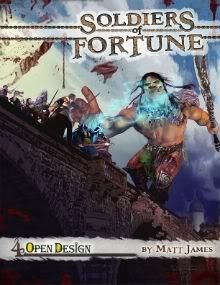
DnD: Review - Soldiers of Fortune
There is something Matt James wants you to know: Being a mercenary does not make you a bad person. A fact he repeats often and emphatically in his new book Soldiers of Fortune. Despite the common stereotypes associated with soldiers for hire - that of unscrupulous, amoral cutthroats looking for easy money - this material encourages your PC's to dive into the often grim and gritty world of professional soldiers paid for their martial expertise and willingness to fight, and quite possibly die, for a cause not their own.
The supplement, written in the context of the Midgard campaign setting, is broadly divided into two parts: fluff and crunch. The fluff, comprised of the first three chapters of the book, starts off with a discussion about the reasons for war, the various Midgardian factions and alliances that often wage war upon one another, and strategies for successfully waging war. The last part of Chapter 2 being comprised of several skill challenges.
The second half, the crunch, occupies most of the book's 79 pages. Features in this section include new feats, powers and paths; magic items, rituals; and a slew* of new monsters and templates. Included in the crunch, but separate from the lists of new material is The Battle of Sanguine-Crag Pass, an adventure for five 7th-level characters.
Content
As someone who grew up hearing a lot of military stories (my father served in Vietnam and my brother currently serves in the National Guard), and eventually getting into table-top wargames myself, a lot of the background and information presented in the fluff about war in general was nothing particularly new to me. I realize, however, this may not be the case for a lot of readers. I will acknowledge, though, that the focus on the role of mercenaries in larger conflicts presented in this work was something I don't recall seeing before in material such as this.
The most welcome portion of the first three chapters, to my mind, were the Skill Challenges. I particularly liked the fact that the Besieged challenge - in which the PC's are tasked with holding a defensible location - could be flipped around to recast the PC's in the role of the besiegers. Another idea presented in this section that I'd like to experiment with is the long-form Skill Challenge which might be conducted in stages over the course of an adventure, or possibly even a campaign.
It is the final four chapters of the book - the crunchy portion - where I felt Soldiers of Fortune really succeeded as a source of inspiration. I frequently found myself stopping and mentally expanding or elaborating on material in the book. Magical banners and standards (including one for Gnolls!), rules and stats for siege engines, templates for PCs and NPCs alike, formations, minions on the battlefield; each of these sections fed my anticipation for my next campaign, and an opportunity for these ideas - some as-written, some tweaked or expanded - to be implemented.
Presentation
The book is laid out in a straightforward two-column format, with a fairly polished feel to it. I wasn't a fan of the page borders or the occasional 3/4 width image that had text crammed around it, but these are minor quibbles and shouldn't detract from the overall reading experience. Stat blocks with titles and descriptions split across pages were probably the most annoying thing; thankfully, this was a rare occurrence. I was also curious as to why certain sections, such as the Skill Challenges, were placed as they were within the overall structure of the book - again, not a deal breaker, just something I noticed.
The full-color cover by Malcom McClinton and interior black-and-white art by Joe Slucher, all original save for one stock image, are average-to-above-average in quality - my personal favorite being the image of the old man at the opening of Chapter 3. Each piece had at least one detail that really stood out and drew my attention.
Crystal Fraizier's encounter maps were well-done and easy to read. One gripe, though: there is no indication of where the PCs are supposed to start, on the map or in the encounter description.
Conclusion
Overall, I thought this was a solid effort. I would have liked to have seen some of the material elaborated and expanded upon, but taking it upon myself to do so draws me to the product in a way that it might not have otherwise if every possible detail were spelled out. I don't know if Matt James has written any other sourcebooks, but, should he continue to build upon and develop the skills and ideas demonstrated in Soldiers of Fortune, I feel certain that he could produce some great RPG material.
Buy Soldiers of Fortune if:
You are planning to run a military-themed campaign; your PC's enjoy the tactical nature of combat encounters; your group enjoys the role-playing opportunities that occur in a profession where money and violence are inextricably bound together; Your PC's have expressed an interest in operating heavy weapons; Your group would like to participate in epic, large-scale conflicts.
Consider Soldiers of Fortune if:
You appreciate reading others' ideas and tweaking them to fit your particular campaign or style of play. You want to give the forces that oppose your PC's some depth and character. You're considering increasing the scale of your combat encounters and skill challenges.
Avoid Soldiers of Fortune if:
Your PC's like to play wondering heroes answering a higher call - righting wrongs, dealing out justice, and slaying evil monsters; hate taking orders from NPC's (even ones paying for their services) and/or don't really care about the consequences of their actions (and you don't care to enforce them); Your group prefers small, quick encounters and simple resolutions to clearly defined problems.
I have included a link to the notes I took as I was reading Soldiers of Fortune, written as stream-of-consciousness observations:
SoF_impressions (9 Kb .txt, Mediafire)
Review Disclosure
I volunteered to review this product; no compensation has been asked for or given for this review. A link to an early version of the .pdf was provided to me by the author. All errors encountered in the text were shared with the author and publisher. I have been assured by the author that most, if not all, errors have been corrected in the final edition.
__________________________________________________________________________
*Slew, in this context, being defined as: 14 templates (2 for minions), 27 monsters, 3 siege engines
The supplement, written in the context of the Midgard campaign setting, is broadly divided into two parts: fluff and crunch. The fluff, comprised of the first three chapters of the book, starts off with a discussion about the reasons for war, the various Midgardian factions and alliances that often wage war upon one another, and strategies for successfully waging war. The last part of Chapter 2 being comprised of several skill challenges.
The second half, the crunch, occupies most of the book's 79 pages. Features in this section include new feats, powers and paths; magic items, rituals; and a slew* of new monsters and templates. Included in the crunch, but separate from the lists of new material is The Battle of Sanguine-Crag Pass, an adventure for five 7th-level characters.
Content
As someone who grew up hearing a lot of military stories (my father served in Vietnam and my brother currently serves in the National Guard), and eventually getting into table-top wargames myself, a lot of the background and information presented in the fluff about war in general was nothing particularly new to me. I realize, however, this may not be the case for a lot of readers. I will acknowledge, though, that the focus on the role of mercenaries in larger conflicts presented in this work was something I don't recall seeing before in material such as this.
The most welcome portion of the first three chapters, to my mind, were the Skill Challenges. I particularly liked the fact that the Besieged challenge - in which the PC's are tasked with holding a defensible location - could be flipped around to recast the PC's in the role of the besiegers. Another idea presented in this section that I'd like to experiment with is the long-form Skill Challenge which might be conducted in stages over the course of an adventure, or possibly even a campaign.
It is the final four chapters of the book - the crunchy portion - where I felt Soldiers of Fortune really succeeded as a source of inspiration. I frequently found myself stopping and mentally expanding or elaborating on material in the book. Magical banners and standards (including one for Gnolls!), rules and stats for siege engines, templates for PCs and NPCs alike, formations, minions on the battlefield; each of these sections fed my anticipation for my next campaign, and an opportunity for these ideas - some as-written, some tweaked or expanded - to be implemented.
Presentation
The book is laid out in a straightforward two-column format, with a fairly polished feel to it. I wasn't a fan of the page borders or the occasional 3/4 width image that had text crammed around it, but these are minor quibbles and shouldn't detract from the overall reading experience. Stat blocks with titles and descriptions split across pages were probably the most annoying thing; thankfully, this was a rare occurrence. I was also curious as to why certain sections, such as the Skill Challenges, were placed as they were within the overall structure of the book - again, not a deal breaker, just something I noticed.
The full-color cover by Malcom McClinton and interior black-and-white art by Joe Slucher, all original save for one stock image, are average-to-above-average in quality - my personal favorite being the image of the old man at the opening of Chapter 3. Each piece had at least one detail that really stood out and drew my attention.
Crystal Fraizier's encounter maps were well-done and easy to read. One gripe, though: there is no indication of where the PCs are supposed to start, on the map or in the encounter description.
Conclusion
Overall, I thought this was a solid effort. I would have liked to have seen some of the material elaborated and expanded upon, but taking it upon myself to do so draws me to the product in a way that it might not have otherwise if every possible detail were spelled out. I don't know if Matt James has written any other sourcebooks, but, should he continue to build upon and develop the skills and ideas demonstrated in Soldiers of Fortune, I feel certain that he could produce some great RPG material.
Buy Soldiers of Fortune if:
You are planning to run a military-themed campaign; your PC's enjoy the tactical nature of combat encounters; your group enjoys the role-playing opportunities that occur in a profession where money and violence are inextricably bound together; Your PC's have expressed an interest in operating heavy weapons; Your group would like to participate in epic, large-scale conflicts.
Consider Soldiers of Fortune if:
You appreciate reading others' ideas and tweaking them to fit your particular campaign or style of play. You want to give the forces that oppose your PC's some depth and character. You're considering increasing the scale of your combat encounters and skill challenges.
Avoid Soldiers of Fortune if:
Your PC's like to play wondering heroes answering a higher call - righting wrongs, dealing out justice, and slaying evil monsters; hate taking orders from NPC's (even ones paying for their services) and/or don't really care about the consequences of their actions (and you don't care to enforce them); Your group prefers small, quick encounters and simple resolutions to clearly defined problems.
I have included a link to the notes I took as I was reading Soldiers of Fortune, written as stream-of-consciousness observations:
SoF_impressions (9 Kb .txt, Mediafire)
Review Disclosure
I volunteered to review this product; no compensation has been asked for or given for this review. A link to an early version of the .pdf was provided to me by the author. All errors encountered in the text were shared with the author and publisher. I have been assured by the author that most, if not all, errors have been corrected in the final edition.
__________________________________________________________________________
*Slew, in this context, being defined as: 14 templates (2 for minions), 27 monsters, 3 siege engines
Sunday, February 6, 2011
DnD: Through the Eyes of a Newb
The game group that was meeting at my house went on hiatus several months ago. I recently emailed them about getting back together. In order improve the experience for everyone, I sent them a brief survey of seven questions. Their responses follow. First, however, some demographic information about the players, all of whom were totally new to role-playing when I asked them to try out 4e with me (I, in turn, was totally new to being a DM). I will be using their PC names to identify them.
1) What aspect of our role-playing sessions did you enjoy the most?
2) What aspect of our role-playing sessions did you enjoy the least?
3) What changes would you recommend to make our D&D sessions more fun?
4) Are there different settings/genres/styles of role-playing that you would prefer to D&D's standard hack-n-slash fantasy setting (please elaborate beyond a simple 'yes' or 'no')?
5) Would having a more experienced role-player in the group make you more or less interested in playing?
6) Did using the digital table make your role-playing experience more or less engaging?
7) Time and distance are big issues for our group, do you have any suggestions for overcoming these obstacles?
- Eponine (Half Elf Paladin, female) - female, married to Lucan IRL, 1 yo son, homemaker/babysitter/violinist, 25
- Erianya (Eladrin Wizard, female) - my lovely wife, School Psychologist, 31 (still looks mid-20's), 5 yo son & 3 yo daughter
- Lucan (Elven Cleric, male) - married to Eponine IRL, 1 yo son, Public Defender, 38
- Telfryn (Elven Ranger, male) - married, Statistics Professor, mid(?)50's, 1 son & 1 daughter - both grown. I referred to him as Teflon.
1) What aspect of our role-playing sessions did you enjoy the most?
Erianya: I liked the dinner, getting together with friends, and the first half hour- so the set up. I liked seeing what [the DM] came up with and the creativity of it. Once there was a box with a logical problem to solve and I figured it out very quickly. I liked that.
Eponine: I enjoyed creating a character and witnessing others' creativity. The collaborative story-telling as well the exploring of the world you set up for us. I also really enjoyed the discovery of our unique roles within the group. I enjoyed being the strong defender. :-) I really enjoyed beginning to learn about the world of D&D -- it was fun how it opened up conversations with some neighbors and many of my college friends (I guess that says a lot about my friends). Thanks for sharing it with us.
Lucan: I agree with Telfryn and Erianya in that the getting together was the main thing. As for the game, I thought the unstructured, open nature of role playing games was challenging. I enjoyed the story-telling aspects of the game, too -- especially [the DM's] work creating the environment. Really the "cooperative story-telling" aspects were quite fun and a very interesting experience to reflect on.
Telfryn: The time together.
2) What aspect of our role-playing sessions did you enjoy the least?
Erianya: I didn't like being bored while everyone else was playing and I wasn't. I didn't like being expected to pay attention when I wasn't playing. I didn't like being expected to have done homework or know what is going on. I liked it better when I'm told "these are rules, here's your game piece, this is what you do, figure out a strategy on your own", rather than "figure out who you are by reading volumes of boring books, figure out what you do by sorting through volumes of boring books, and figure out the rules by reading volumes of boring books." I didn't really like fighting things either, and we did that a lot. The D&D world is vast and complicated. If you are interested in it, could be absorbing and exciting. However, as someone with no interest in those details- I want someone to tell me the minimum I have to learn in order to play, and then be expected to know that minimum- not more- and for that to be okay.
Eponine: The battles seemed to go on for a long time, and at times seemed monotonous and futile.
Lucan: Our mutual lack of experience made the game tedious at times. I suppose that is partly because we were not experienced enough acting in character to be able to know what they would do automatically. We were probably doing too much meta-thinking or at least we were too self-conscious.
Telfryn: The fact that the ads kept popping up on the digital board.
3) What changes would you recommend to make our D&D sessions more fun?
Erianya: Play other games, but we can still be in our character? Keep the sessions to 30 minutes? Here's a good one: When we fight, do speed rounds. Instead of everyone having a turn- set the timer for 2 minutes and everyone silently figures out our attack and then 30 seconds each person to describe the attack. Then the monsters have 2 minutes to decide how to attack all of us. Then we have 2 minutes to decide and 30 seconds to tell and so on. This will get us out of the boring fighting and back into the story. Maybe then I can more easily tolerate more than 30 minutes of play.
Eponine: As others have said - I would recommend shortening the fighting encounters.
Lucan: Shorter and more focused encounters would help probably. I liked using the table. Perhaps we could work the Wii Fit tasks into it, too. There could be adventures where you have to try to complete some Wii thing like flying to an island or something. I realize that is totally ridiculous from a D&D perspective ;-) The problem with D&D for me is that I am not able to really commit to inhabiting the imaginary world seriously enough to make the action happen spontaneously. I also enjoyed playing some of the other games that y'all have and new games that you would find from time to time -- Settlers of Catan comes to mind. And I don't think that we have to play a game -- I am open to other options, both indoors and out, for our time together. Outdoor activities like cook-outs in the park, drive-in movies, etc. all come to mind for the spring and summer. Of course, I also now have to think about [kid]-friendly activities.
Telfryn: I thought they were great fun, but it seemed like we got awfully bogged down sometimes talking things over and not staying focused.
4) Are there different settings/genres/styles of role-playing that you would prefer to D&D's standard hack-n-slash fantasy setting (please elaborate beyond a simple 'yes' or 'no')?
Erianya: Do not understand the question- but hack and slash does not sound like me.
Eponine: Yes, I am sure there are different settings/genres/styles that I would prefer to hack-n-slash fantasy. Like Lucan, I preferred the exploring part of the game, I don't know what genre would be more like that.
Lucan: I thought the exploring part of the game was more fun than the fighting part. Perhaps the fighting could be modified to go more quickly -- more real time. I like Erianya's suggestion. Also, see my comments on question 3.
Telfryn: Not sure, because I don't know what is out there. I am partial to "puzzle" games (al la "Raven" from several years ago), where there was a puzzle that we had to figure out. However, that doesn't lend itself to the sort of invent-as-you-go flavor of D&D. So...I'm happy with the genre we used.
5) Would having a more experienced role-player in the group make you more or less interested in playing?
Erianya: MUCH MUCH less interested. A more experienced role player would expect us to follow a certain set of complicated rules that I'm uninterested in learning. They would be annoyed with us and I'd be anxious over the fact that I was annoying them and then annoyed with them for being sticklers overs rules I don't care about. It seems too dangerous.
Eponine: Less.
Lucan: I agree with Telfryn and Erianya. I don't think we could handle them or they could handle us.
Telfryn: Having a more experienced role player might help us all learn more, but honestly, the real fun for me is in being together...less so than becoming really proficient in D&D. Not sure an experienced player on our team would be happy with our rather messy way of playing.
6) Did using the digital table make your role-playing experience more or less engaging?
Erianya: The digital table was useful and aesthetically pleasing.
Eponine: More. The table was really cool --- except for the pop up ad of course.
Lucan: Aside from the technical difficulties, I thought the table was a great addition.
Telfryn: I liked the digital table . . . with that birds-eye-view. Helped me visualize things (if we can just keep those pesky ads from popping up!).
7) Time and distance are big issues for our group, do you have any suggestions for overcoming these obstacles?
Erianya: I heard you can purchase a helicopter that you put together yourself for only 100,000. I can't verify this- it was just a facebook post.
Eponine: See Lucan's answer
Lucan: Well, with [our young son] this will only be more difficult in the near future -- particularly the time. I suspect that the game will have to allow for Eponine or I to come and go somehow. The distance isn't a huge obstacle. Obviously, it's not like we lived in the same neighborhood so our get-togethers have to be more planned than spontaneous, but the drive is not burdensome. Y'all's new house is certainly the most convenient in terms of space for kids and adults. Our house is pretty loud and chaotic with all that going on in what is essentially the same room.
Telfryn: Don't know how to over come the time/distance issue. Lucan and Eponine have the biggest hurdle. I'll defer to their ideas and needs.sk
Subscribe to:
Posts (Atom)