There is something Matt James wants you to know: Being a mercenary does not make you a bad person. A fact he repeats often and emphatically in his new book Soldiers of Fortune. Despite the common stereotypes associated with soldiers for hire - that of unscrupulous, amoral cutthroats looking for easy money - this material encourages your PC's to dive into the often grim and gritty world of professional soldiers paid for their martial expertise and willingness to fight, and quite possibly die, for a cause not their own.
The supplement, written in the context of the Midgard campaign setting, is broadly divided into two parts: fluff and crunch. The fluff, comprised of the first three chapters of the book, starts off with a discussion about the reasons for war, the various Midgardian factions and alliances that often wage war upon one another, and strategies for successfully waging war. The last part of Chapter 2 being comprised of several skill challenges.
The second half, the crunch, occupies most of the book's 79 pages. Features in this section include new feats, powers and paths; magic items, rituals; and a slew* of new monsters and templates. Included in the crunch, but separate from the lists of new material is The Battle of Sanguine-Crag Pass, an adventure for five 7th-level characters.
Content
As someone who grew up hearing a lot of military stories (my father served in Vietnam and my brother currently serves in the National Guard), and eventually getting into table-top wargames myself, a lot of the background and information presented in the fluff about war in general was nothing particularly new to me. I realize, however, this may not be the case for a lot of readers. I will acknowledge, though, that the focus on the role of mercenaries in larger conflicts presented in this work was something I don't recall seeing before in material such as this.
The most welcome portion of the first three chapters, to my mind, were the Skill Challenges. I particularly liked the fact that the Besieged challenge - in which the PC's are tasked with holding a defensible location - could be flipped around to recast the PC's in the role of the besiegers. Another idea presented in this section that I'd like to experiment with is the long-form Skill Challenge which might be conducted in stages over the course of an adventure, or possibly even a campaign.
It is the final four chapters of the book - the crunchy portion - where I felt Soldiers of Fortune really succeeded as a source of inspiration. I frequently found myself stopping and mentally expanding or elaborating on material in the book. Magical banners and standards (including one for Gnolls!), rules and stats for siege engines, templates for PCs and NPCs alike, formations, minions on the battlefield; each of these sections fed my anticipation for my next campaign, and an opportunity for these ideas - some as-written, some tweaked or expanded - to be implemented.
Presentation
The book is laid out in a straightforward two-column format, with a fairly polished feel to it. I wasn't a fan of the page borders or the occasional 3/4 width image that had text crammed around it, but these are minor quibbles and shouldn't detract from the overall reading experience. Stat blocks with titles and descriptions split across pages were probably the most annoying thing; thankfully, this was a rare occurrence. I was also curious as to why certain sections, such as the Skill Challenges, were placed as they were within the overall structure of the book - again, not a deal breaker, just something I noticed.
The full-color cover by Malcom McClinton and interior black-and-white art by Joe Slucher, all original save for one stock image, are average-to-above-average in quality - my personal favorite being the image of the old man at the opening of Chapter 3. Each piece had at least one detail that really stood out and drew my attention.
Crystal Fraizier's encounter maps were well-done and easy to read. One gripe, though: there is no indication of where the PCs are supposed to start, on the map or in the encounter description.
Conclusion
Overall, I thought this was a solid effort. I would have liked to have seen some of the material elaborated and expanded upon, but taking it upon myself to do so draws me to the product in a way that it might not have otherwise if every possible detail were spelled out. I don't know if Matt James has written any other sourcebooks, but, should he continue to build upon and develop the skills and ideas demonstrated in Soldiers of Fortune, I feel certain that he could produce some great RPG material.
Buy Soldiers of Fortune if:
You are planning to run a military-themed campaign; your PC's enjoy the tactical nature of combat encounters; your group enjoys the role-playing opportunities that occur in a profession where money and violence are inextricably bound together; Your PC's have expressed an interest in operating heavy weapons; Your group would like to participate in epic, large-scale conflicts.
Consider Soldiers of Fortune if:
You appreciate reading others' ideas and tweaking them to fit your particular campaign or style of play. You want to give the forces that oppose your PC's some depth and character. You're considering increasing the scale of your combat encounters and skill challenges.
Avoid Soldiers of Fortune if:
Your PC's like to play wondering heroes answering a higher call - righting wrongs, dealing out justice, and slaying evil monsters; hate taking orders from NPC's (even ones paying for their services) and/or don't really care about the consequences of their actions (and you don't care to enforce them); Your group prefers small, quick encounters and simple resolutions to clearly defined problems.
I have included a link to the notes I took as I was reading Soldiers of Fortune, written as stream-of-consciousness observations:
SoF_impressions (9 Kb .txt, Mediafire)
Review Disclosure
I volunteered to review this product; no compensation has been asked for or given for this review. A link to an early version of the .pdf was provided to me by the author. All errors encountered in the text were shared with the author and publisher. I have been assured by the author that most, if not all, errors have been corrected in the final edition.
__________________________________________________________________________
*Slew, in this context, being defined as: 14 templates (2 for minions), 27 monsters, 3 siege engines
Showing posts with label Review. Show all posts
Showing posts with label Review. Show all posts
Friday, February 18, 2011


Thursday, September 16, 2010
DnD: Quick Review of the Essentials Rules Compendium
Last night I picked up a copy of the Essential Rules Compendium . Here's what you need to know about it:

. Here's what you need to know about it:
- You cannot use this book to make characters. The basics of character creation are spelled out, but the race- and class- specific information are in the Heroes of the Fallen Lands
(Clerics, Fighters, Rogues & Wizards / dwarves, eladrin, elves, halflings & humans) and Heroes of the Forgotten Kingdoms (Druids, Paladins, Rangers & Warlocks / dragonborn, drow, half-elves, half-orcs & tieflings) books.
- The book is intended as a quick table reference. Find the rule you need in the detailed table of contents or index and flip to it. Granted, there are a few pages in the front that go over the history of D&D and the nature of roleplaying (wasted space, IMHO). The rest of the book, however, dumps almost all the fluff and pretty artwork to get to the point. As such, rules lawyers and DM's will benefit the most from having it at their side.
- It's $20. Not a bad price for a compact, currently up-to-date set of rules. Certainly cheaper than the regular 4e hardcover PHB was. Of course, the (first) PHB had everything you needed to build and play a character. If you plan on getting this and one of the other books mentioned above, expect to shell out at least $40 in the store - a bit less online.
Friday, June 25, 2010
DnD: Monster Manual 3 - Review & Impressions
My copy of Monster Manual 3 arrived yesterday!
Let's cut to the chase: It's the third title in the series. You should already know if you want more monsters to pick from. No one needs three Monster Manuals to run a game, but I enjoy having options - even if some of those options are rather unlikely to ever get picked.
Here are the notes I took as I read through the manual last night, paying more attention to fluff and background than stats:
- Flavor text is now relies more on story material than game mechanics
- New layout for the monster stat block:

- Basic Info: HP, AC, speed, resistances, etc.
- Traits: Characteristics that are not powers (auras, regeneration)
- Actions (by type): Standard, Move, Minor, Free
- Triggered Actions
- Skills & Abilities
- Alignment, Equipment, Language
- I like the Banderhobb;seems like it should be a heroic tier monster, rather than paragon.
- For those who don't already know: In DnD, behemoth = dinosaur
- Names of monsters I do NOT look forward to saying out loud:
- Catoblepas
- Klurichir
- Nalfeshnee
- Ultrodemon (can't stop shaking my head)
- Girallon (I may have been negatively influenced by the rock-star pose in the picture)
- Imix (something that dangerous needs a better name)
- Jackalwere (Werejackal wasn't good enough because . . . ?)
- Meenloc (I'm meen, grr!)
- Nagpa
- Any type of Nerra
- Norker (fear the . . . Norker?)
- Xivort
- I am looking forward to using Cave Fishers
- Having trouble buying the Chitine as an established, organized race with a culture - based on their origin (They crawled out of a vat and overran the Drow)
- Apparently, every race needs one (or more) tainted/fallen counterpart:
- Elves/Eladrin :: Drow
- Dwarves :: Duergar
- Halflings :: Derro
- Gnomes :: Spriggan/Xivort
- Humans :: Tieflings
- Dragons :: Primordial Dragons
- I'm a little confused by the Drow fluff. Is there a difference between Drow, Abyssal Drow and Dark Elves - or are they all names for the same race? Perhaps the Underdark book holds the answer . . .
- Some monsters, like the Forsaken, have so much backstory that it seems like you'd have to build a campaign around their fluff in order to justify using them. This is a potential downside to story-driven flavor-text.
- Gremlins? Really? *sigh*
- Glad Primordials are an option for a campaign-ending villains, now.
- Which came first, the Nagpa or the Skeksis from Dark Crystal? Huge rip-off, either way.
- The Nerra live in a giant disco ball. Seriously.
- Conceptually speaking, how does one fight a shadow without using some form of light source?
- Did Tanarukks and Tulgars really need to be two separate races? They seem kind of similar to me.

Monday, April 5, 2010
40K: Thoughts on the new BA Codex; Model Inventory

My History with the Blood Angels
I started playing Warhammer 40,000 some time during high school (1992-1996). Despite using a vanilla Marine army at the time, I was really struck by some of the fluff scattered throughout the three books that came in the 2nd edition box set (Rulebook, Wargear, Codex Imperialis) - particularly that of the Blood Angels.
Upon graduating and heading off to college, I fell out of the hobby - though I kept all my old models at home. Sometime in or around 2000, I picked up the Blood Angels Supplement to the Space Marines Codex that had been released in 1998. I wasn't crazy (pardon the pun) with the new rules for the Red Thirst and Black Rage, as I felt that it sort of tarnished the noble image of the Chapter in my mind - but perhaps that was the point? However, I was still a fan and loved the bright red color scheme that just jumped up in an opponent's face and said "Hey! I'm right here and I'm coming for you!"
When the 2007 'Codex' came out in White Dwarf, I had since shelved the Blood Angels and had been focused on painting and playing Dark Eldar, determined to hone both my army and myself into notable presence at my local game store. I got it, of course, and even printed the whole thing out, but the codex felt incomplete. There really weren't any new models aside from the Baal Predator. Besides, I was having too much fun being the only DE player in the area - even managed a nice little win streak for a while - certainly winning more than I had trying to play the Blood Angels as an inexperienced on-again/off-again wargamer.
So now, still playing DE and trying to get an Ork army painted up, the Blood Angels have a new Codex. I got it the first day it hit the shelves and am in the process of putting the whole thing into a spreadsheet (screw Army Builder and their ridiculous licensing!). Having read it, I can honestly say that, despite a few issues, I missed these crimson-clad, blood-craving maniacs and am now thinking of putting my poor Orks aside to once again fight for the Emperor.
Thoughts on the Codex
There are countless other sites with people more experienced in the game to read about the stats and specific rule changes in the new codex and how they affect the chapter. These quick thoughts (gripes?) are more concerned with fluff and the Blood Angels as a whole:
Hate the cover. Why didn't the use the art on page 4 instead? It's much nicer.
Tycho is dead. Let him go, or at least put him in a Dreadnought. Did Leman Russ show up in the most recent Space Wolves Codex - have their players moved on yet?
Speaking of named Dreadnoughts: Moriar is mentioned in the fluff, but no stats are given this time.
Did they really have to ret-con the history of the Imperium (where BA are concerned) in order to shoehorn in as many references to the new Stormraven as possible? At some point, I think it's okay to say "They developed a new vehicle." The Dark Age of Technology can't realistically last forever - not if the Imperium is going to have any chance at staying alive.
What exactly is the Sanguinor? He's not the Primarch, or the Chapter's Master. He kinda reminds me of Rafen's brother Arkio from the Blood Angel novels by James Swallow - only, y'know, not twisted into a daemonic parody of their Primarch.
Seems like we now have 4 groups of "the most experienced/accomplished/elite" Marines in the chapter: Terminators, Veterans, Honor Guard, and Sanguinary Guard. Gonna run out of superlatives by next edition.
Concerning Successor chapters (all on page 54): The Flesh-Tearers are "divorced" from the rest of Mankind; the Angels Vermillion "shun all contact with the Brother Chapters"; the Angels Sanguine "never remove their helms save in the privacy of their fortress monastery"; the Lamenters "barely survived the repercussions of aligning themselves with the Astral Claws during the Badab War"; and the Knights of Blood have been declared rogue by the High Lords of Terra, being "unwelcome allies at best." How is it that the Imperium hasn't tried to kill them all by now?
The winged Jump Packs will take some getting used to. Also, the Sanguinary Masks are uncomfortably similar to the old Lemartes model and the Angelus Bolters sit a little high for my liking. I bet the next versions of these models will be awesome.
If the Blood Angels are vampires, the Space Wolves are werewolves, and the Necrons are (sort of) mummies . . . does that make the Adeptus Mechanicus Frankenstein's Monster? What about the Fishman? Tau, perhaps.
Current Inventory of BA models
Still in Box (Un-assembled/Unpainted)
1 x Land Raider Crusader
3 x 5-man Assault Marine Combat Squads
1 x Captain (Black Reach)
1 x 10-man Tactical Squad (Black Reach)
Assembled, but Unpainted
1 x 5-man Terminator Squad
1 x Dreadnaught
Assembled & Basecoated
1 x Vindicator
2 x 10-man Tactical Squads
Table-ready (more or less)
1 x 6-man Scout Squad (4 x Sniper Rifles, 1 x HB, 1 x Sgt.)
11 Death Company (Jump Packs) w/Chaplain (Plasma Pistol, Jump Pack)
1 x 5-man Terminator Squad (1 x AC, 1 x Cyclone ML)
1 5-man Combat Squad (Bolters, Helmets painted as Heavy Support)
1 x Furioso Dreadnaught (metal, no base)
1 x Landspeeder (HB)
2 x Landspeeder Tornado (1 x HB, 1 x AC each)
1 x Librarian (Power Weapon, Plasma Pistol)
4 x Honor Guard (2 x Power weapons, 1 x Meltagun, 1 x Chainsword)
1 x Apothecary (Power Weapon)
1 x Razorback (1 x TL Lascannon or HB; old model)
3 x Rhinos (old models)
1 x Predator Annihilator (1 x Autocannon [turret], 2 x Lascannon [sponsons]; old model)
1 x Veteran Sgt. (Power Fist, Plasma Pistol; metal)
1 x Tactical Marine w/Missile Launcher
Tuesday, March 23, 2010
DnD: Player's Handbook 3 Quick Review

For those who want the bottom line right away, here it is:
If you definitely know you want to play a certain class or race featured in the PHB3 - or perhaps you want to build a character using the hybrid rules - this is the book for you. Those players who simply like having a lot of options may find some use in (some of) the Skill Powers and the additional Feats this book provides, but probably little else. I got the impression that the developers were really struggling at points to make all the new races and classes unique and distinctly separate from those in the previous two PHB's. At this point, it's hard to imagine they'd be able to scrape together a fourth PHB - and I don't think I'd want one if they did.
Okay, now that we've gotten that out of the way, I spent the better part of the weekend digesting the PHB3 and taking notes on what jumped out at me. I will confess up front that I did not read every single one of the class and skill powers in detail. So, without further ado:
As an aspiring artist, it would be remiss of me not to point out the incredibly awesome cover illustration. I was really impressed with the rendering and detail.
Introduction
Not a fan of the introduction, which explains the origin of the Shardmind and a (possible) origin of the Psionic power source. I often find the abundance of nameless, faceless figures doing things "a long long time ago, in a place far far away" to be annoying and sloppy writing - but that may just be me.
Races
Gith - Has a Wizard's Ability Scores, but a (Ranger/Rogue)'s skills and abilities
Minotaur - So glad they included them, even if they're competing with Goliaths as the party's 'heavy'
Shardmind - A better Eladrin, they'll make tough Wizards. Hate their concept and origin. HATE the fact that they are depicted as male and female. If the developers/artists could stick with one non-gendered living construct with the Warforged, why not another?
Wilden - Kind of like them, but choosing a new aspect every day could get confusing. Add Psionic powers and Monk disciplines to that and you've got a real pain of a PC to keep track of. WHY are sentient autonomous plants depicted as having genders and mentioned as having parents? Most plants reproduce asexually. Last comment for the Shardmind applies here, as well.
Racial Paragon Paths
Bloodied Champion (Minotaur) is scary.
Shard Disciples' Irruption of the Gate power seems really strong.
As much as I dislike their flavor, powers like Recrystallize are awesome. Min/maxers are going to love the Shardmind.
Classes
Ardent = Cleric + Paladin?
There does not seem to be any rhyme or reason to the power point progression chart.
Battleminds have a lot of movement and damage resistance powers.
Not a comment on the classes, per se, but let it be known that John Stanko is an awesome artist.
The Monk's Full-discipline rules take a few read-throughs to sink in; even then, it seems complicated. Perhaps if I were able to see it in action, it'd make more sense, but from a strictly text perspective, it's not something I'd encourage an unseasoned player to try.
More confusion: The Monk's unarmed strike is a weapon in the unarmed weapon category; Ki-focus is an implement (along the lines of a holy symbol, if I understand it correctly).
Psion = mind Wizard
A high-level Runepriest will be a force to be reckoned with, by my estimation.
The names of powers seem to be getting a little crazier.
Bloodbound Seeker strikes me as a less damaging, but more fun Ranger.
Cloud of Doom (Lv 20 Death Arrow Paragon Path) could put some serious hurt on a flying creature, due to the fact that it automatically makes it fall out of the sky (landing prone).
Hybrid Rules
Oh, the min/maxers are going to have a field day with this section. I can only imagine what sort of insane concoctions are being created at this very moment.
The rules do seem fairly straightforward - low level hybrids will be pretty powerful for their level; higher level hybrids will be somewhat less effective for their level.
Epic destinies are tacked on to this section. Rather awkward place to stick them.
Skill Powers, Feats and Magic Equipment
Nice alternative(s) to Utility Powers, but some skills have more options than others. I think the devs could only think of so many ways to use History. In some ways, it's a reflection of PHB3 in general - they want to add more options, but there are only so many new ideas they could come up with before the races and classes start overlapping and losing their distinction from one another.
More feat options are always welcome.
There is 1 multi-class feat for each new class (6) and 3 multi-class feats for the Psionic Power Source.
Superior Implements add a couple of interesting new properties, but Accurate (+1 Attack) and Deadly (+1 Damage) seem redundant to the existing magic items/weapons/implements.
Really like the consumable magic items for psions - more for the fact that they are consumable than the abilities they confer. It adds an extra dimension to the experience, I feel.
Appendix & Glossary
About what you'd expect: attempts to explain, in a succinct manner the new and older terms, with an emphasis on effect type keywords.
Thursday, December 17, 2009
Art: DC Comics Guide to Digitally Drawing Comics Review
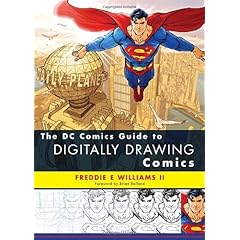 My art library is relatively small, but steadily growing. I have found that the books I end up with tend to fall into one of two categories: inspirational and instructional.
The inspirational books are primarily collections of art work, though some 'how to' books will fall under this category if I'm kinda into the art, but don't really get anything new or worthwhile from the text. Usually, I'll look through them, taking a mental inventory of what kind of art is to be found, and set them aside until I need a specific type of inspiration. They cover a variety of artistic styles and subject matter, and are themselves subjective to the kind of inspiration they provide.
Lately, though, what I've tried to focus on getting are books of a more technical or instructional nature - titles such as: Scott McCloud's Making Comics, James Gurney's Imaginative Realism, Vol. 1 of the Best of Wizard's How to Draw series, and pretty much anything by Andrew Loomis.
These books go in depth with the processes and methodology of artists I respect and admire. I am happy to add to this list The DC Comics Guide to Digitally Drawing Comics, by Freddie Williams II.
I should make clear, though, that it's not Mr. Williams' style I am such a fan of - despite his obvious ability and DC's stamp of approval. What intrigues me most about his work is his process, and that is the main focus of this book. FWII (if I may be so bold . . . and lazy) does his work entirely in Photoshop.
His process basically breaks down into the following steps:
- Load the script for a page and make very rough gestureal sketches for each panel beside the descriptions.
- Move/resize the roughs into panels and develop them further on a new layer.
- Make thin 'wireframe' inks for each panel - sans any sort of lighting or texture. Strictly structural and provides a groundwork for inking.
- Make outlines (contours) of the foreground elements in each panel.
- Turn the contours into "cardboard cutouts" that can be repositioned as needed, but block background elements.
- Ink and drop in black areas.
Another section I found fascinating (simply because I'd never thought of it before) was on making paths of complex background elements, such as building facades and chest emblems, which could then be stored, reused, and distorted to meet the artists' needs. FWII also makes use of Google Sketchup to build entire cityscapes for his scenes. Since I like playing around with Sketchup, I found this to be a pretty cool idea.
On the downside, if you are at all familiar with Photoshop, at least one or two chapters of the book will be going over the same information about the program that this topic always seems obligated to address. Also, there was some background information about the author and the evolution of his process that was mildly interesting, but certainly not what I was after when I decided to get the book.
Overall, I am very happy I got this book, having devoured it in its entirety in less than half the time it took for my laptop to upgrade Windows 7. I would recommend it to anyone interested in producing comic-style artwork and looking to make at least some part of the process digital.
One last tidbit: I have read, to some extent or other, all of the "DC Comics Guide to" series, and this is the first one I felt compelled to buy.
Friday, March 20, 2009
DnD: PBH2 Impressions - Primal Power & Barbarian Missteps
 I finally got my copy of PHB2 last night and read through it. The new and additional races and classes are welcome, certainly, but I have some issues with the way the Primal Power source works and how some of the classes are . . . classified.
The power source itself is cool and I think can really add some flavor to a party - as long as they stay in the natural world. A tenuous connection is mentioned between the natural world and the feywild and, assuming I was reading it correctly (it was late), they tried to extend that connetcion to include the planes and the Astral Sea.
Personally, I think the developers stretched this a little beyond reason. Obviously primal powers would work normally for the world/plane/reality from which they are granted. For something like the Feywild (and possibly the Shadowfell), I would say yes . . . but there would be some distortion or reinterpretation - just the Feywild and Shadowfell are sort of reinterpreations/distortions of the natural world the PC's inhabit. The powers would work, but not necessarily in the same way. I do not see how the powers would be able to extend beyond the reality or plane in which they were granted. It's sort of like going to Neptune, but expecting to operate within the same gravitional and atmospheric parameters of Earth.
Imagine the roleplaying opportunities if a character arrived on a new plane only to discover that all their special abilities no longer worked. Clever thinking, basic attacks and the support of their party would be required to survive until they found their way back home . . . Ah well. It's nice to think about as a fledgling DM, but a player may not enjoy it so much. As long as such forays were reasonably short, I think it'd be fun.
Anyway, on to the primal classes!
The Druid, Shaman and Warden definitely feel like they were all cut from the same cloth - variations on a theme. The Shaman uses a spirit-animal-guide-thingie to carry out most of their attacks, while the Warden can draw power into themselves or exert natural forces upon a foe to stop them cold. The Druid is sort of a mixture of both, but also something different. It almost feels (to this humble reviewer) that the developers are splitting hairs between these classes. But none of the powers overlap, so I guess it helps keep things organized. From an uneducated NPC's perspective, however, I'd find it very hard to spot the differences.
And now, the Barbarian. Yes, they still rage; yes, they do massive amounts of damage; and no, their table manners will not get them invited to any formals anytime soon. For some reason, the Barbarian derives his power from a Primal source. The books states something along the lines of "calling a spirit into themselves" or something similar. Frankly, I think this is wrong. A rage is a state of mind, it is almost of form of self-disciplined chaos. A Barbarian's source of power is more in line with a monk or a psion (both classes yet to be mentioned in 4e) than those of a Druid/Shaman/Warden - regardless of their penchant for tattoos and wearing dead animals. Primitive? Yes. Primal? No.
Until we get to the Paragon Paths, that is, then the Barbarian can turn into (wait for it) . . . a Bear-barian! Yes, they can take the form of an anthropomorphic bear to whoop some monster behind! Why? I'm not sure, I guess because they're Primal and all the other Primal classes get to take on animal characteristics - as well as the Shifters. Hmm, I wonder how a Shifter Barbarian feels about being a patchwork Tiger(or Wolf)/Human/Bear - that's gotta mess with your mind. Or a Dragonborn Barbarian . . . But I digress.
So those were my impressions of PHB2 - not necessarily the direction I would've taken things, but I'm not sorry I got it, either.
Subscribe to:
Posts (Atom)