Showing posts with label Ideas. Show all posts

Thursday, April 1, 2010

DnD: Soduku Trap Room

Dunno if this has been done before, but I'm so desperate to get something up this week, I'm running with it. I'm calling this the Soduku Room because of the way I set up the triggers. If anyone has a better suggestion for a name, I'd be happy to entertain it - I did, however, opt to use a more accurately descriptive name for the stat block below.

Description

The room is 100' square and 10' high. There are no furnishings and the walls, floor and ceiling are all fashioned out of relatively smooth stone. Both the floor and the ceiling have a simple tile pattern applied to them, mirroring each other. Aside from the doorway through which the room is entered - a simple door-sized hole sunk into the wall - the only other feature is another door located on the opposite wall, the same in appearance as the entrance.


Operation & Stats

When the PC's enter the room, certain portions of the floor are pressure sensitive. Once stepped on, a corresponding section of the ceiling somewhere in the room will come crashing down - revealing itself to be a sold block of stone. Once triggered, the column remains where it has fallen, it will not reset while the PC's are in the room.


Options and Variations


To enhance this experience, populate the room with monsters who move around a lot, drawing the PC's further into the room and risking harm to their comrades. Skirmishers should work nicely.

Depending on how nice or cruel you are, you might want the monsters to know which tiles will trigger each section and use that against the PC's. The monster(s) could either already be in the room, or come rushing in when they hear the first rock column come crashing down.

Alternatively, you could use hovering and/or insubstantial monsters - Stirges or Ghosts, for example - who would not trigger the traps to draw the PC's attention away from where they are stepping.

Instead of simply having the doors slam shut to lock the PC's in the room until they 'solve' it, consider having the rock columns fall in front of the entrance and/or exit to the room.

Have a series of rooms like this, with the triggers and columns set-up in different locations. You could require that all the columns be safely triggered in one room before allowing the PC's to progress to the next. You might want to set them up in a meaningful pattern - at the same time, you don't want it to be too obvious which tiles are trapped and which are not.

Hide something in one (or all) of the rock columns.

The size of the room and the number of traps in it are easy to change.

Wednesday, May 13, 2009

DnD: Idea - Fortified Planar Gate

Background

In the world of fantasy, there are many places where one reality overlaps with another. Often times, crossing through these places comes as an unexpected shock - you're in one place one minute, a few steps later, everything is (perhaps radically) different.

But what of those points of intersection that are perceived and located? Having control over such a resource would provide a significant tactical advantage against potential invaders as well as a healthy profit for adventurous merchants seeking to peddle their wares in an exotic locale.

Description

While gates such as this might come in a variety of shapes and sizes, the gate presented here was surrounded by heavy iron doors set into a stone wall. A three-story tower and small barracks sit on either side of the wall, ready to repel those who would try and force their way through the gate as well as stop those who might try to sneak across from the other side. The structure as a whole is not exceedingly tall nor is it very wide. Were it to exist in a forest, it could easily be bypassed by without ever being seen.


Operation

The paths that traverse realities can be fickle, unreliable things. Some are consistently active while others are only usable at certain times of the day or the lunar cycle or some other suitably obscure period of time. Other gates can only be opened with some kind of key that reacts as it passes through the portal.

For example: The Stonewall Gate - as we shall refer to it - is active every full moon for a period of 12 hours. It then closes until the next full moon. The iron doors of the gate can be locked, opened and closed at any point. The doors exist and operate only in the reality in which they were built - if a second set of doors cover the gate in the connected plane, travelers will not be able to pass through without some means of forcing them open.

When a creature passes through the gate, they come out in the new plane on the side opposite of the one they entered. This means that the gate can be used simultaneously from both planes. It also means that when a creature enters on one side, a second creature could return on the opposite side without the first creature's knowledge - hence the importance of the fortifications.

Applications

Two applications for the fortified planar gate immediately spring to mind:

First, both sides of the gate are located in a large, busy cities, the gate is important for allowing trade between two peaceful (or at least somewhat agreeable) civilizations in neighboring planes. Such a gate would probably be active on a daily or weekly basis and the cities on both sides would go to great lengths to protect it. In the event of a siege, the gate could be used to bring in supplies; should the city be overrun, it would become an escape route.

Second, an old forgotten gate exists in obscure corner of large forest. The gate is only ever active once in a long time and has fallen into ruin and disrepair. Any civilized races who happen upon it (and are not well versed in arcane history) might think it an eccentric piece of architecture by some rich noble with more money than sense. Less savory races would be happy to call such a place home, despite it being little more than a wall that doesn't block anything housing a door that doesn't go anywhere.

Friday, April 3, 2009

DnD: Gear Lock & Tiled Floor

I have put a disturbing amount of effort towards getting the details right on this, so I hope the end result was worth it.

Description
A bare or sparsely furnished room with two distinctive features: The first feature is a solid iron door with a large recessed gear located in the middle. There are no handles or keyholes visible and the hinges are set on the opposite side of the door, indicating that it opens inwards. The door cannot be broken down and is constructed of an alloy that will not yield to magical manipulation. Also, due to the lack of any conventional locking mechanism, it cannot be picked. The door is framed in stone which has been decorated with plates that have been hammered directly into the stone to form a simple geometric pattern (see below), part of which is comprised of a bone-like shape.

The second feature is the floor which is covered in metal tiles, each in the shaped of a stylized, spiked skull that forms a regular tessellation. The eyes and nose are filled with small, dark triangular pieces of metal that are hinged to the tile along one edge - a detail that is not observed under normal circumstances.

Unlocking the Door
The door can only be unlocked by turning the gear. To accomplish this, there are two tiles that differ from the others which, once located, can be picked up from the floor and placed - end to end - in the gear. These key-tiles are missing the triangular piece of metal in the nose, and are cut off shorter than the other tiles. To hide this fact, the tiles are placed against a wall or other flat, perpendicular surface. Exactly where in the room they are located doesn't matter, but practicality suggests they would be close to the door.

In addition to the two tiles, one of the metal shapes in the door frame is actually a handle that can be pulled loose - a fact that can be discovered upon close inspection. The handle is then fit into the two nose openings of the key-tiles, allowing them to be turned, unlocking the door.


Above: Layout of the doorframe pattern and floor tiles. Suggested locations for key elements are shown in red.
The key-tiles placed in the lock.


The handle, shown from the back.
Hidden Dangers
Any melee or lightning based attacks that strike the floor not only cause lighting damage to any creature standing on the metal tiles equal to half the value of the original attack (Ex: A Wizard casts Shock Sphere on a section of the tiles and rolls 10 damage for the attack, any creatures/individuals standing on the tiles will take 5 lightning damage).

Such an attack will also cause the hinged metal triangles to flip open, point up, for the remainder of the encounter. While open, the metal spikes are considered difficult terrain. Any movement across the floor will result in an level-appropriate Acrobatics check. If failed, the individual takes 1d4 damage and is slowed (save ends).

Suggested Applications
DM's will probably get the most mileage out of flying/hover creatures as well as any that can use a lightning-based attack from a position of relative safety. Grell Philosophers (MM pg. 144) hover and can cast lightning, making them excellent choices.

Another approach would be to use a trap that does lightning damage - such as a crystal mounted on a podium in the center of the room - to activate the floor spikes. The podium could be raised but hard to stand on, requiring an Acrobatics check while attempting to disable or break the trap.

The style of construction is grim, but displays the kind of detail and efficiency found in Dwarven stone- and metalwork. However, enemy magic-users with even a moderate level of intelligence could be expected to figure out how lightning attacks activate the floor trap.

Thursday, March 12, 2009

DnD: Pendulum Map

First off, I have to give credit where it's due: This idea was directly inspired after seeing this image.

The Pendulum Map


Description
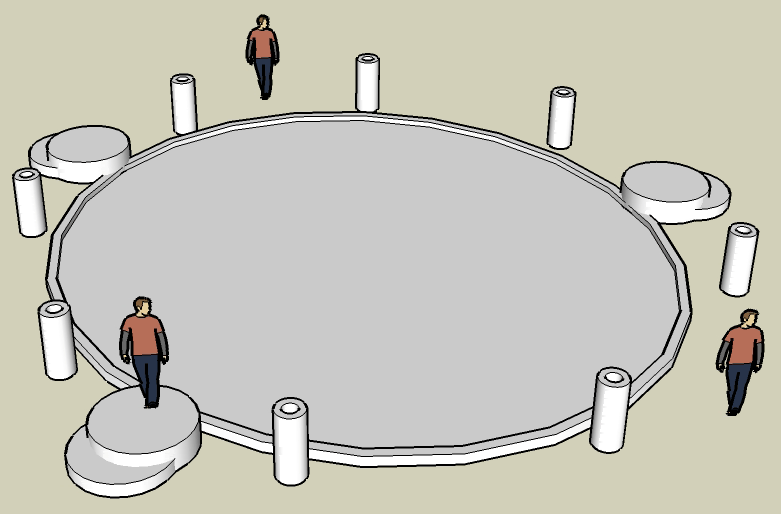
A large, flat circular depression contains a map. It is surrounded by a number of columns, each with a rune or glyph or marking of some sort. These columns are made in such a way as to hold something - a stone or a rod of some sort.

Additionally, two to four raised platforms surrounding the map, in between the columns. These platforms are also marked in some way. A metal pendulum is suspended directly over the center of the map.

Operation
The map can be presented as either a magical or a mechanical device, but the basic operation remains the same: One or more lodestones are placed on the columns. The pendulum is then released from one of the platforms and allowed to swing. The lodestones will either pull or push the pendulum in such a way as to affect its movement across the map.

A marking device will repeatedly cross over certain areas of the map, while other portions will remain relatively untouched. The areas that are marked will vary depending on which columns the stones are placed on as well as from which platform from which the pendulum is released.

The method by which the map is marked may vary: a magical crystal that leaves fading lines of light, sand, chalk or (more crudely) charcoal, etc.

Recommended Environments
A device such as this is best suited to larger Arcane or Mechanical institutions - academies, libraries, observatories, or possibly guild headquarters. The delicate nature of the map means that not just anyone would be given access to it.

Possible Use
The PC's need the map to find a hidden location. Before they can use it, though, the [lodestone, marking device, appropriate column/platform combination] must be found.