Showing posts with label inspiration. Show all posts

Tuesday, July 13, 2010

DnD: Monomyth as a DM Tool, Part 10 - Apotheosis

Apotheosis is defined as exultation or elevation of a person to the rank of god. Alternatively, it may be defined as an ideal or quintessential example of something. In the context of the Hero's Journey, Apotheosis is a period of rest and fulfillment. It is achieved only after the hero has died (literally or figuratively) to himself and has at least reached a point at which they are completely separated (physically, emotionally, spiritually, philosophically) from the life they once lived. In this new state of existence, they find themselves surrounded by divine knowledge, love, compassion and/or bliss.  They are given a glimpse of eternity - or one version of it, at any rate. But, as Don Cheadle's character so astutely states in the 2000 movie, The Family Man, "A glimpse, by definition, is a temporary thing." So, too, the Apotheosis.

Campbell: "Those who know, not only that the Everlasting lies in them, but that what they, and all things, really are is the Everlasting, dwell in the groves of the wish fulfilling trees, drink the brew of immortality, and listen everywhere to the unheard music of eternal concord."

Examples of Apotheosis
Frodo and his friends are harried and attacked by the Ringwraiths until they make it to Rivendell. Later, after surviving the hazards of Moria, the Fellowship finds a moment's peace in Lothlorien. In these elven refuges the hobbits and their companions are healed, rested and equipped for the next leg of their journey.

In many ways, the Pevensie childrens' visit(s) to Narnia is an apotheosis which contains within it a Heroic Journey (or several, if you consider each visit to Narnia a separate journey). In particular, during The Lion, the Witch and the Wardrobe, the idyllic period of time, spanning from the White Witch's defeat to their eventual return through the wardrobe.

There is an apotheosis of sorts at the end of Star Wars: A New Hope (IV) after the Death Star is destroyed. A ceremony is held, celebrations ensue, medals are given, a wookie roars, etc. - presumably in a very public manner. By the time the next movie begins, however, happy-time is over and the rebels are hiding on a bleak, inhospitable ice world.

Vallhalla, in Scandinavian mythology, is a place where the spirits of slain heroes go in preparation to aid Odin in the coming end-of-time battle known as Ragnorok. Despite being existing to prepare for a coming apocalypse, its inhabitants are frequently described as feasting and engaging in various other physical and/or carnal pursuits. The Ellysian fields in Greco-Roman mythology are similar in nature, as is the Islamic Jannat (translated as 'garden' - a concept of paradise), where everything one longs for in this world will be until Yawm al-Qiyāmah ('the Day of Resurrection'). The varying beliefs of Christians in Paradise (as opposed to Heaven) might also fall into this category.

The important detail to note in each of these examples is that the apotheosis setting is not the ultimate final destination, but a brief (relatively speaking) period of rest.

Apotheosis as a DM Tool

Apotheosis occurs many times and at differing levels of abstraction in role playing. In 4e, PC's obtaining immortality after reaching level 30 and completing their destiny quest might be considered a kind of concluding Apotheosis, as the PC's story is considered finished at this point. However, it cannot be considered a true Apotheosis because it is not temporary. There are a multitude of smaller experiences that better fit the definition of an Apotheosis: the completion of a campaign or story arc where the heroes bask in the adulation of a grateful populace; leveling up and gaining new skills/powers/feats; even taking an extended rest and playing with a new ritual or magic item.  Any temporary location or period of time in which the PC's are not struggling, but are graduating into a greater version of themselves - be it though personal growth, or better equipment/armament - can serve as an Apotheosis.

The significance of the apotheosis experience to your players should not be missed. This temporary period of time gives the players a sense of accomplishment - they have survived the onslaught and emerged stronger and/or better equipped than they were before. A brief period of rest allows them the time to explore these changes and revel in their success. However, should the PC's spend too much time in this state, they run an ever increasing chance of becoming bored or complacent. The pace of a campaign can be ruined by a poorly-executed apotheosis, as well.

In Jesse Schell's excellent book The Art of Game Design: A Book of Lenses, the author discusses the challenges of keeping players in the 'flow channel' (Chapter 9, pgs. 119-122). The flow channel is a "repeating cycle of increasing challenge, followed by a reward, often of more power, which gives an easier period of less challenge. Soon enough, the challenge ramps up again."

Schell concludes his discussion on the Lens of Flow with:

This cycle of “tense and release, tense and release ” comes up again and again
in design. It seems to be inherent to human enjoyment. Too much tension, and we
wear out. Too much relaxation, and we grow bored. When we fluctuate between
the two, we enjoy both excitement and relaxation, and this oscillation also provides
both the pleasure of variety, and the pleasure of anticipation.


Having already touched on the importance of keeping an apotheosis temporary, there is one other important aspect to consider: Time does not stop just because your PC's do. Sure, the heroes may be reveling in the adoration and playing with treasure and new magic trinkets in a castle somewhere; but, caravans and ships still have schedules to keep, monstrous creatures still prowl the dark places seeking to fill their bellies, evil schemes continue to hatched and executed, and tyrannical despots continue their subjugation of peasants and farmers.

Pondering Apotheosis
  • Consider the following statement: Only boredom or a perceived threat will effectively rouse PC's from their apotheosis. Agree or disagree? Why or why not?
  • What, if any, are the possible risks of having several minor apotheoses (such as extended rests) occur in a short period of time?
  • Consider the following statement: An apotheosis should occur only when the PC's have earned it. Agree or disagree? Why or why not?
  • What is the (current or next) campaign's villain doing while your PC's are enjoying their current apotheosis? How will they find out - if they do at all?
  • Is it fair to end an opportunity while the PC's are in a state of apotheosis? Why or why not?
Earlier Entries in This Series
Introduction
Stage I: Departure
Stage II: Initiation

Thursday, June 17, 2010

DnD: Monomyth as a DM Tool - Part 9: Atonement with the Father

As fans of fantastic adventures, we typically think of the climax as being a final battle or showdown with a seemingly unbeatable antagonist who, up to that point, the hero was being pursued by - or perhaps had been pursuing himself. While this is certainly one of the most thrilling and overtly dangerous points of the Heroes' Journey, according to Campbell, it is not the showdown with 'the dragon' that is the true climax, but atonement with a father figure.

Atonement, in this context, seems like an odd term, as it is traditionally understood as a reconciliation or bringing together of two or more people who have been torn asunder. Campbell, though, is more interested in the hero's acceptance and initiation by whatever holds the ultimate power in the hero's life - often represented by a father figure who holds the power of life and death in mythology.  Perhaps it might be better phrased thusly: Nothing is as terrifying as the prospect of being rejected by those whose acceptance we most desire.


Campbell's synopsis of the Atonement also contains some interesting spiritual aspects to it:

"Atonement consists in no more that the abandonment of that self-generated double monster – the dragon thought to be God (superego) and the dragon thought to be Sin (repressed id). But this requires an abandonment of the attachment to ego itself, and that is what is difficult. One must have a faith that the father is merciful, and then a reliance on that mercy. Therewith, the center of belief is transferred outside of the bedeviling god's tight scaly ring, and the dreadful ogres dissolve. It is in this ordeal that the hero may derive hope and assurance from the helpful female figure, by whose magic (pollen charms or power of intercession) he is protected through all the frightening experiences of the father's ego-shattering initiation. For if it is impossible to trust the terrifying father-face, then one's faith must be centered elsewhere (Spider Woman, Blessed Mother); and with that reliance for support, one endures the crisis – only to find, in the end, that the father and mother reflect each other, and are in essence the same. The problem of the hero going to meet the father is to open his soul beyond terror to such a degree that he will be ripe to understand how the sickening and insane tragedies of this vast and ruthless cosmos are completely validated in the majesty of Being. The hero transcends life with its peculiar blind spot and for a moment rises to a glimpse of the source. He beholds the face of the father, understands – and the two are atoned."

Examples of Atonement with the Father

Up until the end of Empire Strikes Back, Darth Vader had been a symbol of death and destruction in Luke Skywalker's journey among Rebellion fighters and Jedi knights. Suddenly, it is revealed that not only is his father alive, but is that very same figure responsible for so much suffering. In the final act of the original trilogy, Anakin finally breaks free of the grip Emperor Palpatine/Darth Sidious has over him and reconciles with his son. Luke is able to gain closure and learns that he is not alone in the universe, but has a sister.

In the parable of the prodigal son, the wayward younger son returns home after blowing his inheritance and living - quite literally- among pigs.  He expects to grovel before the father he has embarrassed and spurned and hopes to earn his way back into the household as a hired man.  The love of the father for his son is such that he runs out to him (something a patriarch would never do) and embraces him whole-heartedly, immediately reinstating him as a full member of the family, much to the consternation of his older brother.

In Gaiman's Stardust, Tristran Thorne grows up knowing nothing of his biological mother.  By the end of the novel, her identity - along with Tristran's heritage and destiny - are revealed in classic Shakespearean form.

Another Gaiman novel, American Gods, centers the plot in a more direct fashion around his protagonist, Shadow and his father - or rather, his lack of a father up to that point. To say more would dip into spoiler territory, I fear.

Harry Potter and the Order of the Phoenix has a scene at the end where Harry is venting his frustrations to Dumbledore - the closest thing to a father figure he's had (yes, even more so than Sirius).  Finally, Dumbledore admits his mistakes in trying to protect Harry by putting distance between them and lets him in (for the most part) on what been going on in the escalating hidden war against Voldemort.

Atonement as a DM Tool

There seem to be two main approaches for implementing Atonement in a campaign. First, individual implementation for each PC, while requiring more history/backstory from each player and more effort from the DM to weave each player's details into the narrative tapestry, holds the potential for a meaningful personal experience for both the character and their player. Unfortunately, the other members of the group are at risk for becoming bored, alienated, or jealous when a player gets singled out for her time in the spotlight.

The other primary approach would be to provide an atonement-experience for the entire party.  While certainly easier to execute by involving everyone at once, it will likely be more difficult to set up a meaningful relationship involving every in the party that can be resolved in a single fell-swoop. A possible solution might lie in the group's motivation and/or reasons for adventuring together. Figuring out what brought them together and, more importantly, what has kept them together despite overwhelming resistance from an existence which, for all intents and purposes, seems out to get them at every opportunity.

Regardless of implementation strategy, the first thing a DM will need to know is what/who it is that holds ultimate power in a PC's - or possibly a group's - life. Find out what or who they desire to be accepted and respected by above all others, and you have the key to building a meaningful Atonement climax.

For those who enjoy an immersive experience with a rich supporting cast of NPC's, consider using the PC's to facilitate or enable an NPC in achieving an Atonement experience. Hack-n-Slash players - those generally less interested in plot than combat - are less likely to enjoy the experience, however. As always, a little insight into the personalities of your PC's will go a long way in crafting a meaningful experience for them.

Pondering Atonement
  • What is it that holds ultimate power in your PC's lives - Individually? As a group?
  • How might a PC's actions change when: They desperately want to be accepted? They've been devastated by rejection?
  • How might fellow PC's become an obstacle to achieving one's Atonement? What about NPC's?
  • What might happen if knowledge of these motivations were discovered by a villain?
  • Consider the opposite: What could your PC's do with knowledge of a villain's driving motivation?
Earlier Entries in This Series
Introduction
Stage I: Departure
Stage II: Initiation

    Thursday, May 27, 2010

    DnD: Monomyth as a DM Tool - Part 8: The Temptress

    I must confess feeling a need to tread carefully, lest the discussion of this topic come off as sexist. However, the truth of the matter is (1) that the vast majority of cultures throughout the history of mankind have been patriarchal, and thus their heroes have tended to be male and (2) men, heroic or no, have done - and continue to do - some pretty stupid things in their pursuit/seduction/objectification of women.

    The Temptress embodies anything that might lure the hero away from his quest, possibly even abandoning it altogether. She is a metaphor for the physical or material temptations of life, very similar to the Gnostic belief in dualism. Dualism states, at the risk of oversimplification, that there exists a physical material world that is bad, and a spiritual world which is good.  In order to live in this spiritual world, the physical one must be overcome; for the Gnostics, this 'salvation' came though the accumulation of knowledge. Similarly, the Temptress must be overcome by self-discipline and a dedication to the higher purpose of the journey to which the hero has been called.

    "The crux of the curious difficulty," Campbell writes, "lies in the fact that our conscious views of what life ought to be seldom correspond to what life really is. Generally we refuse to admit within ourselves, or within our friends, the fullness of that pushing, self-protective, malodorous, carnivorous, lecherous fever which is the very nature of the organic cell. Rather, we tend to perfume, whitewash, and reinterpret; meanwhile imagining that all the flies in the ointment, all the hairs in the soup, are the faults of some unpleasant someone else. But when it suddenly dawns on us, or is forced to our attention that everything we think or do is necessarily tainted with the odor of the flesh, then, not uncommonly, there is experienced a moment of revulsion: life, the acts of life, the organs of life, woman in particular as the great symbol of life, become intolerable to the pure, the pure, pure soul. The seeker of the life beyond life must press beyond (the woman), surpass the temptations of her call, and soar to the immaculate ether beyond."

    Examples of the Temptress

    Anakin Skywalker's embrace of the Dark Side was precipitated by the feelings he had for two women: His mother, whose death led him to slaughter a tribe of Tuskan Raiders; and Padme, for whom he sought a means of preventing death.

    One of my all-time favorite movies, Legend, has a scene where a faerie attempts to seduce Jack, the hero, by taking on the appearance of his love, Lily. Additionally, Lily is herself tempted by Darkness when he becomes infatuated with her innocence.


    In late Arthurian mythology (primarily the Lancelot-Grail accounts), Merlin was doomed by his desire for Niviane, the daughter of Northumberland's king. Fearing Merlin's power and how he might use it to control her, the huntress gets Merlin to agree to teach her everything he knows before she will love him. He does and she eventually puts a spell on him and places him in a magic tomb from which he cannot escape.

    There are a handful of examples scattered throughout the Bible, but the the most pertinent to this discussion appear as obvious metaphors in Proverbs 5-9 (personifications of Wisdom, Folly and 'the adulterous woman') and Revelations 17 and 18 (Babylon portrayed as a prostitute).

    The Greek hero Odysseus was advised by the minor goddess/witch Circe (herself a temptress) not only how to safely bypass the Sirens on his return to Ithaca from fighting in the Trojan War, but how he might manage to hear their irresistible song while doing so and live to tell about it.

    The Temptress as a DM Tool

    Heroes in role playing games are faced with many puzzles, trials and challenges on their journey, the vast majority of which are exterior in nature - that is, they appear as an obstructing and/or opposing force from without.  Monsters are easy to fight because they physically exist and can be interacted with, they generally have an exterior that reflects their alignment, and they are actively trying to rip the hero's face off; traps are unthinking and unfeeling and simply react to the PC's presence; riddles and puzzles, by their very nature, appeal to a competitive person's desire to 'win'.

    The Temptress, however, uses her wiles and words to assault from within. These are not merely physical attacks vs. Will, but serious challenges to the underlying motivation driving a PC. She understands that victory in the long term outweighs the immediate satisfaction of driving a dagger into her enemies' heart, and spends her time reshaping a PC's thought process rather than trying to lower their hit points. Then, when her web of deception is complete, it will be the PC's who bring about their own destruction. She is never perceived as a threat - at least, not until it's too late - because she does not use threatening behavior. Words, questions especially, are her favorite weapon; with them, she plants seeds of frustration and confusion and throws the party into turmoil.

    It is not easy to implement, but when done well, the inclusion of a Temptress in a campaign can provide a memorable gaming experience.

    Pondering the Temptress
    • Campbell states that the Temptress does not have to appear as a woman. Can you think of another form The Temptress could assume in your campaign?
    • Why might the Temptress want your PC's to fail in their quest? For personal gain, or does she serve the will of another?
    • If you were an adventurer on a quest, what sorts of fears or concerns might tempt you to stray from or abandon it entirely?
    • Can you think of a situation that might drive a wedge between your PC's? Is there any pre-existing tension or animosity you could draw upon?
    • Do your PC's keep secrets from each other? If not, can you think of a situation in which they might want to?
    Earlier Entries in This Series
    Introduction
    Stage I: Departure
    Stage II: Initiation

      Wednesday, May 19, 2010

      DnD: Monomyth as a DM Tool - Part 7: Meeting the Goddess

      Have you ever wondered why action and comic-book movies often include a love interest? It is generally accepted that the inclusion of a sympathetic female character will make the movie more appealing, and thus more marketable, to what would otherwise be a product that caters to only a portion of the movie-going public.  According to Campbell, however, there may be more to the protagonists' ever-present love interest than we realize:

      "The ultimate adventure, when all the barriers and ogres have been overcome, is commonly represented as a mystical marriage of the triumphant hero-soul with the Queen Goddess of the World. This is the crisis at the nadir, the zenith, or at the uttermost edge of the earth, at the central point of the cosmos, in the tabernacle of the temple, or within the darkness of the deepest chamber of the heart. The meeting with the goddess (who is incarnate in every woman) is the final test of the talent of the hero to win the boon of love, which is life itself enjoyed as the encasement of eternity. And when the adventurer, in this context, is not a youth but a maid, she is the one who, by her qualities, her beauty, or her yearning, is fit to become the consort of an immortal. Then the heavenly husband descends to her and conducts her to his bed – whether she will or not. And if she has shunned him, the scales fall from her eyes; if she has sought him, her desire finds its peace."

      Clearly, there is some emptiness or missing part of the hero that only this embodiment, often present albeit overlooked until late in the journey, can fill. Once that emptiness is realized, to continue to live without it is to exist in a state akin to anguish or yearning.


      Examples of the Goddess

      Over the course of Tolkien's Lord of the Rings, Gimli fell head over heels for the immortal Galadriel - probably the closest manifestation of a literal goddess I can think of - though the dwarf's relationship was strictly a chivalrous one (eg: loving from afar); Eowyn and Faramir, both of whom could be considered heroes of their own journeys, met and fell in love as they recovered from their injuries; and Sam, finally finding the courage within himself after facing many trials and terrors, married Rosie Cotton.  Aragorn and Arwen would also fall into this category, though they had met and started a relationship before the events recorded in the triliogy.  An important detail of this final example being the relinquishing immortality by the goddess-figure in order to grow old and die with her husband (one year after his death, specifically).

      In the Underworld Trilogy, Selene, the vampire protagonist, falls for Michael Corvin.  Initially a 'normal' human, Michael undergoes a transformation into a powerful lycan/vampire hybrid and (using Campbell's lens) Selene becomes his consort.

      On a much lighter note, the premises of the classic TV shows Bewitched and I Dream of Jeannie are a cross between this concept and classic juvenile wish-fulfillment. The movies Splash, Enchanted and My Super Ex-Girlfriend offer big-screen equivalents (though I cannot in good conscience recommend watching the later).

      Meeting the Goddess as a DM Tool

      So how does Meeting the Goddess work in a group-based context? I will confess that I have struggled with this stage of the Hero's Journey. The simplest answer is: it doesn't work; at least, not in the way it is presented. However, if we add a layer of abstraction, it is possible to change the love that a hero is able to win from the goddess into the unexplainable attraction the NPC's have for the PC's.  It is that attraction and affection for the heroes that compels NPC's to offer up any and all assistance in their efforts to rid the land of a threat, despite barely knowing them. There is something the heroes must do or become, but without the assistance of the NPC, they are hopelessly stuck.

      The divine aspect, then, becomes the knowledge held by the DM guiding the words and actions of the NPC's in their interactions with the group - occasionally to harrass, but more commonly to help.

      While it is certainly not required to play a game, for a more immersive role playing environment that fosters true in-character interactions, a DM should seriously consider, before using Random-Guy-on-the-Street #1 to divulge the secret location of the lich's phylactry, what (if anything) a given NPC knows about:
      • this rag-tag band of adventurers who have just blown into town from who-knows-where
      • the mission the PC's are trying to accomplish, and how they might be successful
      • the villain(s) the PC's are working against - their plans, motivations, history, and/or weaknesses
      A tool such as the Johari Window can be very useful for keeping track of this information.

      Aside from what a NPC knows, the DM should consider how the NPC feels about the heroes, the villain(s), their current setting, even themselves. A self-loathing NPC might be just as happy seeing the town wiped out, and himself along with it.

      Pondering the Goddess
      • What roles do NPC's play in your PC's lives?
      • Is the manner in which a NPC obtains the knowledge and/or equipment they provide important? Why or why not?
      • Do you think a campaign can be just as engaging and enjoyable without any NPC interaction? Why or why not?
      • What, if anything, can a NPC provide for a PC (or group of PC's) that they cannot provide for themselves?
      • How might including a non-PC love interest for one or more of your players have an impact on the campaign?
      Earlier Entries in This Series
      Introduction
      Stage I: Departure
      Stage II: Initiation

        Wednesday, May 12, 2010

        DnD: Monomyth as a DM Tool - Part 6: Road of Trials

        The Road of Trials is when the strange new world that exists beyond the Threshold really comes alive for the adventurer. Enemies and obstacles are encountered and the hero must make use of the training, advice and talismans provided by the Supernatural Helper(s).  This is also the stage in which hero begins to see the results of the transformation that began in the Belly of the Whale.

        It is important to point out that the trials on the road tend to come in sets of three. There is a significance to the number three that is easy to overlook, by both the hero actively faced with the challenges and by us in our roles as spectators.  The number three represents completeness:
        • The simplest meaningful geometric shape requires three lines
        • Three dimensions are required to form a solid shape; 2 being the symbol of the flat square vs 3 as the symbol of the cube (x2 vs. x3)
        • There are three great divisions to a temporal existence - past, present, and future
        • Thought, word, and deed, complete the sum of human capability
        • God is defined as having three attributes: omniscience (all-knowing), omnipresence (all-present), omnipotence (all-powerful)
        • The Godhead - also known as the Trinity - is formed of three entities: The Father (God), The Son (Jesus), and the Holy Spirit
        • Three persons, in grammar, express and include all the relationships of mankind
        Many other examples can be found here.

        Campbell writes: "Having traversed the threshold, the hero moves in a dream landscape of curiously fluid, ambiguous forms, where he must survive a succession of trials. This is a favorite phase of the myth-adventure. It has produced a world literature of miraculous tests and ordeals. The hero is covertly aided by the advice, amulets, and secret agents of the supernatural helper whom he met before his entrance into this region. Or it may be that he here discovers for the first time that there is a benign power everywhere supporting him in his superhuman passage. The original departure into the land of trials represented only the beginning of the long and really perilous path of initiatory conquests and moments of illumination. Dragons have now to be slain and surprising barriers passed – again, again, and again. Meanwhile there will be a multitude of preliminary victories, unretainable ecstasies and momentary glimpses of the wonderful land."

        Examples of the Road of Trials

        It can be difficult to identify precisely when the Road of Trials begins and ends in a journey.  Indeed, the entire adventure can often be seen as a continuous series of trials that overlaps and bleeds into the other stages of the journey.  For these examples, we shall focus on those instances where a trial or obstacles occurs in a set of three; Fairy Tales and fables are particularly rich in this regard.

        During the course of his adventure to destroy the One Ring, Frodo was constantly in danger, but found himself very nearly killed on three occasions: After being stabbed by the Witch-king of Angmar at Weathertop, getting skewered by the cave troll in Balin's Tomb (Moria), and being stung by the vile Shelob in the pass of Cirith Ungol.  Each time, he was saved by the works and gifts of those around him: Aragon's medicinal knowledge and Elrond's magic; Bilbo's Mithril shirt; Sting (another gift from Bilbo) and the Light of Earendil, both which were wielded by Sam.

        In the original telling of Jack and the Beanstalk (not to be confused with Jack the Giant Killer), the protagonist climbs the beanstalk three times, eludes capture with help from the giant's wife and comes away first with a bag of gold, then with a hen that laid golden eggs, and finally with a magical harp - killing the giant owner of the house during his final visit to keep the source of his new-found wealth a secret. Jack's distinction as the 'hero' of the tale was questionable at best, and the tale was retold by Bejamin Tabart in 1807 with a moralistic bent by turning the giant into a thief and murder, thus justifying his slaying.

        Red Riding Hood notices three features about her grandmother (eyes, ears, teeth) that are not quite right.

        The evil dwarf Rumpelstiltskin gives the queen three days to discover his name, lest he steal away her first born.

        In Monty Python's classic skewering of the Arthurian legend, the king and his knights must answer three questions to cross a bridge.

        During his time fasting in the wilderness, Jesus was tempted three times by Satan.

        The Road of Trials as a DM Tool

        In the context of gaming, especially video gaming, the vast majority of an adventure will be spent on the Road of Trials.  The obstacles encountered along the road, usually in the form of battles and/or puzzles, are often the only time the player is actually given full control of his character and made responsible for overcoming them.  In video games the other stages of the journey, which are more concerned with character development - such as The Call or the Belly of the Whale - are often glossed over in the form of cut-scenes or annoying run-on dialog that drive impatient players to continually mash a button until they can get back to the excitement of battles and party/inventory management.

        But what does the Road of Trials look like for a traditional pen-and-paper RPG player?  At it's worst, it is merely a grind - a series of combat and skill encounters whose sole purpose is to gain XP and has little, if anything, to do with story. The canny DM will, however, use every encounter as an opportunity for a PC to discover something about themselves.  Perhaps that discovery is simply a new power or ability - or perhaps a new way to use an existing power/ability.


        Terrain and dialog can and should be implemented to drive players towards a new level of understanding and competence and drive the story forward.  Even a seemingly random encounter might have some small clue embedded in it that speaks to one player - or perhaps even the party as a whole. Examples might include a bookshelf that gets knocked over, conveniently scattering some important maps or manuscripts on the floor; a foe who whispers the name of his master as he dies; an oddly colored fire that does not burn when someone is shoved into it, but freezes instead; a ghost that constantly repeats a question or phrase over and over as it harasses the PC's - or perhaps only a particular member of the party.

        In a larger sense, each of the trial-encounters along the Road could represent a different aspect of the party's journey.  For example, battling a group of undead clad in the livery of a PC's homeland might represent a break from a past life that was going nowhere. The following encounter might involve a rival group of adventurers, vying for the same prize/glory as the PC's as a reflection of themselves.  Finally, this particular road concludes with a battle against a meglomaniacal demi-god - a former adventurer who gained great power and lost his mind - as a warning of things to come should the PC's fail to stay grounded and humble.

        Pondering the Road of Trials
        • Can a groups' Road of Trials ever be as engaging and meaningful as that of an individual? Why or why not?
        • Do you think a PC/group can experience more than one Road of Trials at a time? Consider the pros and cons.
        • Does the Road of Trials gain or lose effectiveness if the number of encounters deviates from three? Why or why not?
        • Consider this statement: Any encounter that does not advance the story in some way is a waste of time.  Do you agree? Why or why not?
        • Consider this statement: Combat, while exciting, is generally not meaningful; Vice versa for skill challenges. Do you agree? Why or why not?
        • How does your stance on the previous two statements affect how you build an encounter or set of encounters?
        Earlier Entries in This Series

        Introduction
        Stage I: Departure
        Part 1: The Call
        Part 2: Refusing the Call
        Part 3: Supernatural Aid
        Part 4: Crossing the Threshold
        Part 5: Belly of the Whale

        Wednesday, April 28, 2010

        DnD: Monomyth as a DM Tool - Part 5: Belly of the Whale

        Here now, we have arrived at the final step in the Departure stage of the Hero's Journey.  The call was received, refused at first, supernatural aid sought and provided, and the threshold into the unknown was crossed. The hero now finds herself in the belly of the whale, completing the separation from a world and/or an existence she was familiar - possibly even comfortable - with by undergoing a personal metamorphosis.  Old ways of thinking and doing must be put aside, as they cannot carry the hero past the trials to come.  New paradigms, of natures both physical and mental, are introduced to the hero and must be mastered if she is to have a hope of surviving what lies ahead.


        Campbell writes that the hero's passage into this stage of the journey can often be mistaken by the casual observer as defeat: "The hero, instead of conquering or conciliating the power of the threshold, is swallowed into the unknown and would appear to have died. This popular motif gives emphasis to the lesson that the passage of the threshold is a form of self-annihilation. Instead of passing outward, beyond the confines of the visible world, the hero goes inward, to be born again. The disappearance corresponds to the passing of a worshipper into a temple – where he is to be quickened by the recollection of who and what he is, namely dust and ashes unless immortal. The temple interior, the belly of the whale, and the heavenly land beyond, above, and below the confines of the world, are one and the same. . . The devotee at the moment of entry into a temple undergoes a metamorphosis. Once inside he may be said to have died to time and returned to the World Womb, the World Navel, the Earthly Paradise. Allegorically, then, the passage into a temple and the hero-dive through the jaws of the whale are identical adventures, both denoting in picture language, the life-centering, life-renewing act."" 

        Examples of the Whale's Belly

        The quintessential example of the Whale's Belly comes from the Biblical story of Jonah. Commanded by God to preach to the city of Nineveh, the prophet Jonah instead ran the other direction, boarding a ship sailing for Tarshish. Along the way, a great storm blew up and threatened the ship. Jonah was revealed as the source of the calamity when the sailors cast lots to discover who among them had incurred the wrath of the gods. Accepting responsibility and seeking to spare the ship, Jonah had the sailors throw him overboard, where he was swallowed whole by a great fish, almost always visualized as a whale. He remained in the fish for three days and three nights, praying to God.  Finally, Jonah was vomited onto dry land and, when commanded by God to go to Nineveh a second time, did not delay. The city, destined for destruction due to their evil ways, repented as was spared.

        Luke Skywalker's metamorphosis experience is stretched across one movie, and nearly into a second. Over the course of Empire Strikes Back, shortly after being - quite literally - stuffed inside a Tautaun's belly (womb allegory), he heads to swampy Dagobah to train with Yoda, who lives in a cramped little hut (another womb).  It is here that he truly sees for the first time what the Force is capable of.  It is also during this training that he has a disturbing vision in a cave (yet another womb allegory) about what could happen if he failed to resist the lure of the Dark Side.  By the end of Empire Strikes Back, Luke's metamorphosis has taken on a physical aspect in the hand that is lost and subsequently replaced.  The changes and growth he experiences during the course of this movie carry him into the period between the fifth and sixth chapters, during which he becomes a full-fledged Jedi.

        Despite several close calls with the Nazgul, who appear as nightmares given form to the diminutive hobbits, it is within the mines of Moria that the Frodo, Sam, Merry, and especially Pippin have a transformative experience.  As they pass through the depths of the mountains, they find themselves for the first time face-to-face with goblins (subterranian orcs), a troll and (most terrifying of all) a Balrog - all due to Pippin's carelessness in Balin's Tomb.  This is the first encounter where the hobbits must hold their own, along with their more traditionally heroic companions, lest they be overwhelmed - there would be no last-minute rescue for them as their was with Old Man Willow and on Weathertop.  Eventually, the group escapes, but not before the harsh reality of their situation is made all too clear with the loss of Gandalf.  The movie, specifically, Billy Boyd's portrayal of a guilt-ridden Pippin as the fellowship succumbs to exhaustion and anguish by the Dimrill (East) Gate.

        In the first act of Christopher Nolan's excellent Batman Begins, Bruce Wayne makes his way to the League of Shadows' compound in the mountains of Tibet.  There he undergoes intense martial and psychological training in order to, as Liam Neeson's character put it, "make yourself more than just a man, devote yourself to an ideal, and if they can't stop you, then you become something else entirely . . . A legend."


        Belly of the Whale as a DM Tool

        DM's (or should I be using GM's instead?) regularly make use of this concept, though probably not in such a formal, recognizable manner. Basically, any time the PC's must acquire crucial knowledge and/or abilities in order to complete a task deemed by the common folk to be impossible, the Belly of the Whale comes into play. Their time in the Belly-setting answers the where and how questions about what the PC's need to accomplish in order to be victorious.

        There a couple of common temptations that a DM faces during this stage: First, glossing over the metamorphosis experience - making it happen instantaneously, thereby robbing it of meaning; and, second, requiring the PC's to grind until they have accumulated enough of a resource (gold, XP, specific dropped items) as a symbol of their completion of the metamorphosis process.  This second scenario is particularly frustrating because it assumes that by doing the same thing over and over again, the protagonists have somehow matured or mastered a new way of thinking/fighting - when the reality is that they have simply gotten better at doing the same thing over and over again.

        Setting is important to the metamorphosis, there is something unique about it that is crucial to the changes that need to occur before the PC's can hope to overcome the trials ahead. It makes sense, then, that there is also something repulsive about the location or the process related to the metamorphosis that deters just anyone from pursuing it - perhaps it is in a location that is dangerous to reach, or the metamorphosis process is a painful - even potentially deadly - experience.  Perhaps there is a characteristic about those who have completed the change that is perceived, fairly or unfairly, as unsettling or even dangerous. The concept of a reviled savior is an interesting one and holds a lot of potential for true role playing.

        Pondering the Belly of the Whale
        • What sort of settings do you envision when you think about undergoing a change or experience growth?
        • Is the change that occurs in the Belly of the Whale permanent or temporary? Why?
        • Do you tend to think of the metamorphosis process as being a result primarily of external or internal forces?
        • Can a hero be committed to vanquishing the dragon, but hesitant about what must be done to accomplish such a task? Why or why not?
        • Should a metamorphosis be specific to a single quest? Do relying on a specific change across multiple adventures 'cheapen' it? Why or why not?

        Friday, April 23, 2010

        DnD: Monomyth as a DM Tool, Part 4 - Crossing the Threshold

        A journey of a thousand miles begins with a single step. - Lao-Tzu, Chinese philosopher (604 BC - 531 BC)

        It's a dangerous business, Frodo, going out of your door. You step into the Road, and if you don't keep your feet, there is no knowing where you might be swept off to. - Bilbo Baggins

        Having committed himself to the journey (willingly or otherwise), finding his mentor-guide(s) - or, as Campbell refers to them, "the personifications of his destiny to guide and aid him" - and equipping himself as best he can, the hero stands at the boundary of the world he has known and accepted for so long.  Taking a deep breath, the hero opens the gate and steps across into the unknown.  Campbell also makes mention of a 'threshold guardian' who stands between the hero and this new realm of being and magnified power.  This guardian does not always take an expected form, as do the mythological Cerberus or the castle guardians from Neil Gaiman's excellent Sandman series, but might appear as a friends or loved ones who discourage the hero and must be bypassed in some way before the journey can truly begin.

        Examples of the Threshold

        Samwise Gamgee, in Peter Jackson's LOTR movies says to Frodo, "If I take one more step, it'll be the furthest from home I've ever been."  There is not really a threshold guardian present (though one could say, symbolically, the scarecrow in the background fills the roll as a silent sentinel), but they do have their very first close encounter with the Nazgul shortly beyond that point.  At least one commentator suggests that the Hobbits' encounter with Old Man Willow - where they first come to harm (albeit minor) and must be rescued by Tom Bombadil - is the true threshold experience for the protagonist(s).

        Luke Skywalker trades the known dangers of the Tatooine wasteland for the unknown dangers of the Mos Eisley spaceport, particularly the rough-and-tumble cantina, where his adventure is very nearly cut short before it ever gets off the ground (pardon the pun).  At the time of Luke's arrival, it is being patrolled by Stormtroopers, who attempt to apprehend the group.

        In Stardust (another Gaiman creation), there is a very clear demarcation in the old stone wall that borders the protagonist's village.  An opening in the wall allows one to pass into the world of faerie, but it is stubbornly guarded by old man who takes his position as the keeper of the opening very seriously.

        The scientists who managed to get the Stargate working (in the original movie of the same name) had no clue what - if anything - lay on the otherside of the shimmering, undulating portal.

        Dorothy crosses two thresholds in the Wizard of Oz.  First there is the passage from consciousness into unconsciousness by way of the twister; shortly thereafter, she literally crosses the threshold of her mundane black-and-white existence into the color- and magic-filled realm of Oz.

        The Threshold as a DM Tool

        For a DM, crossing the threshold may impact a game on several different levels.  The first and most obvious being a threshold guardian that must be defeated, either by wits or brute force, before the party can continue their adventure.  Second, achieving a new level or tier acknowledges that the PC's have grown in some way and now have access to new powers and abilities with which to face the challenges ahead - which have also grown in difficulty. While the first two examples are fairly straightforward and go hand-in-hand with the basic mechanics of almost every role-playing system, a third instance - that of the symbolic threshold - is a bit more abstract and hard to define.  And yet, I would suggest that it holds the greatest potential of the three for creating a meaningful experience.

        Monsters and puzzles are external conflicts and often represent forces outside of a person to be overcome. These situations might be cast, rather simplistically, as Man vs. Nature, and Man vs. Man. What is left? Man vs. Himself.  The internal battles against doubts, fear, insecurity, and any number of personal shortcomings that we allow to tie us down and prevent us from achieving what Maslow referred to as 'self-actualization' are often some of the toughest battles a person will face in his or her lifetime. Compounding the issue is our inability to objectively handle and shape those feelings and understandings that shape our perception of the world around us.  In the real world, that is.  In the role-playing world, an able DM can construct situations that threaten from within, though doing so will require some preparation.

        Depending on how much information a DM requires of their PC's at the start of an adventure, and the player's willingness and/or ability to 'put on' their characters and truly role play their strengths and weaknesses, these threshold experiences contain a great deal of potential for the characters' - and possibly even their player's - personal growth. Consider a player who is deathly afraid of spiders (a common fear) who must descend into a lair full of them to save a child.  Or a PC consumed with revenge who attempts to convince a king to forgive a slight, lest war claim thousands of innocent lives. Perhaps there is an accomplished thief who has something precious stolen from him.  These are not thresholds in a physical sense, but can serve as symbolic threshold experiences that, once overcome, empower the PC in some personal way.

        Rewards for overcoming or passing a threshold may be many and varied, ranging from a simple bonus to skill checks or attacks vs. a certain type of creature, or a better understanding of the skills, powers and abilities one possesses.  What if, though, by overcoming a threshold challenge, a player arrives at a deeper understanding of her own motivations or behaviors?  A bit far-fetched, perhaps, but not outside the realm of possibility.


        Pondering the Threshold
        • What, if any, personal obstacles have your PC's had to overcome?
        • Do you think overcoming a physical threshold guardian can be as meaningful a overcoming a symbolic one? Why or why not?
        • Is it possible for PC's to have a meaningful threshold experience as a group? Why or why not?
        • Do you ever include elements from your players' real lives into your adventure/campaign? What forms or roles do these real-world elements take in the game?
        • Have you ever had your real-world perceptions altered by a work of fiction?  Do you think that your adventure/campaign holds the same potential? Why or why not?

        Tuesday, April 20, 2010

        DnD: Monomyth as a DM Tool - Part 3: Supernatural Aid

        Once the hero - by hook or by crook, consciously or unconsciously - begins to undertake his quest in earnest, they usually do not have to wait very long before a guide or magical helper of some sort is introduced into the story. The arrival of supernatural aid in fantasy literature is such a common occurrence that fans of the genre are generally more surprised when it does not occur. Consequently, the event is often taken for granted and treated as little more than a plot device - a means by which the hero obtains possession of some trinket or knowledge they would (or could) not gain on their own.

        Campbell, however, proposes that there exists a deeper significance in role played by this mystical, mysterious mentor. "For those who have not refused the call, the first encounter of the hero journey is with a protective figure (often a little old crone or old man) who provides the adventurer with amulets against the dragon forces he is about to pass. What such a figure represents is the benign, protecting power of destiny. The fantasy is a reassurance - a promise that the peace of Paradise, which was known first within the mother womb, is not to be lost; that is supports the present and stands in the future as well as in the past (is omega as well as alpha); that though omnipotence may seem to be endangered by the threshold passages and life awakenings, protective power is always and ever present within or just behind the unfamiliar features of the world. One has only to know and trust, and the ageless guardians will appear."

        Pardon me while I drag out my soap box, but there were some terms in that description that should really jump out to anyone with a Bible-based Christian upbringing: alpha and omega, omnipotence, always and ever present, trust, the mention of an antagonistic dragon and the persistence/restoration of Paradise. It sounds like Campbell is equating his supernatural helper with God. Whether this is a direct manifestation or an agent acting on behalf of the divine is up for speculation, though some hints are likely to be found in the source material.

        Examples of Supernatural Aid

        In Tolkien's Ring's Trilogy, Gandalf metamorphoses before Frodo's eyes from a wizened old conjurer to a mighty wizard, mentor, and protector. He identifies the One Ring the Bilbo left to Frodo (which, I'll admit, is not exactly the same as giving it to him), guides and protects the Fellowship from a demon in the darkness and death of Moria ("I am a servant of the Secret Fire . . ."; flame ~> Holy Spirit -> God), returns from the dead (!), arrives just in time to save Rohan at Helm's Deep, bolsters and leads the forces of Gondor until Aragorn can arrive with even more supernatural reinforcements, and flies into Mordor on Gwaihir to rescue Frodo and Sam.

        In Star Wars Episode 4, Obi-Won Kenobi arrives just in time to save Luke from the Sand Raiders, gives him his first lightsaber (soooo jealous) and introduces him to The Force. Later, he sacrifices himself against the embodiment of a fallen nature in the form of Darth Vader. Even after dying, Obi-Won provides reassurance and guidance to Luke.

        Despite the confusion and many varied accounts of the legend of King Arthur, the half-human, half-demon Merlin figures prominently in almost all of them. The famous wizard engineers the famous king's birth through magic and intrigue, provides advice, and leads him (at varying points and in varying ways) into possession of the mighty Excalibur.

        Held by a rash promise to present the head of Medusa as a wedding gift, Perseus is instructed by Athena to find the Hesperides and obtain the magical items he will need to overcome the Gorgon. The goddess herself, who cursed Medusa in the first place, provides the hero with a polished shield which plays an important part in the tale, popularized first by the campy 80's movie and again by the 2010 remake.

        Pretty much any occurrence of a hero being given or directed to find 'The [blank] of [blank]' is a pretty good indicator that supernatural aid is being given.

        Supernatural Aid as a DM Tool

        Providing unexpected help in the form of a mysterious NPC is pretty much right up the DM's alley. It's hard to envision a campaign, or even an adventure, in which the party does not get some form of advice, guidance, direction, help, equipment, missing spell component, etc. from a stranger with some uncanny insight and/or understanding of the situation. Video RPG's, in particular, rely on these figures to give the players momentum and keep the story moving forward. The trick, then, is not so much knowing how to use Supernatural Aid, but doing so in an engaging, meaningful way.

        Can you remember the first time you saw Star Wars, or read Fellowship? Can you remember how you felt when Obi-Won powered down his lightsaber or Gandalf fell from the bridge of Khazad-Dum? The main characters had developed a strong attachment to these mentor-guides by this point - their comforting presence having given direction and meaning and excitement to an otherwise ordinary and rather dull existence. The protagonists had come to rely on these figures and were expecting them to be present for the duration of the adventure.

        Now, stripped of this important relationship, the heroes are made suddenly aware of the dangers of the fantastic world in which they find themselves, and the frailty of (demi-)human existence. If the protagonists had simply been simply been using the mentor-guide as a resource, having no more connection to them than they might some impersonal macguffin found lying on the side of the road, then the loss would have little or no meaning and the journey would remain much less personal. Additionally, the continued presence of a powerful, otherworldly ally puts the protagonists at risk for relying on them too heavily for the duration of their journey. Any personal growth the heroes might experience becomes stunted as they take for granted the achievements made with the assistance of another, and the adventure as a whole is cheapened.

        Consider one additional feature of the mentor-guide NPC: A party can pretty much hack-and-slash its way through an adventure without having to speak to any NPC's - often times, just seeing a group of monsters or the entrance to a lair of some sort in more than enough motivation. But, when presented with a situation that cannot be overcome by the (often considerable) power wielded by the heroes, there will be at least one NPC with which they could/should have a social (in-character?) interaction.

        Pondering Supernatural Aid
        • Does it make sense to have a mentor-guide for the duration of an adventure? A campaign? Why or why not?

        • What are some ways you can cultivate a meaningful relationship between your PC's and their mentor-guide?

        • Is the loss of a mentor-guide more meaningful when it occurs at the hands of a villain, or when they must be abandoned/sacrificed by the PC's?

        • What if the role of the mentor-guide was split among several NPC's? What if there were conflict or opposing goals among them?

        • Can you think of an example (games, movies, RPG's, etc.) of a mentor-guide turning into an antagonist? How did such a turn affect the overall experience for you as a viewer/player?
        Other posts in this series
        Introduction
        Part 1 - The Call
        Part 2 - Refusing the Call

        Thursday, April 15, 2010

        DnD: Monomyth as a DM Tool - Part 2: Refusing the Call

        In role playing, it is often taken for granted that the PC's are actively looking for an adventure to undertake. After all, if a person takes the time to roll up a fantastic character who will be living in a fantastic setting, it is generally understood that they'd would like to do something outside of what is legal (theft, killing) or possible (anything to do with magic) in this reality. Thus, the idea of a hero refusing the call to adventure may strike role players - both PC's and DM's alike - as rather odd and uncharacteristic. In mythology and popular fiction, however, it is a fairly common occurrence. Thoughts or feelings that lead to a hero's reluctance to pursue the call and remain in their current circumstances are varied: A sense of inadequacy or unworthiness; fear of the unknown; guilt at the thought of leaving someone/thing behind; an obligation or responsibility holding them back, etc.

        Whatever the reason, when a refusal occurs, the nature of the journey changes. As Campbell writes, "Refusal of the summons converts the adventure into its negative. Walled in boredom, hard work, or 'culture,' the subject loses the power of significant affirmative action and becomes a victim to be saved. His flowering world becomes a wasteland of dry stones and his life feels meaningless . . . All he can do is create new problems for himself and await the gradual approach of his disintegration."

        Examples of Refusal

        Frodo never flat out refused his call to adventure, but he did attempt to pass it off a several points - Gandalf, Guinevere, possibly at Rivendell when those gathered debated what should be done with the ring. During the course of his adventure, Frodo must be defended and rescued and has several narrow escapes from the Nazgul at Weathertop (though he is deeply wounded and scarred for life), the Goblins and Cave Troll in Moria, the Uruk-Hai at Amon Hen, Shelob in Cirith Ungol, and even from himself in the bowels of Mount Doom, where he loses a finger and is finally carried to safety by Gandalf astride Gwaihir. Since none of his offers to pass the ring off were accepted, it is up for debate as to cause of all Frodo's trials and suffering being the direct result of refusing the call.

        An indirect refusal occurs in Star Wars (Episode IV: A New Hope) when Luke asks his uncle, Owen Lars, about Obi-Wan Kenobi. Owen, keen to keep Luke away from the problems and strife that led to the ruin of his father, tell Luke that Obi-Wan is dead and that he should stay away from crazy "Old Ben" who lives in the wastes. A couple of scenes later, the last we see of Owen and his wife are a pair of charred skeletons lying among the remains of their raided moisture farm. Luke, who embraced his call to adventure with Obi-Wan, avoids the immediate repercussions of a refusal, but must now carry on with the pain of their loss brought on by their attempts to dissuade him.

        Nearly every Harry Potter book opens near the end of Harry's summer vacation with the Dursley's attempts to humiliate, hinder and/or discourage him from going back to Hogwarts. In every instance, some form of magical mischief overtakes them, providing a sense of karmic justice to their attempts to keep Harry from both his true nature and his destiny.

        Refusal as a DM Tool

        The reality of role playing is that the initial call to adventure has already been accepted when they decided to play and rolled up a character. Once that choice has been made, the rest of the experience is basically a series of choices about weather or not the PC should act. What a DM must consider is how far-reaching and personal the consequences the response to any given call is going to be.

        It may be hard to conceptualize a response that must come from the PC's as being a 'tool' that can be wielded by the DM. While we as builders of an adventure or campaign may not hold the right of refusal that belongs to our players, we can learn to anticipate and prepare for those instances when they chose not to accept the call we provide them with. In fact, the abilities and responsibilities invested in the DM are such that we are more than capable of arranging and adapting events in such a way the predisposes PC's to act a certain way. A popular piece of advice for DM's is to have a recurring villain, someone who shows up and causes havoc and suffering for the PC's until, at the climax of the adventure, the heroes are able finally able to corner the villain and exact their revenge. But, really, what is really happening here? With each appearance of the villain, the PC's are being conditioned to hate, and possibly, attack him on sight.

        What if the party surprises you and decides they would rather work with/for the villain, or try and help him reform (perhaps your players are into Restorative Justice)? More often then not, I'd wager that the DM does not give much thought to how the NPC's would react to this unexpected news, or what sort of encounters might occur as a result. It is important to understand that no one person could prepare for every potential nuance or variation along a theme. However, I propose that we can and should prepare ourselves - mentally, at least, if nothing else - for both positive (accepted) and negative (refused) responses to each call we present to our players.

        Pondering Refusal
        • If the party refused to act at any point, what would happen to the adventure? Would it be totally derailed, or could you adjust accordingly?
        • Can you remember and/or envision a time that you expected - or even preferred - your PC's to decline a call to action?
        • What happens if there is a division in the party? How might a DM use that to build a more engaging experience?
        • Party's are generally rewarded/punished as a group. What if this was dealt with on an individual basis based on their choices? Is such a thing feasible or would it simply come across as unfair?
        Earlier posts in this series

        Tuesday, April 13, 2010

        DnD: The Monomyth as a DM Tool, Part 1: The Call

        I had originally intended to present the parts of the Monomyth the three groups: Departure, Initiation, and Return. However, as I began writing the first entry, and writing it . . . and writing it, I decided that perhaps each step warranted its own post.

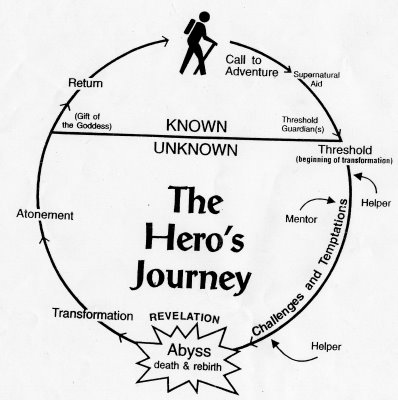
        As we explore each of the 17 aspects of the Monomyth (aka: The Hero's Journey) as a tool for DM's, we will use a four-fold approach: First, a brief description and elaboration of the aspect; Second, some examples taken from some of the most well-known and seminal works of adventure fiction - The Hobbit and Lord of the Rings by J.R.R. Tolkien, Star Wars (Episodes 4-6) by He Who Shall Not be Named, and perhaps a few random others as they apply; Third, we will explore how the aspect is used in RPG's and (hopefully) how it might be better implemented; Fourth and finally, some questions to get the gears turning.

        The Call to Adventure

        Arguably the most important aspect of the monomyth - and one that could generate a whole series of posts on it's own - the call is what pulls an individual into the adventure. The call comes to a protagonist while they exist in a state of familiarity and relative comfort and, through enticement or possibly even brute force, compels them to venture beyond it. The sense of contentment a hero may have has now been relocated - often geographically, but the shift might also be emotional, philosophical, mental, otherwise and/or some combination thereof - and must be found. As Campbell writes, "The hero can go forth of his own volition to accomplish the adventure . . . or he may be carried or sent abroad by some benign or malignant agent. The adventure may begin as a mere blunder ... or still again, one may be only casually strolling when some passing phenomenon catches the wandering eye and lures one away from the frequented paths of man."

        Examples of The Call

        In The Hobbit, Bilbo is swept into his adventure when Gandalf knocks on Bilbo's door and has him host a group of dwarves. Years later, his nephew, the easy-going Frodo, is also told to pack up and hit the road by Gandalf after the One Ring is left in his possession. Both Baggins enjoyed daydreaming about adventure, but were fairly content living in the Shire. Had Gandalf not held such influence over them, they likely would not have pursued their destinies in the larger world.

        Sheltered, teen-aged moisture farmer Luke Skywalker stumbles upon a hidden recording in a dusty R2 unit he is cleaning which gets him thinking about the larger galaxy, though his uncle attempts to quickly put an end to the matter. It's not until the little droid takes it upon itself to seek out the intended recipient of the message, however, that he is compelled to act. In fact, the case could be made that Luke, who was simply trying to retrieve some lost property, was railroaded into his adventure.

        Harry Potter has probably the easiest, most welcome call to adventure of all. He's stuck in a miserable existence with an Aunt and Uncle who are, at best, negligent - but more often than not, downright abusive, when his call to adventure comes pouring through every opening in the house and eventually, literally bursts through the door in the massive form of Hagrid. If anything, Harry's call comes as a huge relief and a release from what was, to that point, a meaningless, dreadful existence.

        The Call as a DM Tool

        Since the inception of role playing games, developers and game masters have been thinking of ways to engage - or 'hook' - their players and get them motivated at the prospect of putting their PC's in harm's way. When the PC's are just starting out on the adventuresome path, these hooks usually seem to boil down to three basic motivators: destiny, revenge, and boredom. Once the PC's have an adventure or two under their enchanted belts, simple greed can be added to the list, be it for money, magic, or experience points.

        It is a generally accepted belief that any hook or call that relates in some personal way to a PC or group of PC's is better than having them approached by a random stranger in a tavern looking for some hack-happy handyman to rid her garden of dire bunnies. A problem arises, however, when a DM tries to make every problem in the campaign world revolve around the PC's. Before long, every time the heroes came into the town, the populate would either run from them in fear or mob up and lynch them for the calamity their existence was wreaking.

        Thus, the challenge for the architect of an adventure or campaign is in finding or creating hooks that are meaningful and provocative to the PC's, while not necessarily revolving around or focusing specifically on them.

        Pondering The Call
        • Campbell mentions that in some instances a hero stumbles across an opportunity or call that has nothing to do with them. How do you think your players would react in that situation?
        • What if the decision to answer the call was not an easy one to make? If the heroes risked more by undertaking an adventure than by avoiding it, would they still accept the call?
        • If an antagonist attempted to intercept or block the call from reaching the heroes, what would happen? Is there more than one way the same call could be sent?
        • What if the heroes received two different calls to action from two opposing influences? How might their choice shape the rest of their adventure/life?
        • How would adding a time element - an expiration, if you will - to the call affect the PC's perception of it? Would they be more or less likely to react if they knew a window of opportunity was going to close?

        Thursday, April 8, 2010

        DnD: The Monomyth as a DM Tool - Intro

        Newbiedm made a blog post about a book titled The 36 Dramatic Situations by Georges Polti as a source of inspiration for DM's in need of adventure ideas. Looking over this excellent resource got me thinking about another writing resource that might provide some creative direction for DM's - the concept of the monomyth, as described by Joseph Cambell in The Hero with a Thousand Faces.

        Basically the monomyth structure begins with the hero - or heroes, as is more appropriate in a RPG context - living a normal life in what they recognize as the ordinary world, when they receive a call to enter the unknown, face trials and challenges, and then return with something they've gained along the way, using it to improve the world they left behind upon their return.

        Campbell defined 17 stages of the journey, but it is important to note that not every journey has all 17 steps. In fact, some popular myths are only concerned with one or two of the stages while others deal with them in a different order.

        What a DM needs to take from this is that the monomyth is a flexible concept - it can and should be altered as needed, rather than being treated as a rigid framework for creating campaigns and/or adventures.

        Here is a short list of the 17 stages that comprise the Hero's Journey:

        • Departure
          • The Call
          • Refusing the Call
          • Supernatural Aid
          • Crossing the Threshold
          • Belly of the Whale
        • Initiation
          • Road of Trials
          • Meeting the Goddess
          • The Temptress
          • Atonement w/Father
          • Apotheosis
          • The Ultimate Boon
        • Return
          • Refusing to Return
          • Magic Flight
          • Rescue from Without
          • Crossing the Threshold
          • Master of Two Worlds
          • Freedom to Live
        Over the next several posts, we will be looking at the three sections in more detail, and how each the 17 stages of the journey might contribute to the creation of a compelling role-playing experience it the scope of an adventure or campaign.

        Saturday, June 13, 2009

        40K: Vacation Photos as Inspiration . . . I hope

        We interrupt this lull for a post!

        This week we did a lot of traveling through Baltimore's Inner Harbor, Wilmington Delaware, and lower New Jersey (ugh, see below). One of the sights of the Inner Harbor was the USS Torsk, a WWII submarine that is now on display to the public. I took a bunch of pictures of the interior in the hopes of finding something inspiring that I might (at some point) be able to use for 40K. More to come as I get them uploaded.