Wednesday, May 19, 2010

DnD: Monomyth as a DM Tool - Part 7: Meeting the Goddess

Have you ever wondered why action and comic-book movies often include a love interest? It is generally accepted that the inclusion of a sympathetic female character will make the movie more appealing, and thus more marketable, to what would otherwise be a product that caters to only a portion of the movie-going public.  According to Campbell, however, there may be more to the protagonists' ever-present love interest than we realize:

"The ultimate adventure, when all the barriers and ogres have been overcome, is commonly represented as a mystical marriage of the triumphant hero-soul with the Queen Goddess of the World. This is the crisis at the nadir, the zenith, or at the uttermost edge of the earth, at the central point of the cosmos, in the tabernacle of the temple, or within the darkness of the deepest chamber of the heart. The meeting with the goddess (who is incarnate in every woman) is the final test of the talent of the hero to win the boon of love, which is life itself enjoyed as the encasement of eternity. And when the adventurer, in this context, is not a youth but a maid, she is the one who, by her qualities, her beauty, or her yearning, is fit to become the consort of an immortal. Then the heavenly husband descends to her and conducts her to his bed – whether she will or not. And if she has shunned him, the scales fall from her eyes; if she has sought him, her desire finds its peace."

Clearly, there is some emptiness or missing part of the hero that only this embodiment, often present albeit overlooked until late in the journey, can fill. Once that emptiness is realized, to continue to live without it is to exist in a state akin to anguish or yearning.


Examples of the Goddess

Over the course of Tolkien's Lord of the Rings, Gimli fell head over heels for the immortal Galadriel - probably the closest manifestation of a literal goddess I can think of - though the dwarf's relationship was strictly a chivalrous one (eg: loving from afar); Eowyn and Faramir, both of whom could be considered heroes of their own journeys, met and fell in love as they recovered from their injuries; and Sam, finally finding the courage within himself after facing many trials and terrors, married Rosie Cotton.  Aragorn and Arwen would also fall into this category, though they had met and started a relationship before the events recorded in the triliogy.  An important detail of this final example being the relinquishing immortality by the goddess-figure in order to grow old and die with her husband (one year after his death, specifically).

In the Underworld Trilogy, Selene, the vampire protagonist, falls for Michael Corvin.  Initially a 'normal' human, Michael undergoes a transformation into a powerful lycan/vampire hybrid and (using Campbell's lens) Selene becomes his consort.

On a much lighter note, the premises of the classic TV shows Bewitched and I Dream of Jeannie are a cross between this concept and classic juvenile wish-fulfillment. The movies Splash, Enchanted and My Super Ex-Girlfriend offer big-screen equivalents (though I cannot in good conscience recommend watching the later).

Meeting the Goddess as a DM Tool

So how does Meeting the Goddess work in a group-based context? I will confess that I have struggled with this stage of the Hero's Journey. The simplest answer is: it doesn't work; at least, not in the way it is presented. However, if we add a layer of abstraction, it is possible to change the love that a hero is able to win from the goddess into the unexplainable attraction the NPC's have for the PC's.  It is that attraction and affection for the heroes that compels NPC's to offer up any and all assistance in their efforts to rid the land of a threat, despite barely knowing them. There is something the heroes must do or become, but without the assistance of the NPC, they are hopelessly stuck.

The divine aspect, then, becomes the knowledge held by the DM guiding the words and actions of the NPC's in their interactions with the group - occasionally to harrass, but more commonly to help.

While it is certainly not required to play a game, for a more immersive role playing environment that fosters true in-character interactions, a DM should seriously consider, before using Random-Guy-on-the-Street #1 to divulge the secret location of the lich's phylactry, what (if anything) a given NPC knows about:
  • this rag-tag band of adventurers who have just blown into town from who-knows-where
  • the mission the PC's are trying to accomplish, and how they might be successful
  • the villain(s) the PC's are working against - their plans, motivations, history, and/or weaknesses
A tool such as the Johari Window can be very useful for keeping track of this information.

Aside from what a NPC knows, the DM should consider how the NPC feels about the heroes, the villain(s), their current setting, even themselves. A self-loathing NPC might be just as happy seeing the town wiped out, and himself along with it.

Pondering the Goddess
  • What roles do NPC's play in your PC's lives?
  • Is the manner in which a NPC obtains the knowledge and/or equipment they provide important? Why or why not?
  • Do you think a campaign can be just as engaging and enjoyable without any NPC interaction? Why or why not?
  • What, if anything, can a NPC provide for a PC (or group of PC's) that they cannot provide for themselves?
  • How might including a non-PC love interest for one or more of your players have an impact on the campaign?
Earlier Entries in This Series
Introduction
Stage I: Departure
Stage II: Initiation

    Wednesday, May 12, 2010

    DnD: Monomyth as a DM Tool - Part 6: Road of Trials

    The Road of Trials is when the strange new world that exists beyond the Threshold really comes alive for the adventurer. Enemies and obstacles are encountered and the hero must make use of the training, advice and talismans provided by the Supernatural Helper(s).  This is also the stage in which hero begins to see the results of the transformation that began in the Belly of the Whale.

    It is important to point out that the trials on the road tend to come in sets of three. There is a significance to the number three that is easy to overlook, by both the hero actively faced with the challenges and by us in our roles as spectators.  The number three represents completeness:
    • The simplest meaningful geometric shape requires three lines
    • Three dimensions are required to form a solid shape; 2 being the symbol of the flat square vs 3 as the symbol of the cube (x2 vs. x3)
    • There are three great divisions to a temporal existence - past, present, and future
    • Thought, word, and deed, complete the sum of human capability
    • God is defined as having three attributes: omniscience (all-knowing), omnipresence (all-present), omnipotence (all-powerful)
    • The Godhead - also known as the Trinity - is formed of three entities: The Father (God), The Son (Jesus), and the Holy Spirit
    • Three persons, in grammar, express and include all the relationships of mankind
    Many other examples can be found here.

    Campbell writes: "Having traversed the threshold, the hero moves in a dream landscape of curiously fluid, ambiguous forms, where he must survive a succession of trials. This is a favorite phase of the myth-adventure. It has produced a world literature of miraculous tests and ordeals. The hero is covertly aided by the advice, amulets, and secret agents of the supernatural helper whom he met before his entrance into this region. Or it may be that he here discovers for the first time that there is a benign power everywhere supporting him in his superhuman passage. The original departure into the land of trials represented only the beginning of the long and really perilous path of initiatory conquests and moments of illumination. Dragons have now to be slain and surprising barriers passed – again, again, and again. Meanwhile there will be a multitude of preliminary victories, unretainable ecstasies and momentary glimpses of the wonderful land."

    Examples of the Road of Trials

    It can be difficult to identify precisely when the Road of Trials begins and ends in a journey.  Indeed, the entire adventure can often be seen as a continuous series of trials that overlaps and bleeds into the other stages of the journey.  For these examples, we shall focus on those instances where a trial or obstacles occurs in a set of three; Fairy Tales and fables are particularly rich in this regard.

    During the course of his adventure to destroy the One Ring, Frodo was constantly in danger, but found himself very nearly killed on three occasions: After being stabbed by the Witch-king of Angmar at Weathertop, getting skewered by the cave troll in Balin's Tomb (Moria), and being stung by the vile Shelob in the pass of Cirith Ungol.  Each time, he was saved by the works and gifts of those around him: Aragon's medicinal knowledge and Elrond's magic; Bilbo's Mithril shirt; Sting (another gift from Bilbo) and the Light of Earendil, both which were wielded by Sam.

    In the original telling of Jack and the Beanstalk (not to be confused with Jack the Giant Killer), the protagonist climbs the beanstalk three times, eludes capture with help from the giant's wife and comes away first with a bag of gold, then with a hen that laid golden eggs, and finally with a magical harp - killing the giant owner of the house during his final visit to keep the source of his new-found wealth a secret. Jack's distinction as the 'hero' of the tale was questionable at best, and the tale was retold by Bejamin Tabart in 1807 with a moralistic bent by turning the giant into a thief and murder, thus justifying his slaying.

    Red Riding Hood notices three features about her grandmother (eyes, ears, teeth) that are not quite right.

    The evil dwarf Rumpelstiltskin gives the queen three days to discover his name, lest he steal away her first born.

    In Monty Python's classic skewering of the Arthurian legend, the king and his knights must answer three questions to cross a bridge.

    During his time fasting in the wilderness, Jesus was tempted three times by Satan.

    The Road of Trials as a DM Tool

    In the context of gaming, especially video gaming, the vast majority of an adventure will be spent on the Road of Trials.  The obstacles encountered along the road, usually in the form of battles and/or puzzles, are often the only time the player is actually given full control of his character and made responsible for overcoming them.  In video games the other stages of the journey, which are more concerned with character development - such as The Call or the Belly of the Whale - are often glossed over in the form of cut-scenes or annoying run-on dialog that drive impatient players to continually mash a button until they can get back to the excitement of battles and party/inventory management.

    But what does the Road of Trials look like for a traditional pen-and-paper RPG player?  At it's worst, it is merely a grind - a series of combat and skill encounters whose sole purpose is to gain XP and has little, if anything, to do with story. The canny DM will, however, use every encounter as an opportunity for a PC to discover something about themselves.  Perhaps that discovery is simply a new power or ability - or perhaps a new way to use an existing power/ability.


    Terrain and dialog can and should be implemented to drive players towards a new level of understanding and competence and drive the story forward.  Even a seemingly random encounter might have some small clue embedded in it that speaks to one player - or perhaps even the party as a whole. Examples might include a bookshelf that gets knocked over, conveniently scattering some important maps or manuscripts on the floor; a foe who whispers the name of his master as he dies; an oddly colored fire that does not burn when someone is shoved into it, but freezes instead; a ghost that constantly repeats a question or phrase over and over as it harasses the PC's - or perhaps only a particular member of the party.

    In a larger sense, each of the trial-encounters along the Road could represent a different aspect of the party's journey.  For example, battling a group of undead clad in the livery of a PC's homeland might represent a break from a past life that was going nowhere. The following encounter might involve a rival group of adventurers, vying for the same prize/glory as the PC's as a reflection of themselves.  Finally, this particular road concludes with a battle against a meglomaniacal demi-god - a former adventurer who gained great power and lost his mind - as a warning of things to come should the PC's fail to stay grounded and humble.

    Pondering the Road of Trials
    • Can a groups' Road of Trials ever be as engaging and meaningful as that of an individual? Why or why not?
    • Do you think a PC/group can experience more than one Road of Trials at a time? Consider the pros and cons.
    • Does the Road of Trials gain or lose effectiveness if the number of encounters deviates from three? Why or why not?
    • Consider this statement: Any encounter that does not advance the story in some way is a waste of time.  Do you agree? Why or why not?
    • Consider this statement: Combat, while exciting, is generally not meaningful; Vice versa for skill challenges. Do you agree? Why or why not?
    • How does your stance on the previous two statements affect how you build an encounter or set of encounters?
    Earlier Entries in This Series

    Introduction
    Stage I: Departure
    Part 1: The Call
    Part 2: Refusing the Call
    Part 3: Supernatural Aid
    Part 4: Crossing the Threshold
    Part 5: Belly of the Whale

    Friday, May 7, 2010

    40K: Spreadsheet Template for Codex: Orks

    I'm done with Army Builder.  I continued to use version 2.2 for my Dark Eldar army lists as long as I could, but now that the new codex has been announced, I no longer need it.  And, thanks to their asinine licensing scheme, I no longer want anything to do with the software.

    Unfortunately, there are no really good open-source alternatives out there for generating an army list.  Until there is (don't look at me, I've got enough on my plate to last me a pretty good while), I have decided to put my 5th edition codices into a spreadsheet.

    Using Open Office, I've developed a template that will accommodate the entire army list - including weapons, wargear, and rules (complete with page numbers).  The goal was to find a way to represent as much, if not more, data than Army Builder provided.  Additionally, I wanted to try and get the entire list on a single sheet of paper - stats and point costs on one side, wargear and rules on the other.


    The Wargear and Special Rules use a simple code reference system to save space.  It's not quite as useful as actually having it spelled out for you on the paper, but I'm of the opinion that it's more for a opponent's reference, since a player should already know what special rules affect his army.


    The first list to be finished are the Orks. I will make this template available with as much information as I can legally include. Stats, details and point costs will have to be filled out on your own.  The vast majority of the work was in getting developing the layout, though, so entering numbers goes pretty quickly. 

    Give it a whirl and let me know if it works as a tool for army building, if there are any errors I missed, or what changes might enhance its usefulness. Enjoy!

    Codex: Orks Template (Mediafire, .ods)

    Next up: Blood Angels! (nearly finished)

    UPDATE (6-3-10): I made some additions and format changes to the spreadsheet - mainly to the Reference page. Calling it version 1.3

    Tuesday, May 4, 2010

    Misc: A Brief High Ate Us

    +1 Internets if you get the reference.  Also, you have excellent taste in literature.

    In an attempt to avoid burning myself (and you) out on the Monomyth series, I'm taking a little break before starting on the next block of entries.  I had hoped to have something to fill the gap, but collaborative schedules rarely work out so conveniently.

    At any rate, so you won't think I'm a lazy slacker, here's what's going on at Kingworks Creative (aka: the time in the evening after the kids go to bed and my own bedtime):

    Art
    • I finished a cover piece and an encounter map for the next Nevermet Press release, due later this month, IIRC. (Once NMP officially shows the cover, I will post them here).
    • Another drawing and a digital painting for two NMP settings are about half done. Not for anything in particular, just wanted to do them. 
    DnD
    • Remember the card game I was working on?  I started the third one, but the design has been frustrating me, so I set it aside. Counting it, there are 2.5 cards left to finish, as well as the design for the back.
    • I have an idea for what I think could be a cool encounter, but it's in the early stages and needs some work.
    40k
    • The release of the Codex: Blood Angels has me revamping my army.  I'm currently converting half-finished Tactical Marines into Assault Marines, putting magnets in Sergeants and special weapons Marines.
    • Building a kustom Ork Trukk based on Dave Taylor's excellent tutorial.
    • At least one mob of Slugga Boyz and some Nobz waiting on a final pass of highlights and an ink wash.
    Misc
    • In an effort to save money on the house we're building, I've been looking for things I can do myself to save money.  Thus far, I've only sealed windows, doors & wall seams. Soon, however, I will be putting down tile and hardwood flooring; after that, we'll be seeding the grass and landscaping ourselves.  Then taking a break to save up again in order to add a deck and finish the basement.
    • I've been working through Foundation Game Design with Flash a little bit each day (or week, if I was being completely honest) and it's got me thinking that I just might be able to finish that 40k Flash game after all.  No time soon, unfortunately.  I also need to look into the legality of making a free Flash game based on an established IP. I don't think 'homage' is going to cut it - GW's legal dept. can be pretty ruthless. I may need to make it a parody . . .
    • One of my freelance clients has been emailing me about doing an update on his website.  I'm expecting the files any day now.
    I'm sure there are some other things going on, but that's all I can think of right now. Cheers!

    Wednesday, April 28, 2010

    DnD: Monomyth as a DM Tool - Part 5: Belly of the Whale

    Here now, we have arrived at the final step in the Departure stage of the Hero's Journey.  The call was received, refused at first, supernatural aid sought and provided, and the threshold into the unknown was crossed. The hero now finds herself in the belly of the whale, completing the separation from a world and/or an existence she was familiar - possibly even comfortable - with by undergoing a personal metamorphosis.  Old ways of thinking and doing must be put aside, as they cannot carry the hero past the trials to come.  New paradigms, of natures both physical and mental, are introduced to the hero and must be mastered if she is to have a hope of surviving what lies ahead.


    Campbell writes that the hero's passage into this stage of the journey can often be mistaken by the casual observer as defeat: "The hero, instead of conquering or conciliating the power of the threshold, is swallowed into the unknown and would appear to have died. This popular motif gives emphasis to the lesson that the passage of the threshold is a form of self-annihilation. Instead of passing outward, beyond the confines of the visible world, the hero goes inward, to be born again. The disappearance corresponds to the passing of a worshipper into a temple – where he is to be quickened by the recollection of who and what he is, namely dust and ashes unless immortal. The temple interior, the belly of the whale, and the heavenly land beyond, above, and below the confines of the world, are one and the same. . . The devotee at the moment of entry into a temple undergoes a metamorphosis. Once inside he may be said to have died to time and returned to the World Womb, the World Navel, the Earthly Paradise. Allegorically, then, the passage into a temple and the hero-dive through the jaws of the whale are identical adventures, both denoting in picture language, the life-centering, life-renewing act."" 

    Examples of the Whale's Belly

    The quintessential example of the Whale's Belly comes from the Biblical story of Jonah. Commanded by God to preach to the city of Nineveh, the prophet Jonah instead ran the other direction, boarding a ship sailing for Tarshish. Along the way, a great storm blew up and threatened the ship. Jonah was revealed as the source of the calamity when the sailors cast lots to discover who among them had incurred the wrath of the gods. Accepting responsibility and seeking to spare the ship, Jonah had the sailors throw him overboard, where he was swallowed whole by a great fish, almost always visualized as a whale. He remained in the fish for three days and three nights, praying to God.  Finally, Jonah was vomited onto dry land and, when commanded by God to go to Nineveh a second time, did not delay. The city, destined for destruction due to their evil ways, repented as was spared.

    Luke Skywalker's metamorphosis experience is stretched across one movie, and nearly into a second. Over the course of Empire Strikes Back, shortly after being - quite literally - stuffed inside a Tautaun's belly (womb allegory), he heads to swampy Dagobah to train with Yoda, who lives in a cramped little hut (another womb).  It is here that he truly sees for the first time what the Force is capable of.  It is also during this training that he has a disturbing vision in a cave (yet another womb allegory) about what could happen if he failed to resist the lure of the Dark Side.  By the end of Empire Strikes Back, Luke's metamorphosis has taken on a physical aspect in the hand that is lost and subsequently replaced.  The changes and growth he experiences during the course of this movie carry him into the period between the fifth and sixth chapters, during which he becomes a full-fledged Jedi.

    Despite several close calls with the Nazgul, who appear as nightmares given form to the diminutive hobbits, it is within the mines of Moria that the Frodo, Sam, Merry, and especially Pippin have a transformative experience.  As they pass through the depths of the mountains, they find themselves for the first time face-to-face with goblins (subterranian orcs), a troll and (most terrifying of all) a Balrog - all due to Pippin's carelessness in Balin's Tomb.  This is the first encounter where the hobbits must hold their own, along with their more traditionally heroic companions, lest they be overwhelmed - there would be no last-minute rescue for them as their was with Old Man Willow and on Weathertop.  Eventually, the group escapes, but not before the harsh reality of their situation is made all too clear with the loss of Gandalf.  The movie, specifically, Billy Boyd's portrayal of a guilt-ridden Pippin as the fellowship succumbs to exhaustion and anguish by the Dimrill (East) Gate.

    In the first act of Christopher Nolan's excellent Batman Begins, Bruce Wayne makes his way to the League of Shadows' compound in the mountains of Tibet.  There he undergoes intense martial and psychological training in order to, as Liam Neeson's character put it, "make yourself more than just a man, devote yourself to an ideal, and if they can't stop you, then you become something else entirely . . . A legend."


    Belly of the Whale as a DM Tool

    DM's (or should I be using GM's instead?) regularly make use of this concept, though probably not in such a formal, recognizable manner. Basically, any time the PC's must acquire crucial knowledge and/or abilities in order to complete a task deemed by the common folk to be impossible, the Belly of the Whale comes into play. Their time in the Belly-setting answers the where and how questions about what the PC's need to accomplish in order to be victorious.

    There a couple of common temptations that a DM faces during this stage: First, glossing over the metamorphosis experience - making it happen instantaneously, thereby robbing it of meaning; and, second, requiring the PC's to grind until they have accumulated enough of a resource (gold, XP, specific dropped items) as a symbol of their completion of the metamorphosis process.  This second scenario is particularly frustrating because it assumes that by doing the same thing over and over again, the protagonists have somehow matured or mastered a new way of thinking/fighting - when the reality is that they have simply gotten better at doing the same thing over and over again.

    Setting is important to the metamorphosis, there is something unique about it that is crucial to the changes that need to occur before the PC's can hope to overcome the trials ahead. It makes sense, then, that there is also something repulsive about the location or the process related to the metamorphosis that deters just anyone from pursuing it - perhaps it is in a location that is dangerous to reach, or the metamorphosis process is a painful - even potentially deadly - experience.  Perhaps there is a characteristic about those who have completed the change that is perceived, fairly or unfairly, as unsettling or even dangerous. The concept of a reviled savior is an interesting one and holds a lot of potential for true role playing.

    Pondering the Belly of the Whale
    • What sort of settings do you envision when you think about undergoing a change or experience growth?
    • Is the change that occurs in the Belly of the Whale permanent or temporary? Why?
    • Do you tend to think of the metamorphosis process as being a result primarily of external or internal forces?
    • Can a hero be committed to vanquishing the dragon, but hesitant about what must be done to accomplish such a task? Why or why not?
    • Should a metamorphosis be specific to a single quest? Do relying on a specific change across multiple adventures 'cheapen' it? Why or why not?

    Friday, April 23, 2010

    DnD: Monomyth as a DM Tool, Part 4 - Crossing the Threshold

    A journey of a thousand miles begins with a single step. - Lao-Tzu, Chinese philosopher (604 BC - 531 BC)

    It's a dangerous business, Frodo, going out of your door. You step into the Road, and if you don't keep your feet, there is no knowing where you might be swept off to. - Bilbo Baggins

    Having committed himself to the journey (willingly or otherwise), finding his mentor-guide(s) - or, as Campbell refers to them, "the personifications of his destiny to guide and aid him" - and equipping himself as best he can, the hero stands at the boundary of the world he has known and accepted for so long.  Taking a deep breath, the hero opens the gate and steps across into the unknown.  Campbell also makes mention of a 'threshold guardian' who stands between the hero and this new realm of being and magnified power.  This guardian does not always take an expected form, as do the mythological Cerberus or the castle guardians from Neil Gaiman's excellent Sandman series, but might appear as a friends or loved ones who discourage the hero and must be bypassed in some way before the journey can truly begin.

    Examples of the Threshold

    Samwise Gamgee, in Peter Jackson's LOTR movies says to Frodo, "If I take one more step, it'll be the furthest from home I've ever been."  There is not really a threshold guardian present (though one could say, symbolically, the scarecrow in the background fills the roll as a silent sentinel), but they do have their very first close encounter with the Nazgul shortly beyond that point.  At least one commentator suggests that the Hobbits' encounter with Old Man Willow - where they first come to harm (albeit minor) and must be rescued by Tom Bombadil - is the true threshold experience for the protagonist(s).

    Luke Skywalker trades the known dangers of the Tatooine wasteland for the unknown dangers of the Mos Eisley spaceport, particularly the rough-and-tumble cantina, where his adventure is very nearly cut short before it ever gets off the ground (pardon the pun).  At the time of Luke's arrival, it is being patrolled by Stormtroopers, who attempt to apprehend the group.

    In Stardust (another Gaiman creation), there is a very clear demarcation in the old stone wall that borders the protagonist's village.  An opening in the wall allows one to pass into the world of faerie, but it is stubbornly guarded by old man who takes his position as the keeper of the opening very seriously.

    The scientists who managed to get the Stargate working (in the original movie of the same name) had no clue what - if anything - lay on the otherside of the shimmering, undulating portal.

    Dorothy crosses two thresholds in the Wizard of Oz.  First there is the passage from consciousness into unconsciousness by way of the twister; shortly thereafter, she literally crosses the threshold of her mundane black-and-white existence into the color- and magic-filled realm of Oz.

    The Threshold as a DM Tool

    For a DM, crossing the threshold may impact a game on several different levels.  The first and most obvious being a threshold guardian that must be defeated, either by wits or brute force, before the party can continue their adventure.  Second, achieving a new level or tier acknowledges that the PC's have grown in some way and now have access to new powers and abilities with which to face the challenges ahead - which have also grown in difficulty. While the first two examples are fairly straightforward and go hand-in-hand with the basic mechanics of almost every role-playing system, a third instance - that of the symbolic threshold - is a bit more abstract and hard to define.  And yet, I would suggest that it holds the greatest potential of the three for creating a meaningful experience.

    Monsters and puzzles are external conflicts and often represent forces outside of a person to be overcome. These situations might be cast, rather simplistically, as Man vs. Nature, and Man vs. Man. What is left? Man vs. Himself.  The internal battles against doubts, fear, insecurity, and any number of personal shortcomings that we allow to tie us down and prevent us from achieving what Maslow referred to as 'self-actualization' are often some of the toughest battles a person will face in his or her lifetime. Compounding the issue is our inability to objectively handle and shape those feelings and understandings that shape our perception of the world around us.  In the real world, that is.  In the role-playing world, an able DM can construct situations that threaten from within, though doing so will require some preparation.

    Depending on how much information a DM requires of their PC's at the start of an adventure, and the player's willingness and/or ability to 'put on' their characters and truly role play their strengths and weaknesses, these threshold experiences contain a great deal of potential for the characters' - and possibly even their player's - personal growth. Consider a player who is deathly afraid of spiders (a common fear) who must descend into a lair full of them to save a child.  Or a PC consumed with revenge who attempts to convince a king to forgive a slight, lest war claim thousands of innocent lives. Perhaps there is an accomplished thief who has something precious stolen from him.  These are not thresholds in a physical sense, but can serve as symbolic threshold experiences that, once overcome, empower the PC in some personal way.

    Rewards for overcoming or passing a threshold may be many and varied, ranging from a simple bonus to skill checks or attacks vs. a certain type of creature, or a better understanding of the skills, powers and abilities one possesses.  What if, though, by overcoming a threshold challenge, a player arrives at a deeper understanding of her own motivations or behaviors?  A bit far-fetched, perhaps, but not outside the realm of possibility.


    Pondering the Threshold
    • What, if any, personal obstacles have your PC's had to overcome?
    • Do you think overcoming a physical threshold guardian can be as meaningful a overcoming a symbolic one? Why or why not?
    • Is it possible for PC's to have a meaningful threshold experience as a group? Why or why not?
    • Do you ever include elements from your players' real lives into your adventure/campaign? What forms or roles do these real-world elements take in the game?
    • Have you ever had your real-world perceptions altered by a work of fiction?  Do you think that your adventure/campaign holds the same potential? Why or why not?

    Tuesday, April 20, 2010

    DnD: Monomyth as a DM Tool - Part 3: Supernatural Aid

    Once the hero - by hook or by crook, consciously or unconsciously - begins to undertake his quest in earnest, they usually do not have to wait very long before a guide or magical helper of some sort is introduced into the story. The arrival of supernatural aid in fantasy literature is such a common occurrence that fans of the genre are generally more surprised when it does not occur. Consequently, the event is often taken for granted and treated as little more than a plot device - a means by which the hero obtains possession of some trinket or knowledge they would (or could) not gain on their own.

    Campbell, however, proposes that there exists a deeper significance in role played by this mystical, mysterious mentor. "For those who have not refused the call, the first encounter of the hero journey is with a protective figure (often a little old crone or old man) who provides the adventurer with amulets against the dragon forces he is about to pass. What such a figure represents is the benign, protecting power of destiny. The fantasy is a reassurance - a promise that the peace of Paradise, which was known first within the mother womb, is not to be lost; that is supports the present and stands in the future as well as in the past (is omega as well as alpha); that though omnipotence may seem to be endangered by the threshold passages and life awakenings, protective power is always and ever present within or just behind the unfamiliar features of the world. One has only to know and trust, and the ageless guardians will appear."

    Pardon me while I drag out my soap box, but there were some terms in that description that should really jump out to anyone with a Bible-based Christian upbringing: alpha and omega, omnipotence, always and ever present, trust, the mention of an antagonistic dragon and the persistence/restoration of Paradise. It sounds like Campbell is equating his supernatural helper with God. Whether this is a direct manifestation or an agent acting on behalf of the divine is up for speculation, though some hints are likely to be found in the source material.

    Examples of Supernatural Aid

    In Tolkien's Ring's Trilogy, Gandalf metamorphoses before Frodo's eyes from a wizened old conjurer to a mighty wizard, mentor, and protector. He identifies the One Ring the Bilbo left to Frodo (which, I'll admit, is not exactly the same as giving it to him), guides and protects the Fellowship from a demon in the darkness and death of Moria ("I am a servant of the Secret Fire . . ."; flame ~> Holy Spirit -> God), returns from the dead (!), arrives just in time to save Rohan at Helm's Deep, bolsters and leads the forces of Gondor until Aragorn can arrive with even more supernatural reinforcements, and flies into Mordor on Gwaihir to rescue Frodo and Sam.

    In Star Wars Episode 4, Obi-Won Kenobi arrives just in time to save Luke from the Sand Raiders, gives him his first lightsaber (soooo jealous) and introduces him to The Force. Later, he sacrifices himself against the embodiment of a fallen nature in the form of Darth Vader. Even after dying, Obi-Won provides reassurance and guidance to Luke.

    Despite the confusion and many varied accounts of the legend of King Arthur, the half-human, half-demon Merlin figures prominently in almost all of them. The famous wizard engineers the famous king's birth through magic and intrigue, provides advice, and leads him (at varying points and in varying ways) into possession of the mighty Excalibur.

    Held by a rash promise to present the head of Medusa as a wedding gift, Perseus is instructed by Athena to find the Hesperides and obtain the magical items he will need to overcome the Gorgon. The goddess herself, who cursed Medusa in the first place, provides the hero with a polished shield which plays an important part in the tale, popularized first by the campy 80's movie and again by the 2010 remake.

    Pretty much any occurrence of a hero being given or directed to find 'The [blank] of [blank]' is a pretty good indicator that supernatural aid is being given.

    Supernatural Aid as a DM Tool

    Providing unexpected help in the form of a mysterious NPC is pretty much right up the DM's alley. It's hard to envision a campaign, or even an adventure, in which the party does not get some form of advice, guidance, direction, help, equipment, missing spell component, etc. from a stranger with some uncanny insight and/or understanding of the situation. Video RPG's, in particular, rely on these figures to give the players momentum and keep the story moving forward. The trick, then, is not so much knowing how to use Supernatural Aid, but doing so in an engaging, meaningful way.

    Can you remember the first time you saw Star Wars, or read Fellowship? Can you remember how you felt when Obi-Won powered down his lightsaber or Gandalf fell from the bridge of Khazad-Dum? The main characters had developed a strong attachment to these mentor-guides by this point - their comforting presence having given direction and meaning and excitement to an otherwise ordinary and rather dull existence. The protagonists had come to rely on these figures and were expecting them to be present for the duration of the adventure.

    Now, stripped of this important relationship, the heroes are made suddenly aware of the dangers of the fantastic world in which they find themselves, and the frailty of (demi-)human existence. If the protagonists had simply been simply been using the mentor-guide as a resource, having no more connection to them than they might some impersonal macguffin found lying on the side of the road, then the loss would have little or no meaning and the journey would remain much less personal. Additionally, the continued presence of a powerful, otherworldly ally puts the protagonists at risk for relying on them too heavily for the duration of their journey. Any personal growth the heroes might experience becomes stunted as they take for granted the achievements made with the assistance of another, and the adventure as a whole is cheapened.

    Consider one additional feature of the mentor-guide NPC: A party can pretty much hack-and-slash its way through an adventure without having to speak to any NPC's - often times, just seeing a group of monsters or the entrance to a lair of some sort in more than enough motivation. But, when presented with a situation that cannot be overcome by the (often considerable) power wielded by the heroes, there will be at least one NPC with which they could/should have a social (in-character?) interaction.

    Pondering Supernatural Aid
    • Does it make sense to have a mentor-guide for the duration of an adventure? A campaign? Why or why not?

    • What are some ways you can cultivate a meaningful relationship between your PC's and their mentor-guide?

    • Is the loss of a mentor-guide more meaningful when it occurs at the hands of a villain, or when they must be abandoned/sacrificed by the PC's?

    • What if the role of the mentor-guide was split among several NPC's? What if there were conflict or opposing goals among them?

    • Can you think of an example (games, movies, RPG's, etc.) of a mentor-guide turning into an antagonist? How did such a turn affect the overall experience for you as a viewer/player?
    Other posts in this series
    Introduction
    Part 1 - The Call
    Part 2 - Refusing the Call

    Thursday, April 15, 2010

    DnD: Monomyth as a DM Tool - Part 2: Refusing the Call

    In role playing, it is often taken for granted that the PC's are actively looking for an adventure to undertake. After all, if a person takes the time to roll up a fantastic character who will be living in a fantastic setting, it is generally understood that they'd would like to do something outside of what is legal (theft, killing) or possible (anything to do with magic) in this reality. Thus, the idea of a hero refusing the call to adventure may strike role players - both PC's and DM's alike - as rather odd and uncharacteristic. In mythology and popular fiction, however, it is a fairly common occurrence. Thoughts or feelings that lead to a hero's reluctance to pursue the call and remain in their current circumstances are varied: A sense of inadequacy or unworthiness; fear of the unknown; guilt at the thought of leaving someone/thing behind; an obligation or responsibility holding them back, etc.

    Whatever the reason, when a refusal occurs, the nature of the journey changes. As Campbell writes, "Refusal of the summons converts the adventure into its negative. Walled in boredom, hard work, or 'culture,' the subject loses the power of significant affirmative action and becomes a victim to be saved. His flowering world becomes a wasteland of dry stones and his life feels meaningless . . . All he can do is create new problems for himself and await the gradual approach of his disintegration."

    Examples of Refusal

    Frodo never flat out refused his call to adventure, but he did attempt to pass it off a several points - Gandalf, Guinevere, possibly at Rivendell when those gathered debated what should be done with the ring. During the course of his adventure, Frodo must be defended and rescued and has several narrow escapes from the Nazgul at Weathertop (though he is deeply wounded and scarred for life), the Goblins and Cave Troll in Moria, the Uruk-Hai at Amon Hen, Shelob in Cirith Ungol, and even from himself in the bowels of Mount Doom, where he loses a finger and is finally carried to safety by Gandalf astride Gwaihir. Since none of his offers to pass the ring off were accepted, it is up for debate as to cause of all Frodo's trials and suffering being the direct result of refusing the call.

    An indirect refusal occurs in Star Wars (Episode IV: A New Hope) when Luke asks his uncle, Owen Lars, about Obi-Wan Kenobi. Owen, keen to keep Luke away from the problems and strife that led to the ruin of his father, tell Luke that Obi-Wan is dead and that he should stay away from crazy "Old Ben" who lives in the wastes. A couple of scenes later, the last we see of Owen and his wife are a pair of charred skeletons lying among the remains of their raided moisture farm. Luke, who embraced his call to adventure with Obi-Wan, avoids the immediate repercussions of a refusal, but must now carry on with the pain of their loss brought on by their attempts to dissuade him.

    Nearly every Harry Potter book opens near the end of Harry's summer vacation with the Dursley's attempts to humiliate, hinder and/or discourage him from going back to Hogwarts. In every instance, some form of magical mischief overtakes them, providing a sense of karmic justice to their attempts to keep Harry from both his true nature and his destiny.

    Refusal as a DM Tool

    The reality of role playing is that the initial call to adventure has already been accepted when they decided to play and rolled up a character. Once that choice has been made, the rest of the experience is basically a series of choices about weather or not the PC should act. What a DM must consider is how far-reaching and personal the consequences the response to any given call is going to be.

    It may be hard to conceptualize a response that must come from the PC's as being a 'tool' that can be wielded by the DM. While we as builders of an adventure or campaign may not hold the right of refusal that belongs to our players, we can learn to anticipate and prepare for those instances when they chose not to accept the call we provide them with. In fact, the abilities and responsibilities invested in the DM are such that we are more than capable of arranging and adapting events in such a way the predisposes PC's to act a certain way. A popular piece of advice for DM's is to have a recurring villain, someone who shows up and causes havoc and suffering for the PC's until, at the climax of the adventure, the heroes are able finally able to corner the villain and exact their revenge. But, really, what is really happening here? With each appearance of the villain, the PC's are being conditioned to hate, and possibly, attack him on sight.

    What if the party surprises you and decides they would rather work with/for the villain, or try and help him reform (perhaps your players are into Restorative Justice)? More often then not, I'd wager that the DM does not give much thought to how the NPC's would react to this unexpected news, or what sort of encounters might occur as a result. It is important to understand that no one person could prepare for every potential nuance or variation along a theme. However, I propose that we can and should prepare ourselves - mentally, at least, if nothing else - for both positive (accepted) and negative (refused) responses to each call we present to our players.

    Pondering Refusal
    • If the party refused to act at any point, what would happen to the adventure? Would it be totally derailed, or could you adjust accordingly?
    • Can you remember and/or envision a time that you expected - or even preferred - your PC's to decline a call to action?
    • What happens if there is a division in the party? How might a DM use that to build a more engaging experience?
    • Party's are generally rewarded/punished as a group. What if this was dealt with on an individual basis based on their choices? Is such a thing feasible or would it simply come across as unfair?
    Earlier posts in this series

    Tuesday, April 13, 2010

    DnD: The Monomyth as a DM Tool, Part 1: The Call

    I had originally intended to present the parts of the Monomyth the three groups: Departure, Initiation, and Return. However, as I began writing the first entry, and writing it . . . and writing it, I decided that perhaps each step warranted its own post.

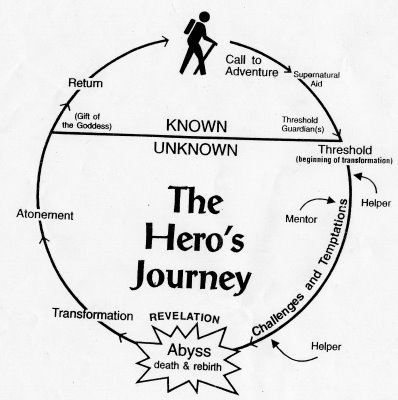
    As we explore each of the 17 aspects of the Monomyth (aka: The Hero's Journey) as a tool for DM's, we will use a four-fold approach: First, a brief description and elaboration of the aspect; Second, some examples taken from some of the most well-known and seminal works of adventure fiction - The Hobbit and Lord of the Rings by J.R.R. Tolkien, Star Wars (Episodes 4-6) by He Who Shall Not be Named, and perhaps a few random others as they apply; Third, we will explore how the aspect is used in RPG's and (hopefully) how it might be better implemented; Fourth and finally, some questions to get the gears turning.

    The Call to Adventure

    Arguably the most important aspect of the monomyth - and one that could generate a whole series of posts on it's own - the call is what pulls an individual into the adventure. The call comes to a protagonist while they exist in a state of familiarity and relative comfort and, through enticement or possibly even brute force, compels them to venture beyond it. The sense of contentment a hero may have has now been relocated - often geographically, but the shift might also be emotional, philosophical, mental, otherwise and/or some combination thereof - and must be found. As Campbell writes, "The hero can go forth of his own volition to accomplish the adventure . . . or he may be carried or sent abroad by some benign or malignant agent. The adventure may begin as a mere blunder ... or still again, one may be only casually strolling when some passing phenomenon catches the wandering eye and lures one away from the frequented paths of man."

    Examples of The Call

    In The Hobbit, Bilbo is swept into his adventure when Gandalf knocks on Bilbo's door and has him host a group of dwarves. Years later, his nephew, the easy-going Frodo, is also told to pack up and hit the road by Gandalf after the One Ring is left in his possession. Both Baggins enjoyed daydreaming about adventure, but were fairly content living in the Shire. Had Gandalf not held such influence over them, they likely would not have pursued their destinies in the larger world.

    Sheltered, teen-aged moisture farmer Luke Skywalker stumbles upon a hidden recording in a dusty R2 unit he is cleaning which gets him thinking about the larger galaxy, though his uncle attempts to quickly put an end to the matter. It's not until the little droid takes it upon itself to seek out the intended recipient of the message, however, that he is compelled to act. In fact, the case could be made that Luke, who was simply trying to retrieve some lost property, was railroaded into his adventure.

    Harry Potter has probably the easiest, most welcome call to adventure of all. He's stuck in a miserable existence with an Aunt and Uncle who are, at best, negligent - but more often than not, downright abusive, when his call to adventure comes pouring through every opening in the house and eventually, literally bursts through the door in the massive form of Hagrid. If anything, Harry's call comes as a huge relief and a release from what was, to that point, a meaningless, dreadful existence.

    The Call as a DM Tool

    Since the inception of role playing games, developers and game masters have been thinking of ways to engage - or 'hook' - their players and get them motivated at the prospect of putting their PC's in harm's way. When the PC's are just starting out on the adventuresome path, these hooks usually seem to boil down to three basic motivators: destiny, revenge, and boredom. Once the PC's have an adventure or two under their enchanted belts, simple greed can be added to the list, be it for money, magic, or experience points.

    It is a generally accepted belief that any hook or call that relates in some personal way to a PC or group of PC's is better than having them approached by a random stranger in a tavern looking for some hack-happy handyman to rid her garden of dire bunnies. A problem arises, however, when a DM tries to make every problem in the campaign world revolve around the PC's. Before long, every time the heroes came into the town, the populate would either run from them in fear or mob up and lynch them for the calamity their existence was wreaking.

    Thus, the challenge for the architect of an adventure or campaign is in finding or creating hooks that are meaningful and provocative to the PC's, while not necessarily revolving around or focusing specifically on them.

    Pondering The Call
    • Campbell mentions that in some instances a hero stumbles across an opportunity or call that has nothing to do with them. How do you think your players would react in that situation?
    • What if the decision to answer the call was not an easy one to make? If the heroes risked more by undertaking an adventure than by avoiding it, would they still accept the call?
    • If an antagonist attempted to intercept or block the call from reaching the heroes, what would happen? Is there more than one way the same call could be sent?
    • What if the heroes received two different calls to action from two opposing influences? How might their choice shape the rest of their adventure/life?
    • How would adding a time element - an expiration, if you will - to the call affect the PC's perception of it? Would they be more or less likely to react if they knew a window of opportunity was going to close?

    Thursday, April 8, 2010

    DnD: The Monomyth as a DM Tool - Intro

    Newbiedm made a blog post about a book titled The 36 Dramatic Situations by Georges Polti as a source of inspiration for DM's in need of adventure ideas. Looking over this excellent resource got me thinking about another writing resource that might provide some creative direction for DM's - the concept of the monomyth, as described by Joseph Cambell in The Hero with a Thousand Faces.

    Basically the monomyth structure begins with the hero - or heroes, as is more appropriate in a RPG context - living a normal life in what they recognize as the ordinary world, when they receive a call to enter the unknown, face trials and challenges, and then return with something they've gained along the way, using it to improve the world they left behind upon their return.

    Campbell defined 17 stages of the journey, but it is important to note that not every journey has all 17 steps. In fact, some popular myths are only concerned with one or two of the stages while others deal with them in a different order.

    What a DM needs to take from this is that the monomyth is a flexible concept - it can and should be altered as needed, rather than being treated as a rigid framework for creating campaigns and/or adventures.

    Here is a short list of the 17 stages that comprise the Hero's Journey:

    • Departure
      • The Call
      • Refusing the Call
      • Supernatural Aid
      • Crossing the Threshold
      • Belly of the Whale
    • Initiation
      • Road of Trials
      • Meeting the Goddess
      • The Temptress
      • Atonement w/Father
      • Apotheosis
      • The Ultimate Boon
    • Return
      • Refusing to Return
      • Magic Flight
      • Rescue from Without
      • Crossing the Threshold
      • Master of Two Worlds
      • Freedom to Live
    Over the next several posts, we will be looking at the three sections in more detail, and how each the 17 stages of the journey might contribute to the creation of a compelling role-playing experience it the scope of an adventure or campaign.

    Monday, April 5, 2010

    40K: Thoughts on the new BA Codex; Model Inventory


    My History with the Blood Angels

    I started playing Warhammer 40,000 some time during high school (1992-1996). Despite using a vanilla Marine army at the time, I was really struck by some of the fluff scattered throughout the three books that came in the 2nd edition box set (Rulebook, Wargear, Codex Imperialis) - particularly that of the Blood Angels.

    Upon graduating and heading off to college, I fell out of the hobby - though I kept all my old models at home. Sometime in or around 2000, I picked up the Blood Angels Supplement to the Space Marines Codex that had been released in 1998. I wasn't crazy (pardon the pun) with the new rules for the Red Thirst and Black Rage, as I felt that it sort of tarnished the noble image of the Chapter in my mind - but perhaps that was the point? However, I was still a fan and loved the bright red color scheme that just jumped up in an opponent's face and said "Hey! I'm right here and I'm coming for you!"

    When the 2007 'Codex' came out in White Dwarf, I had since shelved the Blood Angels and had been focused on painting and playing Dark Eldar, determined to hone both my army and myself into notable presence at my local game store. I got it, of course, and even printed the whole thing out, but the codex felt incomplete. There really weren't any new models aside from the Baal Predator. Besides, I was having too much fun being the only DE player in the area - even managed a nice little win streak for a while - certainly winning more than I had trying to play the Blood Angels as an inexperienced on-again/off-again wargamer.

    So now, still playing DE and trying to get an Ork army painted up, the Blood Angels have a new Codex. I got it the first day it hit the shelves and am in the process of putting the whole thing into a spreadsheet (screw Army Builder and their ridiculous licensing!). Having read it, I can honestly say that, despite a few issues, I missed these crimson-clad, blood-craving maniacs and am now thinking of putting my poor Orks aside to once again fight for the Emperor.

    Thoughts on the Codex

    There are countless other sites with people more experienced in the game to read about the stats and specific rule changes in the new codex and how they affect the chapter. These quick thoughts (gripes?) are more concerned with fluff and the Blood Angels as a whole:

    Hate the cover. Why didn't the use the art on page 4 instead? It's much nicer.

    Tycho is dead. Let him go, or at least put him in a Dreadnought. Did Leman Russ show up in the most recent Space Wolves Codex - have their players moved on yet?

    Speaking of named Dreadnoughts: Moriar is mentioned in the fluff, but no stats are given this time.

    Did they really have to ret-con the history of the Imperium (where BA are concerned) in order to shoehorn in as many references to the new Stormraven as possible? At some point, I think it's okay to say "They developed a new vehicle." The Dark Age of Technology can't realistically last forever - not if the Imperium is going to have any chance at staying alive.

    What exactly is the Sanguinor? He's not the Primarch, or the Chapter's Master. He kinda reminds me of Rafen's brother Arkio from the Blood Angel novels by James Swallow - only, y'know, not twisted into a daemonic parody of their Primarch.

    Seems like we now have 4 groups of "the most experienced/accomplished/elite" Marines in the chapter: Terminators, Veterans, Honor Guard, and Sanguinary Guard. Gonna run out of superlatives by next edition.

    Concerning Successor chapters (all on page 54): The Flesh-Tearers are "divorced" from the rest of Mankind; the Angels Vermillion "shun all contact with the Brother Chapters"; the Angels Sanguine "never remove their helms save in the privacy of their fortress monastery"; the Lamenters "barely survived the repercussions of aligning themselves with the Astral Claws during the Badab War"; and the Knights of Blood have been declared rogue by the High Lords of Terra, being "unwelcome allies at best." How is it that the Imperium hasn't tried to kill them all by now?

    The winged Jump Packs will take some getting used to. Also, the Sanguinary Masks are uncomfortably similar to the old Lemartes model and the Angelus Bolters sit a little high for my liking. I bet the next versions of these models will be awesome.

    If the Blood Angels are vampires, the Space Wolves are werewolves, and the Necrons are (sort of) mummies . . . does that make the Adeptus Mechanicus Frankenstein's Monster? What about the Fishman? Tau, perhaps.

    Current Inventory of BA models

    Still in Box (Un-assembled/Unpainted)
    1 x Land Raider Crusader
    3 x 5-man Assault Marine Combat Squads
    1 x Captain (Black Reach)
    1 x 10-man Tactical Squad (Black Reach)

    Assembled, but Unpainted
    1 x 5-man Terminator Squad
    1 x Dreadnaught

    Assembled & Basecoated
    1 x Vindicator
    2 x 10-man Tactical Squads

    Table-ready (more or less)
    1 x 6-man Scout Squad (4 x Sniper Rifles, 1 x HB, 1 x Sgt.)
    11 Death Company (Jump Packs) w/Chaplain (Plasma Pistol, Jump Pack)
    1 x 5-man Terminator Squad (1 x AC, 1 x Cyclone ML)
    1 5-man Combat Squad (Bolters, Helmets painted as Heavy Support)
    1 x Furioso Dreadnaught (metal, no base)
    1 x Landspeeder (HB)
    2 x Landspeeder Tornado (1 x HB, 1 x AC each)
    1 x Librarian (Power Weapon, Plasma Pistol)
    4 x Honor Guard (2 x Power weapons, 1 x Meltagun, 1 x Chainsword)
    1 x Apothecary (Power Weapon)
    1 x Razorback (1 x TL Lascannon or HB; old model)
    3 x Rhinos (old models)
    1 x Predator Annihilator (1 x Autocannon [turret], 2 x Lascannon [sponsons]; old model)
    1 x Veteran Sgt. (Power Fist, Plasma Pistol; metal)
    1 x Tactical Marine w/Missile Launcher

    Thursday, April 1, 2010

    DnD: Soduku Trap Room

    Dunno if this has been done before, but I'm so desperate to get something up this week, I'm running with it. I'm calling this the Soduku Room because of the way I set up the triggers. If anyone has a better suggestion for a name, I'd be happy to entertain it - I did, however, opt to use a more accurately descriptive name for the stat block below.

    Description

    The room is 100' square and 10' high. There are no furnishings and the walls, floor and ceiling are all fashioned out of relatively smooth stone. Both the floor and the ceiling have a simple tile pattern applied to them, mirroring each other. Aside from the doorway through which the room is entered - a simple door-sized hole sunk into the wall - the only other feature is another door located on the opposite wall, the same in appearance as the entrance.


    Operation & Stats

    When the PC's enter the room, certain portions of the floor are pressure sensitive. Once stepped on, a corresponding section of the ceiling somewhere in the room will come crashing down - revealing itself to be a sold block of stone. Once triggered, the column remains where it has fallen, it will not reset while the PC's are in the room.


    Options and Variations


    To enhance this experience, populate the room with monsters who move around a lot, drawing the PC's further into the room and risking harm to their comrades. Skirmishers should work nicely.

    Depending on how nice or cruel you are, you might want the monsters to know which tiles will trigger each section and use that against the PC's. The monster(s) could either already be in the room, or come rushing in when they hear the first rock column come crashing down.

    Alternatively, you could use hovering and/or insubstantial monsters - Stirges or Ghosts, for example - who would not trigger the traps to draw the PC's attention away from where they are stepping.

    Instead of simply having the doors slam shut to lock the PC's in the room until they 'solve' it, consider having the rock columns fall in front of the entrance and/or exit to the room.

    Have a series of rooms like this, with the triggers and columns set-up in different locations. You could require that all the columns be safely triggered in one room before allowing the PC's to progress to the next. You might want to set them up in a meaningful pattern - at the same time, you don't want it to be too obvious which tiles are trapped and which are not.

    Hide something in one (or all) of the rock columns.

    The size of the room and the number of traps in it are easy to change.

    Friday, March 26, 2010

    DnD: Some Handbook Statistics

    I'm a big fan of xkcd.com and the humorous-yet-informative charts Randall produces. Additionally, I'm thinking of designing something to help people new to roleplaying and D&D figure out what race/class might best suit them, without overwhelming them with 3 handbooks' worth of information. So, having compiled the information from the handbooks on a spreadsheet (or two) and inspired by a webcomic, I present to you a bunch of Excel charts.

    Please note, these have all been scaled to 350 px wide, clicking on the images will open up the full size chart. Also, this only incorporates data from the three Player's Handbooks - it does not include any campaign-specific source material (Eberron, Forgotten Realms, Dark Sun).

    Some info on the Races of 4th edition


    Concerning Classes


    And finally . . .

    Tuesday, March 23, 2010

    DnD: Player's Handbook 3 Quick Review


    For those who want the bottom line right away, here it is:

    If you definitely know you want to play a certain class or race featured in the PHB3 - or perhaps you want to build a character using the hybrid rules - this is the book for you. Those players who simply like having a lot of options may find some use in (some of) the Skill Powers and the additional Feats this book provides, but probably little else. I got the impression that the developers were really struggling at points to make all the new races and classes unique and distinctly separate from those in the previous two PHB's. At this point, it's hard to imagine they'd be able to scrape together a fourth PHB - and I don't think I'd want one if they did.

    Okay, now that we've gotten that out of the way, I spent the better part of the weekend digesting the PHB3 and taking notes on what jumped out at me. I will confess up front that I did not read every single one of the class and skill powers in detail. So, without further ado:

    As an aspiring artist, it would be remiss of me not to point out the incredibly awesome cover illustration. I was really impressed with the rendering and detail.

    Introduction

    Not a fan of the introduction, which explains the origin of the Shardmind and a (possible) origin of the Psionic power source. I often find the abundance of nameless, faceless figures doing things "a long long time ago, in a place far far away" to be annoying and sloppy writing - but that may just be me.

    Races

    Gith - Has a Wizard's Ability Scores, but a (Ranger/Rogue)'s skills and abilities

    Minotaur -
    So glad they included them, even if they're competing with Goliaths as the party's 'heavy'

    Shardmind -
    A better Eladrin, they'll make tough Wizards. Hate their concept and origin. HATE the fact that they are depicted as male and female. If the developers/artists could stick with one non-gendered living construct with the Warforged, why not another?

    Wilden -
    Kind of like them, but choosing a new aspect every day could get confusing. Add Psionic powers and Monk disciplines to that and you've got a real pain of a PC to keep track of. WHY are sentient autonomous plants depicted as having genders and mentioned as having parents? Most plants reproduce asexually. Last comment for the Shardmind applies here, as well.

    Racial Paragon Paths

    Bloodied Champion (Minotaur) is scary.

    Shard Disciples' Irruption of the Gate power seems really strong.

    As much as I dislike their flavor, powers like Recrystallize are awesome. Min/maxers are going to love the Shardmind.

    Classes

    Ardent = Cleric + Paladin?

    There does not seem to be any rhyme or reason to the power point progression chart.

    Battleminds have a lot of movement and damage resistance powers.

    Not a comment on the classes, per se, but let it be known that John Stanko is an awesome artist.

    The Monk's Full-discipline rules take a few read-throughs to sink in; even then, it seems complicated. Perhaps if I were able to see it in action, it'd make more sense, but from a strictly text perspective, it's not something I'd encourage an unseasoned player to try.

    More confusion: The Monk's unarmed strike is a weapon in the unarmed weapon category; Ki-focus is an implement (along the lines of a holy symbol, if I understand it correctly).

    Psion = mind Wizard

    A high-level Runepriest will be a force to be reckoned with, by my estimation.

    The names of powers seem to be getting a little crazier.

    Bloodbound Seeker strikes me as a less damaging, but more fun Ranger.

    Cloud of Doom (Lv 20 Death Arrow Paragon Path) could put some serious hurt on a flying creature, due to the fact that it automatically makes it fall out of the sky (landing prone).

    Hybrid Rules

    Oh, the min/maxers are going to have a field day with this section. I can only imagine what sort of insane concoctions are being created at this very moment.

    The rules do seem fairly straightforward - low level hybrids will be pretty powerful for their level; higher level hybrids will be somewhat less effective for their level.

    Epic destinies are tacked on to this section. Rather awkward place to stick them.

    Skill Powers, Feats and Magic Equipment

    Nice alternative(s) to Utility Powers, but some skills have more options than others. I think the devs could only think of so many ways to use History. In some ways, it's a reflection of PHB3 in general - they want to add more options, but there are only so many new ideas they could come up with before the races and classes start overlapping and losing their distinction from one another.

    More feat options are always welcome.

    There is 1 multi-class feat for each new class (6) and 3 multi-class feats for the Psionic Power Source.

    Superior Implements add a couple of interesting new properties, but Accurate (+1 Attack) and Deadly (+1 Damage) seem redundant to the existing magic items/weapons/implements.

    Really like the consumable magic items for psions - more for the fact that they are consumable than the abilities they confer. It adds an extra dimension to the experience, I feel.

    Appendix & Glossary

    About what you'd expect: attempts to explain, in a succinct manner the new and older terms, with an emphasis on effect type keywords.

    Friday, March 19, 2010

    DnD: Diplomacy Discourse

    First, some quotes:

    Diplomat: A person who can tell you to go to hell in such a way that you actually look forward to the trip. - Caskie Stinett, Out of the Red, 1960

    Diplomacy is to do and say the nastiest thing in the nicest way. - Bisaac Goldberg

    Diplomacy: The business of handling a porcupine without disturbing the quills. - Author Unknown

    In my limited experience as a DM, I have come to the conclusion that while most players, particularly those new to Dungeons & Dragons, feel that they have a decent conceptual understanding of the Diplomacy skill, it is rarely applied correctly during the course of a game.

    The Concept

    When asked to explain what the Diplomacy skill does, I would wager that the vast majority of roleplayers - on both sides of the screen - would offer up something along the lines of "A character's ability to speak in a convincing manner." And that certainly sounds reasonable. In-game, use of the Diplomacy skill in such a manner probably runs something like this:

    DM: The guard moves to block you. (determines a DC of 15)
    PC: I use my Diplomacy skill to convince him to let us pass - got a 17.
    DM: Okay, you convince him to let you in.


    How boring! I would like to suggest that both the understanding and the application of the Diplomacy skill in this example are incorrect. Let's take a closer look at what the Player's Handbook says about Diplomacy:

    You can influence others with your tact, subtlety, and social grace. Make a Diplomacy check to change opinions, to inspire good will, to haggle with a patron, to demonstrate proper etiquette and decorum, or to negotiate a deal in good faith. - PHB I (4th ed.) pg. 183

    Did you catch it? It's easy to miss right there at the beginning. The third word: influence. The Diplomacy skill doesn't determine what your character says or does, Diplomacy determines how others react to what your character has said or done. The higher the roll for Diplomacy, the better the reaction.

    But something is missing. Let's apply this new understanding of the skill to our example:

    DM: The guard moves to block you. (determines a DC of 15)
    PC: I use my Diplomacy skill to convince him to let us pass - got a 17.
    DM: Okay . . . (in guard's voice) What do you lot want?
    PC: Uh . . . aren't you going to let us pass?
    DM: (as guard) Is that why yer starin' at me like a lost puppy?
    PC: We want to enter the city.
    DM: (as guard) Why didn't you just say so?
    PC: So . . . is it okay if we enter the city?
    DM: (as guard) Well, under normal circumstances, no - it's past sun down. But . . . seein' as how my shift is over in a coupla minutes and you don't look like trouble-makers . . . sure, what the heck. (OOC) He lets you pass.


    A little awkward, but certainly not as boring as before - there was an actual exchange between a player and a NPC!

    The player's Diplomacy check exceeded the DC set by the DM, so why wouldn't he just let them into the city? This brings up the second important point about the Diplomacy skill: Diplomacy does not (and should not) automatically perform the actions for the PC. The PCs must still say and do things to which NPC's can react.

    Let's try it one more time, with our newly enlightened PC:

    DM: The guard won't let you pass. (determines a DC of 15)
    PC: (IC) Good evening, sir! We're hoping to find some hot food and soft beds for the night (OOC) I rolled a 17 on Diplomacy.
    DM: (as guard) We don't usually allow people through the gates past sun-down. But . . . seein' as how my shift is over in a coupla minutes and you don't look like trouble-makers . . . sure, what the heck. (OOC) He lets you pass.


    Short, engaging and, most importantly, the flow of the game was not disrupted.

    It is important to note that Diplomacy, no matter how high a PC might roll, does NOT offer carte blanche for threatening, anti-social behavior. An NPC who gets stabbed is not going to like it, no matter how convincing your argument for doing it might have been. This is where common sense must step in and override that infuriating tendency some people have to play according to the letter of the law, and not the spirit in which it was written. This might also be where a DM needs to back down and possibly get a little creative in allowing an individual or group to be influenced by the Diplomacy roll and not the specific words or actions made by the PC.

    Applying Diplomacy

    Cataloging the specific instances and uses for the Diplomacy skill would be impossible. However, I believe there to be two broad categories of interaction that I believe situations benefiting from the use of Diplomacy fall under. For lack of better terminology, they are: Manipulation and Avoidance

    Manipulation

    At its core, manipulation is all about changing, for good or ill, the way an individual or group thinks and acts. This is probably the most common use players have for the Diplomacy skill. PC's might seek to change an NPC's mind in order to: lower a price, provide assistance, allow entry, prohibit behavior, stand up to an oppressor, emancipate the oppressed, draft or abolish a law, offer information, confess guilt - basically anytime the PC's want someone to act a certain way, they will need to manipulate them (via Diplomacy) into the desired behavior.

    This category can be further divided by the amount of time the manipulation needs to be accomplished. There are those manipulations, usually removing some sort of obstacle, which need to happen immediately (give me discount, let us in) and those of a more subtle, political nature which occur over the course of time (the neighboring kingdom is ripe for invasion, the humans have overstayed their welcome).

    Avoidance

    This may seem a little odd at first, especially because Diplomacy requires interaction to work. But the avoidance referenced here is not avoidance of the interaction itself, rather, of the potentially negative consequences of delicate social interactions. Adventuring takes characters from a variety of races and cultures and puts them in awkward situations - some they are prepared for and some that fall well beyond their realm of expertise and zone of comfort.

    Where Perception and History and possibly even Insight might help prepare a PC for a social interaction, Diplomacy can be used to fill in the gaps and gloss over what might normally be a serious breach of etiquette or an obvious lack of decorum on the fly. A NPC might find that they just like the PC's smile or can't help liking her despite herself. NPC's who might normally be dismissive or even outraged at an uneducated PC's behavior find themselves simply shrugging it off, eager to preserve or improve the relationship.

    One of these guys is using Diplomacy while the other uses Insight.
    The horse just wants to take a huge dump.


    Conclusion

    To summarize, Diplomacy is not an action that PC performs as a substitute for roleplaying. It is their ability to influence how those around them react to the things they do and say. This, of course, requires that your PC's do and say things. For those players who are self-conscious about acting and doing voices (I include myself in this group, though I've gotten a little less uptight about it), having NPC's react based on the Diplomacy roll - and not the manner in which the lines are delivered - can help ease them into the idea of playing 'in-character,' as well as provide the opportunity for some really memorable - and humorous - interactions.

    Give this approach a try and let me know what effect it has on your game!

    Tuesday, March 16, 2010

    Art: Fantastic Phrenology - Elves

    We have arrived at the last Fantastic Phrenology entry for the foreseeable future. I have reached my limit of boring profile and mug shots. If you look back over past entries, you can probably see a decline in the attention to detail and proportion - which is kind of the opposite of what drawing every day is supposed to do for you, as I understand it.

    Dungeons & Dragons (4th ed. Monster Manual I)

    Slightly shorter than humans, and of a slighter build, these Elves have almond-shaped eyes that are just slightly proportionately larger and turned up at the outer corners. They share the same high cheekbones and sharp, delicate features possessed by the large majority of elves, regardless of origin. They are one of the few traditionally heroic races with pointed ears, by which they are generally most recognized.

    World of Warcraft
    Barring the occasional daemonic pact, the elven peoples of Azeroth, despite a pronounced variation in skin tone, are nearly identical in most other respects. Possessing overly large pointed ears which sweep back past the skull, perhaps the most unique feature of the full-blooded Warcraft elf is the ability to grow facial hair. Elongated eyebrows, not unlike the antennae of some great insect, add to their uniqueness among the elven variants.

    Warhammer Fantasy Battle (7th ed.)
    Of the elves portrayed here - even among all of the races and variants selected for this series, the elves of the Warhammer world are likely those which most closely resemble humans, albeit ones with the tell-tale high cheekbones and sharp, well-defined features. The ever-present pointed ears should come as little surprise, though the fact that they are proportionate the rest of the head might.