Thursday, April 15, 2010

DnD: Monomyth as a DM Tool - Part 2: Refusing the Call

In role playing, it is often taken for granted that the PC's are actively looking for an adventure to undertake. After all, if a person takes the time to roll up a fantastic character who will be living in a fantastic setting, it is generally understood that they'd would like to do something outside of what is legal (theft, killing) or possible (anything to do with magic) in this reality. Thus, the idea of a hero refusing the call to adventure may strike role players - both PC's and DM's alike - as rather odd and uncharacteristic. In mythology and popular fiction, however, it is a fairly common occurrence. Thoughts or feelings that lead to a hero's reluctance to pursue the call and remain in their current circumstances are varied: A sense of inadequacy or unworthiness; fear of the unknown; guilt at the thought of leaving someone/thing behind; an obligation or responsibility holding them back, etc.

Whatever the reason, when a refusal occurs, the nature of the journey changes. As Campbell writes, "Refusal of the summons converts the adventure into its negative. Walled in boredom, hard work, or 'culture,' the subject loses the power of significant affirmative action and becomes a victim to be saved. His flowering world becomes a wasteland of dry stones and his life feels meaningless . . . All he can do is create new problems for himself and await the gradual approach of his disintegration."

Examples of Refusal

Frodo never flat out refused his call to adventure, but he did attempt to pass it off a several points - Gandalf, Guinevere, possibly at Rivendell when those gathered debated what should be done with the ring. During the course of his adventure, Frodo must be defended and rescued and has several narrow escapes from the Nazgul at Weathertop (though he is deeply wounded and scarred for life), the Goblins and Cave Troll in Moria, the Uruk-Hai at Amon Hen, Shelob in Cirith Ungol, and even from himself in the bowels of Mount Doom, where he loses a finger and is finally carried to safety by Gandalf astride Gwaihir. Since none of his offers to pass the ring off were accepted, it is up for debate as to cause of all Frodo's trials and suffering being the direct result of refusing the call.

An indirect refusal occurs in Star Wars (Episode IV: A New Hope) when Luke asks his uncle, Owen Lars, about Obi-Wan Kenobi. Owen, keen to keep Luke away from the problems and strife that led to the ruin of his father, tell Luke that Obi-Wan is dead and that he should stay away from crazy "Old Ben" who lives in the wastes. A couple of scenes later, the last we see of Owen and his wife are a pair of charred skeletons lying among the remains of their raided moisture farm. Luke, who embraced his call to adventure with Obi-Wan, avoids the immediate repercussions of a refusal, but must now carry on with the pain of their loss brought on by their attempts to dissuade him.

Nearly every Harry Potter book opens near the end of Harry's summer vacation with the Dursley's attempts to humiliate, hinder and/or discourage him from going back to Hogwarts. In every instance, some form of magical mischief overtakes them, providing a sense of karmic justice to their attempts to keep Harry from both his true nature and his destiny.

Refusal as a DM Tool

The reality of role playing is that the initial call to adventure has already been accepted when they decided to play and rolled up a character. Once that choice has been made, the rest of the experience is basically a series of choices about weather or not the PC should act. What a DM must consider is how far-reaching and personal the consequences the response to any given call is going to be.

It may be hard to conceptualize a response that must come from the PC's as being a 'tool' that can be wielded by the DM. While we as builders of an adventure or campaign may not hold the right of refusal that belongs to our players, we can learn to anticipate and prepare for those instances when they chose not to accept the call we provide them with. In fact, the abilities and responsibilities invested in the DM are such that we are more than capable of arranging and adapting events in such a way the predisposes PC's to act a certain way. A popular piece of advice for DM's is to have a recurring villain, someone who shows up and causes havoc and suffering for the PC's until, at the climax of the adventure, the heroes are able finally able to corner the villain and exact their revenge. But, really, what is really happening here? With each appearance of the villain, the PC's are being conditioned to hate, and possibly, attack him on sight.

What if the party surprises you and decides they would rather work with/for the villain, or try and help him reform (perhaps your players are into Restorative Justice)? More often then not, I'd wager that the DM does not give much thought to how the NPC's would react to this unexpected news, or what sort of encounters might occur as a result. It is important to understand that no one person could prepare for every potential nuance or variation along a theme. However, I propose that we can and should prepare ourselves - mentally, at least, if nothing else - for both positive (accepted) and negative (refused) responses to each call we present to our players.

Pondering Refusal
  • If the party refused to act at any point, what would happen to the adventure? Would it be totally derailed, or could you adjust accordingly?
  • Can you remember and/or envision a time that you expected - or even preferred - your PC's to decline a call to action?
  • What happens if there is a division in the party? How might a DM use that to build a more engaging experience?
  • Party's are generally rewarded/punished as a group. What if this was dealt with on an individual basis based on their choices? Is such a thing feasible or would it simply come across as unfair?
Earlier posts in this series

Tuesday, April 13, 2010

DnD: The Monomyth as a DM Tool, Part 1: The Call

I had originally intended to present the parts of the Monomyth the three groups: Departure, Initiation, and Return. However, as I began writing the first entry, and writing it . . . and writing it, I decided that perhaps each step warranted its own post.

As we explore each of the 17 aspects of the Monomyth (aka: The Hero's Journey) as a tool for DM's, we will use a four-fold approach: First, a brief description and elaboration of the aspect; Second, some examples taken from some of the most well-known and seminal works of adventure fiction - The Hobbit and Lord of the Rings by J.R.R. Tolkien, Star Wars (Episodes 4-6) by He Who Shall Not be Named, and perhaps a few random others as they apply; Third, we will explore how the aspect is used in RPG's and (hopefully) how it might be better implemented; Fourth and finally, some questions to get the gears turning.

The Call to Adventure

Arguably the most important aspect of the monomyth - and one that could generate a whole series of posts on it's own - the call is what pulls an individual into the adventure. The call comes to a protagonist while they exist in a state of familiarity and relative comfort and, through enticement or possibly even brute force, compels them to venture beyond it. The sense of contentment a hero may have has now been relocated - often geographically, but the shift might also be emotional, philosophical, mental, otherwise and/or some combination thereof - and must be found. As Campbell writes, "The hero can go forth of his own volition to accomplish the adventure . . . or he may be carried or sent abroad by some benign or malignant agent. The adventure may begin as a mere blunder ... or still again, one may be only casually strolling when some passing phenomenon catches the wandering eye and lures one away from the frequented paths of man."

Examples of The Call

In The Hobbit, Bilbo is swept into his adventure when Gandalf knocks on Bilbo's door and has him host a group of dwarves. Years later, his nephew, the easy-going Frodo, is also told to pack up and hit the road by Gandalf after the One Ring is left in his possession. Both Baggins enjoyed daydreaming about adventure, but were fairly content living in the Shire. Had Gandalf not held such influence over them, they likely would not have pursued their destinies in the larger world.

Sheltered, teen-aged moisture farmer Luke Skywalker stumbles upon a hidden recording in a dusty R2 unit he is cleaning which gets him thinking about the larger galaxy, though his uncle attempts to quickly put an end to the matter. It's not until the little droid takes it upon itself to seek out the intended recipient of the message, however, that he is compelled to act. In fact, the case could be made that Luke, who was simply trying to retrieve some lost property, was railroaded into his adventure.

Harry Potter has probably the easiest, most welcome call to adventure of all. He's stuck in a miserable existence with an Aunt and Uncle who are, at best, negligent - but more often than not, downright abusive, when his call to adventure comes pouring through every opening in the house and eventually, literally bursts through the door in the massive form of Hagrid. If anything, Harry's call comes as a huge relief and a release from what was, to that point, a meaningless, dreadful existence.

The Call as a DM Tool

Since the inception of role playing games, developers and game masters have been thinking of ways to engage - or 'hook' - their players and get them motivated at the prospect of putting their PC's in harm's way. When the PC's are just starting out on the adventuresome path, these hooks usually seem to boil down to three basic motivators: destiny, revenge, and boredom. Once the PC's have an adventure or two under their enchanted belts, simple greed can be added to the list, be it for money, magic, or experience points.

It is a generally accepted belief that any hook or call that relates in some personal way to a PC or group of PC's is better than having them approached by a random stranger in a tavern looking for some hack-happy handyman to rid her garden of dire bunnies. A problem arises, however, when a DM tries to make every problem in the campaign world revolve around the PC's. Before long, every time the heroes came into the town, the populate would either run from them in fear or mob up and lynch them for the calamity their existence was wreaking.

Thus, the challenge for the architect of an adventure or campaign is in finding or creating hooks that are meaningful and provocative to the PC's, while not necessarily revolving around or focusing specifically on them.

Pondering The Call
  • Campbell mentions that in some instances a hero stumbles across an opportunity or call that has nothing to do with them. How do you think your players would react in that situation?
  • What if the decision to answer the call was not an easy one to make? If the heroes risked more by undertaking an adventure than by avoiding it, would they still accept the call?
  • If an antagonist attempted to intercept or block the call from reaching the heroes, what would happen? Is there more than one way the same call could be sent?
  • What if the heroes received two different calls to action from two opposing influences? How might their choice shape the rest of their adventure/life?
  • How would adding a time element - an expiration, if you will - to the call affect the PC's perception of it? Would they be more or less likely to react if they knew a window of opportunity was going to close?

Thursday, April 8, 2010

DnD: The Monomyth as a DM Tool - Intro

Newbiedm made a blog post about a book titled The 36 Dramatic Situations by Georges Polti as a source of inspiration for DM's in need of adventure ideas. Looking over this excellent resource got me thinking about another writing resource that might provide some creative direction for DM's - the concept of the monomyth, as described by Joseph Cambell in The Hero with a Thousand Faces.

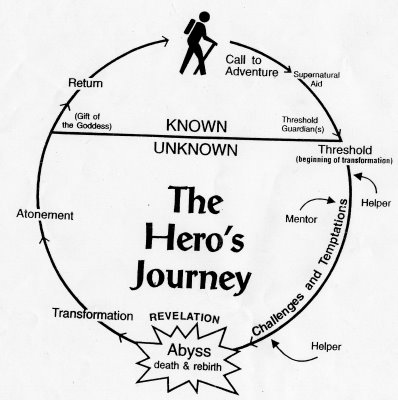
Basically the monomyth structure begins with the hero - or heroes, as is more appropriate in a RPG context - living a normal life in what they recognize as the ordinary world, when they receive a call to enter the unknown, face trials and challenges, and then return with something they've gained along the way, using it to improve the world they left behind upon their return.

Campbell defined 17 stages of the journey, but it is important to note that not every journey has all 17 steps. In fact, some popular myths are only concerned with one or two of the stages while others deal with them in a different order.

What a DM needs to take from this is that the monomyth is a flexible concept - it can and should be altered as needed, rather than being treated as a rigid framework for creating campaigns and/or adventures.

Here is a short list of the 17 stages that comprise the Hero's Journey:

  • Departure
    • The Call
    • Refusing the Call
    • Supernatural Aid
    • Crossing the Threshold
    • Belly of the Whale
  • Initiation
    • Road of Trials
    • Meeting the Goddess
    • The Temptress
    • Atonement w/Father
    • Apotheosis
    • The Ultimate Boon
  • Return
    • Refusing to Return
    • Magic Flight
    • Rescue from Without
    • Crossing the Threshold
    • Master of Two Worlds
    • Freedom to Live
Over the next several posts, we will be looking at the three sections in more detail, and how each the 17 stages of the journey might contribute to the creation of a compelling role-playing experience it the scope of an adventure or campaign.

Monday, April 5, 2010

40K: Thoughts on the new BA Codex; Model Inventory


My History with the Blood Angels

I started playing Warhammer 40,000 some time during high school (1992-1996). Despite using a vanilla Marine army at the time, I was really struck by some of the fluff scattered throughout the three books that came in the 2nd edition box set (Rulebook, Wargear, Codex Imperialis) - particularly that of the Blood Angels.

Upon graduating and heading off to college, I fell out of the hobby - though I kept all my old models at home. Sometime in or around 2000, I picked up the Blood Angels Supplement to the Space Marines Codex that had been released in 1998. I wasn't crazy (pardon the pun) with the new rules for the Red Thirst and Black Rage, as I felt that it sort of tarnished the noble image of the Chapter in my mind - but perhaps that was the point? However, I was still a fan and loved the bright red color scheme that just jumped up in an opponent's face and said "Hey! I'm right here and I'm coming for you!"

When the 2007 'Codex' came out in White Dwarf, I had since shelved the Blood Angels and had been focused on painting and playing Dark Eldar, determined to hone both my army and myself into notable presence at my local game store. I got it, of course, and even printed the whole thing out, but the codex felt incomplete. There really weren't any new models aside from the Baal Predator. Besides, I was having too much fun being the only DE player in the area - even managed a nice little win streak for a while - certainly winning more than I had trying to play the Blood Angels as an inexperienced on-again/off-again wargamer.

So now, still playing DE and trying to get an Ork army painted up, the Blood Angels have a new Codex. I got it the first day it hit the shelves and am in the process of putting the whole thing into a spreadsheet (screw Army Builder and their ridiculous licensing!). Having read it, I can honestly say that, despite a few issues, I missed these crimson-clad, blood-craving maniacs and am now thinking of putting my poor Orks aside to once again fight for the Emperor.

Thoughts on the Codex

There are countless other sites with people more experienced in the game to read about the stats and specific rule changes in the new codex and how they affect the chapter. These quick thoughts (gripes?) are more concerned with fluff and the Blood Angels as a whole:

Hate the cover. Why didn't the use the art on page 4 instead? It's much nicer.

Tycho is dead. Let him go, or at least put him in a Dreadnought. Did Leman Russ show up in the most recent Space Wolves Codex - have their players moved on yet?

Speaking of named Dreadnoughts: Moriar is mentioned in the fluff, but no stats are given this time.

Did they really have to ret-con the history of the Imperium (where BA are concerned) in order to shoehorn in as many references to the new Stormraven as possible? At some point, I think it's okay to say "They developed a new vehicle." The Dark Age of Technology can't realistically last forever - not if the Imperium is going to have any chance at staying alive.

What exactly is the Sanguinor? He's not the Primarch, or the Chapter's Master. He kinda reminds me of Rafen's brother Arkio from the Blood Angel novels by James Swallow - only, y'know, not twisted into a daemonic parody of their Primarch.

Seems like we now have 4 groups of "the most experienced/accomplished/elite" Marines in the chapter: Terminators, Veterans, Honor Guard, and Sanguinary Guard. Gonna run out of superlatives by next edition.

Concerning Successor chapters (all on page 54): The Flesh-Tearers are "divorced" from the rest of Mankind; the Angels Vermillion "shun all contact with the Brother Chapters"; the Angels Sanguine "never remove their helms save in the privacy of their fortress monastery"; the Lamenters "barely survived the repercussions of aligning themselves with the Astral Claws during the Badab War"; and the Knights of Blood have been declared rogue by the High Lords of Terra, being "unwelcome allies at best." How is it that the Imperium hasn't tried to kill them all by now?

The winged Jump Packs will take some getting used to. Also, the Sanguinary Masks are uncomfortably similar to the old Lemartes model and the Angelus Bolters sit a little high for my liking. I bet the next versions of these models will be awesome.

If the Blood Angels are vampires, the Space Wolves are werewolves, and the Necrons are (sort of) mummies . . . does that make the Adeptus Mechanicus Frankenstein's Monster? What about the Fishman? Tau, perhaps.

Current Inventory of BA models

Still in Box (Un-assembled/Unpainted)
1 x Land Raider Crusader
3 x 5-man Assault Marine Combat Squads
1 x Captain (Black Reach)
1 x 10-man Tactical Squad (Black Reach)

Assembled, but Unpainted
1 x 5-man Terminator Squad
1 x Dreadnaught

Assembled & Basecoated
1 x Vindicator
2 x 10-man Tactical Squads

Table-ready (more or less)
1 x 6-man Scout Squad (4 x Sniper Rifles, 1 x HB, 1 x Sgt.)
11 Death Company (Jump Packs) w/Chaplain (Plasma Pistol, Jump Pack)
1 x 5-man Terminator Squad (1 x AC, 1 x Cyclone ML)
1 5-man Combat Squad (Bolters, Helmets painted as Heavy Support)
1 x Furioso Dreadnaught (metal, no base)
1 x Landspeeder (HB)
2 x Landspeeder Tornado (1 x HB, 1 x AC each)
1 x Librarian (Power Weapon, Plasma Pistol)
4 x Honor Guard (2 x Power weapons, 1 x Meltagun, 1 x Chainsword)
1 x Apothecary (Power Weapon)
1 x Razorback (1 x TL Lascannon or HB; old model)
3 x Rhinos (old models)
1 x Predator Annihilator (1 x Autocannon [turret], 2 x Lascannon [sponsons]; old model)
1 x Veteran Sgt. (Power Fist, Plasma Pistol; metal)
1 x Tactical Marine w/Missile Launcher

Thursday, April 1, 2010

DnD: Soduku Trap Room

Dunno if this has been done before, but I'm so desperate to get something up this week, I'm running with it. I'm calling this the Soduku Room because of the way I set up the triggers. If anyone has a better suggestion for a name, I'd be happy to entertain it - I did, however, opt to use a more accurately descriptive name for the stat block below.

Description

The room is 100' square and 10' high. There are no furnishings and the walls, floor and ceiling are all fashioned out of relatively smooth stone. Both the floor and the ceiling have a simple tile pattern applied to them, mirroring each other. Aside from the doorway through which the room is entered - a simple door-sized hole sunk into the wall - the only other feature is another door located on the opposite wall, the same in appearance as the entrance.


Operation & Stats

When the PC's enter the room, certain portions of the floor are pressure sensitive. Once stepped on, a corresponding section of the ceiling somewhere in the room will come crashing down - revealing itself to be a sold block of stone. Once triggered, the column remains where it has fallen, it will not reset while the PC's are in the room.


Options and Variations


To enhance this experience, populate the room with monsters who move around a lot, drawing the PC's further into the room and risking harm to their comrades. Skirmishers should work nicely.

Depending on how nice or cruel you are, you might want the monsters to know which tiles will trigger each section and use that against the PC's. The monster(s) could either already be in the room, or come rushing in when they hear the first rock column come crashing down.

Alternatively, you could use hovering and/or insubstantial monsters - Stirges or Ghosts, for example - who would not trigger the traps to draw the PC's attention away from where they are stepping.

Instead of simply having the doors slam shut to lock the PC's in the room until they 'solve' it, consider having the rock columns fall in front of the entrance and/or exit to the room.

Have a series of rooms like this, with the triggers and columns set-up in different locations. You could require that all the columns be safely triggered in one room before allowing the PC's to progress to the next. You might want to set them up in a meaningful pattern - at the same time, you don't want it to be too obvious which tiles are trapped and which are not.

Hide something in one (or all) of the rock columns.

The size of the room and the number of traps in it are easy to change.

Friday, March 26, 2010

DnD: Some Handbook Statistics

I'm a big fan of xkcd.com and the humorous-yet-informative charts Randall produces. Additionally, I'm thinking of designing something to help people new to roleplaying and D&D figure out what race/class might best suit them, without overwhelming them with 3 handbooks' worth of information. So, having compiled the information from the handbooks on a spreadsheet (or two) and inspired by a webcomic, I present to you a bunch of Excel charts.

Please note, these have all been scaled to 350 px wide, clicking on the images will open up the full size chart. Also, this only incorporates data from the three Player's Handbooks - it does not include any campaign-specific source material (Eberron, Forgotten Realms, Dark Sun).

Some info on the Races of 4th edition


Concerning Classes


And finally . . .

Tuesday, March 23, 2010

DnD: Player's Handbook 3 Quick Review


For those who want the bottom line right away, here it is:

If you definitely know you want to play a certain class or race featured in the PHB3 - or perhaps you want to build a character using the hybrid rules - this is the book for you. Those players who simply like having a lot of options may find some use in (some of) the Skill Powers and the additional Feats this book provides, but probably little else. I got the impression that the developers were really struggling at points to make all the new races and classes unique and distinctly separate from those in the previous two PHB's. At this point, it's hard to imagine they'd be able to scrape together a fourth PHB - and I don't think I'd want one if they did.

Okay, now that we've gotten that out of the way, I spent the better part of the weekend digesting the PHB3 and taking notes on what jumped out at me. I will confess up front that I did not read every single one of the class and skill powers in detail. So, without further ado:

As an aspiring artist, it would be remiss of me not to point out the incredibly awesome cover illustration. I was really impressed with the rendering and detail.

Introduction

Not a fan of the introduction, which explains the origin of the Shardmind and a (possible) origin of the Psionic power source. I often find the abundance of nameless, faceless figures doing things "a long long time ago, in a place far far away" to be annoying and sloppy writing - but that may just be me.

Races

Gith - Has a Wizard's Ability Scores, but a (Ranger/Rogue)'s skills and abilities

Minotaur -
So glad they included them, even if they're competing with Goliaths as the party's 'heavy'

Shardmind -
A better Eladrin, they'll make tough Wizards. Hate their concept and origin. HATE the fact that they are depicted as male and female. If the developers/artists could stick with one non-gendered living construct with the Warforged, why not another?

Wilden -
Kind of like them, but choosing a new aspect every day could get confusing. Add Psionic powers and Monk disciplines to that and you've got a real pain of a PC to keep track of. WHY are sentient autonomous plants depicted as having genders and mentioned as having parents? Most plants reproduce asexually. Last comment for the Shardmind applies here, as well.

Racial Paragon Paths

Bloodied Champion (Minotaur) is scary.

Shard Disciples' Irruption of the Gate power seems really strong.

As much as I dislike their flavor, powers like Recrystallize are awesome. Min/maxers are going to love the Shardmind.

Classes

Ardent = Cleric + Paladin?

There does not seem to be any rhyme or reason to the power point progression chart.

Battleminds have a lot of movement and damage resistance powers.

Not a comment on the classes, per se, but let it be known that John Stanko is an awesome artist.

The Monk's Full-discipline rules take a few read-throughs to sink in; even then, it seems complicated. Perhaps if I were able to see it in action, it'd make more sense, but from a strictly text perspective, it's not something I'd encourage an unseasoned player to try.

More confusion: The Monk's unarmed strike is a weapon in the unarmed weapon category; Ki-focus is an implement (along the lines of a holy symbol, if I understand it correctly).

Psion = mind Wizard

A high-level Runepriest will be a force to be reckoned with, by my estimation.

The names of powers seem to be getting a little crazier.

Bloodbound Seeker strikes me as a less damaging, but more fun Ranger.

Cloud of Doom (Lv 20 Death Arrow Paragon Path) could put some serious hurt on a flying creature, due to the fact that it automatically makes it fall out of the sky (landing prone).

Hybrid Rules

Oh, the min/maxers are going to have a field day with this section. I can only imagine what sort of insane concoctions are being created at this very moment.

The rules do seem fairly straightforward - low level hybrids will be pretty powerful for their level; higher level hybrids will be somewhat less effective for their level.

Epic destinies are tacked on to this section. Rather awkward place to stick them.

Skill Powers, Feats and Magic Equipment

Nice alternative(s) to Utility Powers, but some skills have more options than others. I think the devs could only think of so many ways to use History. In some ways, it's a reflection of PHB3 in general - they want to add more options, but there are only so many new ideas they could come up with before the races and classes start overlapping and losing their distinction from one another.

More feat options are always welcome.

There is 1 multi-class feat for each new class (6) and 3 multi-class feats for the Psionic Power Source.

Superior Implements add a couple of interesting new properties, but Accurate (+1 Attack) and Deadly (+1 Damage) seem redundant to the existing magic items/weapons/implements.

Really like the consumable magic items for psions - more for the fact that they are consumable than the abilities they confer. It adds an extra dimension to the experience, I feel.

Appendix & Glossary

About what you'd expect: attempts to explain, in a succinct manner the new and older terms, with an emphasis on effect type keywords.

Friday, March 19, 2010

DnD: Diplomacy Discourse

First, some quotes:

Diplomat: A person who can tell you to go to hell in such a way that you actually look forward to the trip. - Caskie Stinett, Out of the Red, 1960

Diplomacy is to do and say the nastiest thing in the nicest way. - Bisaac Goldberg

Diplomacy: The business of handling a porcupine without disturbing the quills. - Author Unknown

In my limited experience as a DM, I have come to the conclusion that while most players, particularly those new to Dungeons & Dragons, feel that they have a decent conceptual understanding of the Diplomacy skill, it is rarely applied correctly during the course of a game.

The Concept

When asked to explain what the Diplomacy skill does, I would wager that the vast majority of roleplayers - on both sides of the screen - would offer up something along the lines of "A character's ability to speak in a convincing manner." And that certainly sounds reasonable. In-game, use of the Diplomacy skill in such a manner probably runs something like this:

DM: The guard moves to block you. (determines a DC of 15)
PC: I use my Diplomacy skill to convince him to let us pass - got a 17.
DM: Okay, you convince him to let you in.


How boring! I would like to suggest that both the understanding and the application of the Diplomacy skill in this example are incorrect. Let's take a closer look at what the Player's Handbook says about Diplomacy:

You can influence others with your tact, subtlety, and social grace. Make a Diplomacy check to change opinions, to inspire good will, to haggle with a patron, to demonstrate proper etiquette and decorum, or to negotiate a deal in good faith. - PHB I (4th ed.) pg. 183

Did you catch it? It's easy to miss right there at the beginning. The third word: influence. The Diplomacy skill doesn't determine what your character says or does, Diplomacy determines how others react to what your character has said or done. The higher the roll for Diplomacy, the better the reaction.

But something is missing. Let's apply this new understanding of the skill to our example:

DM: The guard moves to block you. (determines a DC of 15)
PC: I use my Diplomacy skill to convince him to let us pass - got a 17.
DM: Okay . . . (in guard's voice) What do you lot want?
PC: Uh . . . aren't you going to let us pass?
DM: (as guard) Is that why yer starin' at me like a lost puppy?
PC: We want to enter the city.
DM: (as guard) Why didn't you just say so?
PC: So . . . is it okay if we enter the city?
DM: (as guard) Well, under normal circumstances, no - it's past sun down. But . . . seein' as how my shift is over in a coupla minutes and you don't look like trouble-makers . . . sure, what the heck. (OOC) He lets you pass.


A little awkward, but certainly not as boring as before - there was an actual exchange between a player and a NPC!

The player's Diplomacy check exceeded the DC set by the DM, so why wouldn't he just let them into the city? This brings up the second important point about the Diplomacy skill: Diplomacy does not (and should not) automatically perform the actions for the PC. The PCs must still say and do things to which NPC's can react.

Let's try it one more time, with our newly enlightened PC:

DM: The guard won't let you pass. (determines a DC of 15)
PC: (IC) Good evening, sir! We're hoping to find some hot food and soft beds for the night (OOC) I rolled a 17 on Diplomacy.
DM: (as guard) We don't usually allow people through the gates past sun-down. But . . . seein' as how my shift is over in a coupla minutes and you don't look like trouble-makers . . . sure, what the heck. (OOC) He lets you pass.


Short, engaging and, most importantly, the flow of the game was not disrupted.

It is important to note that Diplomacy, no matter how high a PC might roll, does NOT offer carte blanche for threatening, anti-social behavior. An NPC who gets stabbed is not going to like it, no matter how convincing your argument for doing it might have been. This is where common sense must step in and override that infuriating tendency some people have to play according to the letter of the law, and not the spirit in which it was written. This might also be where a DM needs to back down and possibly get a little creative in allowing an individual or group to be influenced by the Diplomacy roll and not the specific words or actions made by the PC.

Applying Diplomacy

Cataloging the specific instances and uses for the Diplomacy skill would be impossible. However, I believe there to be two broad categories of interaction that I believe situations benefiting from the use of Diplomacy fall under. For lack of better terminology, they are: Manipulation and Avoidance

Manipulation

At its core, manipulation is all about changing, for good or ill, the way an individual or group thinks and acts. This is probably the most common use players have for the Diplomacy skill. PC's might seek to change an NPC's mind in order to: lower a price, provide assistance, allow entry, prohibit behavior, stand up to an oppressor, emancipate the oppressed, draft or abolish a law, offer information, confess guilt - basically anytime the PC's want someone to act a certain way, they will need to manipulate them (via Diplomacy) into the desired behavior.

This category can be further divided by the amount of time the manipulation needs to be accomplished. There are those manipulations, usually removing some sort of obstacle, which need to happen immediately (give me discount, let us in) and those of a more subtle, political nature which occur over the course of time (the neighboring kingdom is ripe for invasion, the humans have overstayed their welcome).

Avoidance

This may seem a little odd at first, especially because Diplomacy requires interaction to work. But the avoidance referenced here is not avoidance of the interaction itself, rather, of the potentially negative consequences of delicate social interactions. Adventuring takes characters from a variety of races and cultures and puts them in awkward situations - some they are prepared for and some that fall well beyond their realm of expertise and zone of comfort.

Where Perception and History and possibly even Insight might help prepare a PC for a social interaction, Diplomacy can be used to fill in the gaps and gloss over what might normally be a serious breach of etiquette or an obvious lack of decorum on the fly. A NPC might find that they just like the PC's smile or can't help liking her despite herself. NPC's who might normally be dismissive or even outraged at an uneducated PC's behavior find themselves simply shrugging it off, eager to preserve or improve the relationship.

One of these guys is using Diplomacy while the other uses Insight.
The horse just wants to take a huge dump.


Conclusion

To summarize, Diplomacy is not an action that PC performs as a substitute for roleplaying. It is their ability to influence how those around them react to the things they do and say. This, of course, requires that your PC's do and say things. For those players who are self-conscious about acting and doing voices (I include myself in this group, though I've gotten a little less uptight about it), having NPC's react based on the Diplomacy roll - and not the manner in which the lines are delivered - can help ease them into the idea of playing 'in-character,' as well as provide the opportunity for some really memorable - and humorous - interactions.

Give this approach a try and let me know what effect it has on your game!

Tuesday, March 16, 2010

Art: Fantastic Phrenology - Elves

We have arrived at the last Fantastic Phrenology entry for the foreseeable future. I have reached my limit of boring profile and mug shots. If you look back over past entries, you can probably see a decline in the attention to detail and proportion - which is kind of the opposite of what drawing every day is supposed to do for you, as I understand it.

Dungeons & Dragons (4th ed. Monster Manual I)

Slightly shorter than humans, and of a slighter build, these Elves have almond-shaped eyes that are just slightly proportionately larger and turned up at the outer corners. They share the same high cheekbones and sharp, delicate features possessed by the large majority of elves, regardless of origin. They are one of the few traditionally heroic races with pointed ears, by which they are generally most recognized.

World of Warcraft
Barring the occasional daemonic pact, the elven peoples of Azeroth, despite a pronounced variation in skin tone, are nearly identical in most other respects. Possessing overly large pointed ears which sweep back past the skull, perhaps the most unique feature of the full-blooded Warcraft elf is the ability to grow facial hair. Elongated eyebrows, not unlike the antennae of some great insect, add to their uniqueness among the elven variants.

Warhammer Fantasy Battle (7th ed.)
Of the elves portrayed here - even among all of the races and variants selected for this series, the elves of the Warhammer world are likely those which most closely resemble humans, albeit ones with the tell-tale high cheekbones and sharp, well-defined features. The ever-present pointed ears should come as little surprise, though the fact that they are proportionate the rest of the head might.

Friday, March 12, 2010

Art: Fantastic Phrenology - Ogres

The term 'ogre' refers to a large, cruel, monstrous and hideous humanoid monster, featured in mythology, folklore and fiction. Ogres are often depicted in fairy tales and folklore as feeding on human beings, and have appeared in many classic works of literature. Of French origin, the term is often applied in a metaphorical sense to disgusting persons who exploit, brutalize or devour their victims and may have originally referred to giants, rather than a separate race.

Dungeons & Dragons (4th ed. Monster Manual I)
Resembling an early ancestor of humans, D&D ogres have sloped foreheads overshadowing beady, deep-set eyes. Wide noses and large maws full of misshapen teeth take up most of the facial region. Ogres are typically depicted as having a deeply recessed hairline and varying amounts of facial hair - though the area around the mouth tends to have little more than stubble. As with nearly every other monstrous race, the ears are pointed. They are also relatively small in relation to the size of the skull, protruding slightly

World of Warcraft
Of the selection of Ogres presented, those inhabiting the world of Azeroth are the most generally animalistic in appearance as well as being possessed of the widest amount of variation within a single species. Specimens have been observed possessing either one or two eyes, one or more horns, hair - even two dissimilar heads! Most, however, appear to have large, semi-pointed ears and tusks in common. Surprisingly, these ogres appear to be capable of learning how to harness and utilize magic.

Warhammer Fantasy Battle (7th ed.)
The ogres of the Warhammer reality appear as oversized humans bearing a distinct resemblance to a certain race of central Asian origin. Facial features, while large, are fairly proportionate to a human's, though noses tend to be flat and wide and the teeth will often protrude at odd angles due to a lack of dental hygine and an insatiable and nearly indiscriminate appetite. Facial hair is common and typically worn in a culturally-derived fashion, as are the locks of hair which can occasionally be spotted.

Note: Instead of scanning these images as a color document, as I had been doing up to this point, I accidentally left the setting on black & white for the final two entries of the Fantastic Phrenology series. Any differences in presentation are likely a result of this goof. Any deficiency in quality, however, is likely a result of my own ability - or lack thereof.

Wednesday, March 10, 2010

40K: What if current Wounds = base Attacks?

I was going to post the next installment of the (blessedly soon to be finished) Fantastic Phrenology series (I'm sick of drawing mangled profiles and mug shots), but had an idea strike me as I went about my sinus infected-business today, so I'm gonna toss it up and see if anything sticks.

As I mulled the recent loss of my poor, forsaken Dark Eldar against the new uber-'Nids, and how I couldn't land a wounding Dark Lance shot on it to save my life, the thought occurred to me:

What if the base number of Attacks a model has is equal to it's current number of Wounds?

For most models, this is already the case: Base troops have 1 Wound and 1 Attack. Some Independent Characters and Monstrous Creatures are already this way, as well: My DE Archon (3) and the new Trygon (6, IIRC), for example. You'd still get the bonuses for CCW, charging, Combat Drugs, Wargear, etc.

As a model takes damage, however, it should not be capable of performing in combat as if it were undamaged. Even tanks have status like Immobilized and Weapon Destroyed that indicate it has taken damage and, while not out of the game, is less effective on the table. So why not apply that logic to the rest of the army?

An argument could be made against the complexity of tracking wounds in units of multi-wound creatures, but there are already rules in place for that. Really, unless you're running a MC-heavy 'Nid list, I think such a rule would be a welcome addition to the game and balance things nicely.

What do you more experienced players think: Worth considering or way off base?

Monday, March 8, 2010

Art: Steampunk Walking Contraption Mock-Up

One more step closer to the abyss: I'm on YouTube now.

This is a mock-up of a steampunk walking contraption I made in Google Sketchup 7 to help work out some perspective issues I was having on a drawing for Nevermet Press.


I exported the video from Sketch up as an .avi file and uploaded it to YouTube. Not really happy with the quality. If anyone knows how to export and upload better looking videos, I'd love to find out how.

Tuesday, February 23, 2010

Art: Fantastic Phrenology - Trolls

Of all the commonly appearing fantasy races, trolls seem to be the most varied and divergent - even within their own realities. I endeavored to record the features of the 'basic' troll present in each.

In case you were wondering (and how could you not?) This series of sketches is being recorded in a 3.5" x 5.5" Moleskine Pocket Sketchbook, using a Pilot Better extra fine retractable ballpoint pen (black ink). There are no preliminary sketches or pencil roughs - good or bad, everything is presented as it was put down in a single pass.

Dungeons & Dragons (Monster Manual I, 4th ed.)
The face of a troll is dominated by its long, pointed nose. The mouth is wide and filled with relatively small - albeit sharp - teeth. Proportionately small, the pointed ears sweep back and out, and have a tendency to droop. An unkempt mane of greasy black hair is not uncommon in the species, though it does not appear to grow anywhere else on the body in any significant amount. The spine connects to the skull further back than in the more civilized races - a trait more commonly seen in lower order carnivores. Consequently, the overall posture takes on a slouched appearance, with the head thrust forward.


World of Warcraft
Like the goblins of the Warcraft world, trolls have large ears and long pointed noses. The former being more swept back and the later being thinner and only slightly more in proportion to the face than their smaller Horde-mates. Additionally, their facial structure tends to be longer and generally more narrow, in proportion. However, it would appear that the defining feature among trolls in this reality are the two large tusks that grow down and curve up out of their mouths. Hair may be present on the face and head, and tends to be a warm, bright color of a contrasting nature to that of their cool-hued skin.


Warhamer Fantasy Battle (7th ed.)
Most animalistic of the specimens observed, the Warhammer troll has thick, mottled skin bordering on the verge of being reptilian in nature. Indeed, the regenerative properties of the troll are not unlike those observed among reptiles and amphibians - though that topic extends beyond a casual taxonomic discussion such as this. The mouth is large and filled with oversized, misshapen teeth that jut out. The nose is large and flat with small nostrils, and the ears are little more than ragged scraps of flesh that sweep back and sag downward. The rearward connection of the skull and spine that is present in the D&D troll is even more pronounced in this specimen, exacerbating the hunched appearance.

Art: Fantastic Phrenology - Orcs

I am noticing an interesting phenomenon as I make these sketches - when I hate the profile, I am usually okay with how the mug shot looks; conversely, when I like the profile, the mug shot tends to be disappointing. I guess that's better than flat out hating both of them, right?

Dungeons & Dragons (4e Monster Manual I)
In comparing the realities, the Orcs of the D&D world appear the most simian in nature. A sloping brow leads down to a flat, upturned snout; which in turn follows a slightly convex upper perioral region to a powerful lower jaw dominated by two tusks. The ears are proportionally small to the head and situated slightly lower than other humanoids. The body is covered in a layer of short but dense hair, usually of a dull gray hue. A subtle brown or greenish tint may be present in the hide.

World of Warcraft
Like their D&D relatives, the Warcraft Orc is defined by his powerful lower jaw and the enlarged canines that protrude from it. The ears are large, pointed, and generally sweep back and slightly out from the skull. The brow and nose are most akin to humans, as are the areas and frequency of hair appearing on the head.

Warhammer Fantasy Battle (7th ed.)
The Warhammer orc has a thick, protruding brow shading beady eyes and an upturned snub nose that crown a disproportionately large upper-perioral region. A powerful lower jaw frames a large mouth in which teeth rapidly grow long and large enough to protrude at random from the lips. The pointed ears are not oversized, but do stick out more so than in the other realities. Warhammer orcs are naturally hairless. It is not unusual, however, to see an orc adorn its head with a pelt, tail or other hair-bearing accessory - usually taken by force from the original owner.

Monday, February 22, 2010

DnD, Art: Shayakand Campaign Map for NMP

Just completed for Nevermet Press, a campaign map for the upcoming Shayakand setting:

Hope it's okay to post this . . .

Wednesday, February 17, 2010

Art: Fantastic Phrenology - Goblins

Phrenology (noun) - The study of the shape and protuberances of the skull, based on the now discredited belief that they reveal character and mental capacity.
-The American Heritage® Dictionary of the English Language, Fourth Edition
Copyright © 2009 by Houghton Mifflin Company.

Fantastic Phrenology (noun) - The comparison of the shape and protuberances of a given fictional race appearing across a spectrum of fantasy realities, communicated via a collection of casual observations and rough sketches.
- The Kingworks Creative Blog, 2010

Dungeon & Dragons (4th ed. Monster Manual I)
D&D goblins are the most individually varied, but still maintain a few common traits among their kind: A wide protruding forehead with a thick brow overshadowing the eyes; a small upturned nose; pointed ears swept back at roughly 45° angle from the skull. Small, mishapen teeth that are less sharp than they are broken and poorly cared for. These goblins have the most hair (usually greasy and unkempt) and the widest range of skin tones and texture (often mottled).

World of Warcraft
The goblins of the Warcraft world all appear to have pointed ears that sweep out to the sides of the skull and a long pointed nose, both oversized in relation to the rest of the head. The chin descends to a point and the lips are well defined. These features appear softer and more rounded on the females. Males typically have a shock of hair sprouting towards the back of the skull in a variety of colors - whether the colors are natural or not, this observer could not discern. The skin is almost always green, with males being a few shades darker than females. Of the goblins, the Warcraft goblin appears to have the largest eyes.

Warhammer Fantasy Battle (7th edition)
The face of the Warhammer goblin is dominated by a thick, fleshy nose. It has bhe most well-defined jawline of the goblins and it's ears, while not as large as the Warcraft goblin in proportion to its head, stick out to the side in a similar fashion. While the braincase is the smallest of the three, its teeth are the largest. The eyes are small and deep-set under a thick brow. The Warhammer goblin is always some shade of green and naturally hairless.

Friday, February 12, 2010

40K: Removing Super Glue from Models - Epilogue

I tried soaking the model in warm water, as suggested on the super glue manufacturer's website. No luck - either the water couldn't get to the bond, or the magnet was just wedged to tightly into the torso that it would not come out.

At this point, I decided to do something drastic:

Since I had not glued the front of the torso on the model, I was able to use a wire-gauge pin vise and drill in behind the magnet - pushing it out.

It turns out that that particular setting was simply wedged in too tight. Even when I went to re-glue the magnet in correctly, I had to use a bit more pressure to get it back into the hole.

I guess the lesson here is to always give yourself at least a tiny bit of wiggle room. It makes things easier to work with. Well, that and rubbing alcohol seems to work for removing super glue bonds between metal and plastic.

40K: Removing Super Glue From Models - Part 2

If you need to get caught up, check out Part 1.

In this experiment, I will be using the plastic Ork Nobz box set which have had magnets super glued into them using Duro super glue.

Method 1: Rubbing Alcohol

I poured some rubbing alcohol into a old glass baby-food jar that I sometimes use to clean my brushes as I paint. Not sure of the alcohol's affect on the plastic, I broke off a small bit of extra sprue and left it sitting in the liquid for about an hour. It is highly suggested that you cover the container, to keep fumes from spreading. I don't have a lid for this jar, so I used saran wrap and a rubber band.

The test bit of sprue did not seem to have any sort of deformation or softening as a result of being in the alcohol, so I went ahead and dropped in the two arms and Nob torso (already glued to a base) into which the magnets had been glued backwards from the others. The jar was then left to sit out of reach of little hands for about 24 hours.

The next evening, took the bits out of the jar with a pair of tweezers, and dabbed them with a paper towel. I was shocked to discover one of the magnets from the torso just fell right out! The two magnets in the arms came out, but required some work with my Xacto knife. I slid the blade into the narrow gaps around the magnet and wiggled it a bit. Eventually, they too came free.

Unfortunately, the other magnet in the torso was still glued firmly in place. There was no room around this last remaining magnet to slide the blade in without damaging or cutting away at the plastic around it. Since I needed the area to stay intact in order to re-glue the magnet in properly, I opted to move on to the next method.

Result: 3 of 4 magnets removed

Why (I think) it worked

Assuming there were pockets of moisture trapped in and around the super glue bond holding the magnet to the plastic, the alcohol help remove that trapped moisture, leaving behind empty pores in the super glue - weakening it. Thus, less tension was required to break the bond. (I totally pulled that out of my rear, but it sounds good . . . right?)

Method 2: Freezing

Taking the torso into the kitchen, I ran it under the faucet for a couple of minutes, try to ensure that water got into every nook and cranny around the magnet. The model was then placed in the freezer and left for 48 hours - Not because I thought the extra time would matter, I just forgot about it for a day.

Taking the model out, I worked at it a little bit with the X-acto knife and also tried holding other magnets on either side of the embedded magnet. Unfortunately, all I managed to do was hack up the area around the magnet a little and leave a scratch on the magnet itself.

Result: 0 magnets removed

Why it was supposed to work

I actually read this on the messageboard (sorry, don't have the link) where I learned about this method - again, this assume moisture is trapped in an around the super glue bond: When water freezes, it expands. The expanding moisture in and around the super glue creates tiny cracks in the bond, weakening it and allowing the bond to be easily broken.

Why it didn't work

Not sure really. Perhaps the alcohol effectively removed what moisture may have been trapped, so there was nothing to expand upon freezing. Perhaps the magnet is set in such a way that there is no space for either liquid - alcohol or water - to penetrate.

What's Next?

According to Loctite's poorly designed website (the makers of the super glue I was using), soaking the bond in warm water might work. There also exists super glue remover, but I'm really only interested in cheap, non-hazardous alternatives.

I would also like to get a new digital camera - one with a working LCD screen, exports directly to my laptop, and doesn't try to cram a ton of noise-producing megapixels through an undersized processor - but that's another rant-er . . . story for another time.

Tuesday, February 9, 2010

40K: Removing Super Glue from Models - Part 1

Bear With Me* for a minute.

It happens to the best of us at some point - and trust me, I am far from the best at any part of this hobby - modelers' regret. You put something together, permanently, in a manner that you wish you could undo. Unfortunately, the nature of modeling almost always means that the parts you stick together are not intended to come apart . . . Well, almost always.

Not so long ago, as I was just getting into this whole blogging 'thang' for myself, I stumbled across an excellent article about magnetizing your models by Master Darksol of All Things 40K.

Months later, I won a box of Ork Nobz on eBay and realized that the time had come. I purchased the same magnets from amazon that Master Darksol used, and eagerly set to work magnetizing my Nobz (which I was hoping to get written up before now, but life has a way of dictating what gets posted and when).

It didn't take long to realize I screwed up.

I started putting magnets in the torsos, then the arms. Unfortunately, despite my efforts to prevent just such an occurrence from . . . occurring . . . one of the torsos and a set of arms were glued in backwards from the others.

So, after offering the requisite amount of cursing and lamentation to Anoia**, I started Googling ways to dissolve super glue. I came across two fairly simple methods: Rubbing Alcohol and Freezing.

Stay tuned as I try both methods and analyze, in my own special*** way, the results.


* Pretty sure I'm 1/64th Cherokee.
** Everyone is a follower, whether you know it or not.
*** IE: completely subjective and uninformed
**** I'm really jonesing for some Pratchett

Friday, February 5, 2010

DnD, Art: Card Game Preview - King

Got another preview for you from the card deck/game I'm developing. For the king, I used the knight as a template and tweaked it a bit, figuring that king would be similarly arrayed for battle as his knights.


The remaining cards will have to be built from scratch. But before I get to them, I need to finish a campaign map for an upcoming Nevermet Press release.